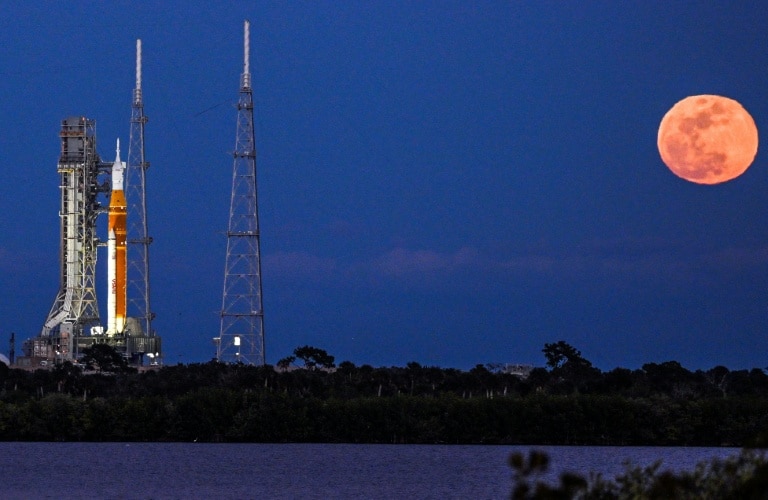
NASA’s groundbreaking Artemis II mission is preparing for its historic April launch, marking America’s first crewed lunar expedition in over fifty years since the conclusion of the Apollo program. The diverse four-member crew—Americans Reid Wiseman, Victor Glover, and Christina Koch alongside Canadian Jeremy Hansen—will embark on an approximately ten-day journey to orbit the Moon without landing, echoing the pioneering trajectory of Apollo 8 in 1968.
This mission represents multiple historic firsts: the first woman, first person of color, and first non-American to participate in a lunar mission. The crew will travel aboard the newly developed Space Launch System (SLS) rocket, a monumental orange-and-white vehicle engineered to enable sustained lunar exploration. The SLS is designed to support America’s ambitious plan to establish a permanent lunar base as a strategic stepping stone for future Mars colonization.
“Our return to the Moon represents the crucial next phase in our ultimate journey to Mars,” stated mission commander Wiseman during a recent NASA podcast. The Artemis program—named after Apollo’s mythological twin sister—aims to test technologies essential for eventual human missions to the Red Planet.
The mission unfolds against a backdrop of renewed global space competition, with China targeting a human lunar landing by 2030 and focusing particularly on the resource-rich lunar South Pole. While comparisons to the Cold War space race emerge, Harvard professor Matthew Hersch notes fundamental differences: “The Chinese are primarily competing with themselves rather than engaging in direct competition like the US-Soviet rivalry.”
Despite advanced technology that would be “almost unimaginable” to Apollo-era astronauts, significant risks remain. The crew will travel in a spacecraft that has never carried humans or ventured to the Moon, navigating a distance of over 384,000 kilometers from Earth—approximately 1,000 times farther than the International Space Station.
NASA maintains rigorous safety protocols, with former chief astronaut Peggy Whitson emphasizing: “We accept nothing less than perfection. Our spaceflight history reminds us that when accidents occur, lives are lost.”
The mission faces an ambitious timeline, with plans for a lunar landing by 2028 dependent on developing lunar landers through private sector partnerships with companies led by Elon Musk and Jeff Bezos. The program has encountered substantial delays and budget overruns, yet NASA hopes Artemis II can recreate the unifying inspiration of Apollo 8, which famously “saved 1968” during a period of global turmoil.
As the world again faces division and uncertainty, Artemis II carries the potential to inspire a new generation and demonstrate humanity’s continuing capacity for extraordinary achievement in space exploration.