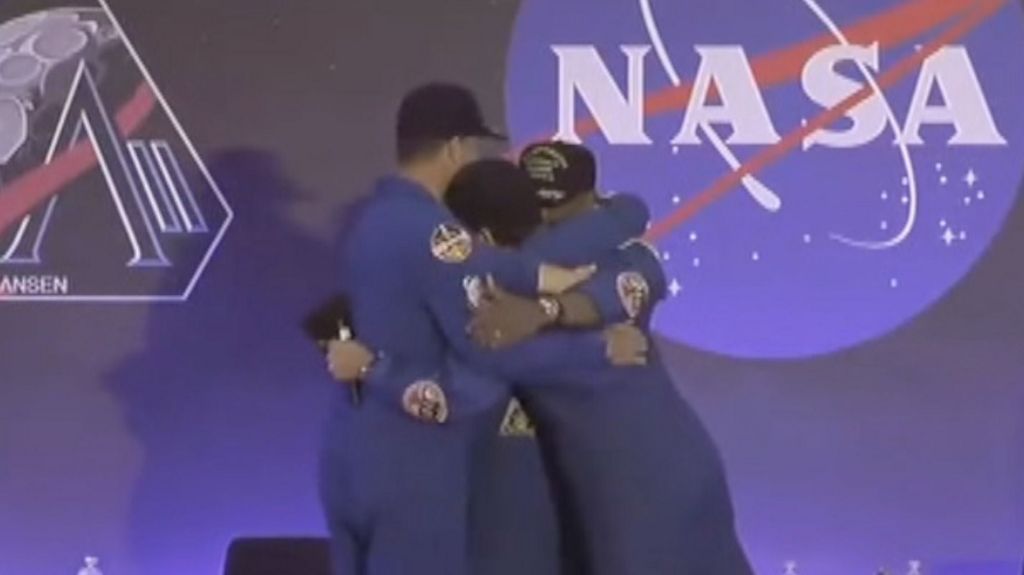
Houston’s Johnson Space Center rolled out a warm, celebratory welcome on Monday for the four-member Artemis II crew, whose landmark nine-day journey around the Moon has secured its place in human exploration history. The mission marked an extraordinary milestone for space travel: the four-person team traveled farther from Earth than any humans have ever gone before, pushing the boundaries of human deep-space exploration and paving the way for NASA’s ambitious goal of returning astronauts to the lunar surface.
Addressing an audience of thousands of cheering NASA employees, space industry partners, and family members, crew commander Reid Wiseman summed up the profound emotion of the journey, saying, “It’s a special thing to be on Planet Earth.” The comment reflected the transformative perspective the astronauts gained from seeing Earth rise against the black expanse of space from lunar orbit, a view that only 24 humans have witnessed firsthand since the Apollo era.
The nine-day mission, which launched from NASA’s Kennedy Space Center in Florida earlier this month, was a critical uncrewed test flight no—wait, correction, this was the first crewed test flight of the Space Launch System rocket and Orion capsule, the core vehicles that will power future Artemis landing missions. The successful voyage validated key life support, navigation, and heat shield systems that will be used when the first woman and first person of color step onto the Moon during Artemis III, currently scheduled for 2026.
NASA officials emphasized that the mission’s success is more than a symbolic win for space exploration; it lays the groundwork for eventual human missions to Mars, turning decades of planning into tangible progress. For Houston, which has served as the heart of American human spaceflight for more than 60 years, the homecoming celebration was also a reminder of the city’s enduring role in leading humanity’s push beyond low Earth orbit.