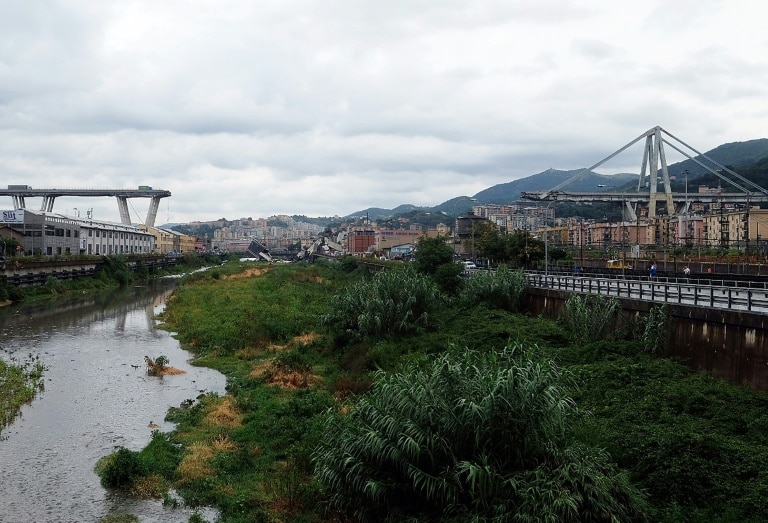
Nearly eight years after one of Italy’s deadliest infrastructure disasters claimed 43 lives, an Italian court is scheduled to issue its long-awaited verdict on Thursday for the collapse of Genoa’s Morandi Bridge. The landmark structure, a critical link on the highway connecting France and Italy, crumbled during torrential rain on August 14, 2018, sending dozens of vehicles and their occupants plummeting into the void below. On the eve of the verdict announcement, crowds of victims’ relatives and reporters from dozens of international and domestic media outlets gathered outside the Genoa court building to await the outcome of the four-year legal process.
Fifty-seven defendants have stood trial throughout the proceedings, facing charges that range from manslaughter and endangerment of public transport safety to falsification of official government documents. Prosecutors have collectively requested more than 400 years of combined prison sentences for all accused parties.
For many family members, the verdict carries more symbolic than personal weight. Egle Possetti, who leads a support committee for victims’ relatives, lost her sister, nephew, niece, and brother-in-law when the bridge’s ninth pillar gave way. Speaking to reporters from AFP as she entered the court Thursday, Possetti acknowledged that a conviction would not reverse the tragedy or bring her loved ones back. “But clearly the most important thing for the victims is that the truth finally comes out,” she said. She also voiced the frustration shared by many grieving families, noting that through years of trial hearings, “not a single person has said, ‘I bear some responsibility.’ That has been hard.” The court is expected to release its ruling after 12:00 GMT.
Investigative findings from magistrates paint a damning picture of systemic neglect. Official documents confirm that between the bridge’s inauguration in 1967 and its collapse 51 years later, no minimal structural reinforcement or critical maintenance work was ever completed on the stays of pillar nine. While limited upgrades were carried out on the adjacent 10th and 11th pillars, planned reinforcement work on pillar nine was repeatedly delayed. Lead prosecutor Walter Cotugno famously described the decaying infrastructure as “a ticking time bomb” long before the disaster occurred.
The majority of defendants are senior executives and lead technicians from Autostrade per l’Italia (ASPI), the company that manages nearly half of Italy’s entire motorway network, and Spea, the private engineering firm contracted to oversee the bridge’s ongoing maintenance. High-profile accused include Giovanni Castellucci, ASPI’s general manager at the time of the collapse, and Antonino Galata, Spea’s former chief executive, alongside multiple senior officials from Italy’s infrastructure ministry. Castellucci faces up to 18 years in prison if convicted, as prosecutors hold him directly responsible for repeatedly postponing critical reinforcement work on pillar nine. Notably, Castellucci is already serving a prison sentence for his role in a separate 2013 highway accident that left 40 people dead when a bus crashed through viaduct barriers.
Defense attorneys for the accused have centered their case on an alternative narrative, arguing that the collapse was caused by an unidentifiable, hidden construction defect—specifically, internal corrosion of the bridge’s support cables—rather than intentional or negligent lack of maintenance.
While their former top executives remain on trial, both ASPI and Spea reached an out-of-court settlement with prosecutors prior to the verdict. The agreement requires the firms to pay 29 million euros ($30 million) in compensation to the Italian state. At the time of the 2018 disaster, ASPI was owned by the Atlantia group, which was controlled by Italy’s wealthy Benetton family. Widespread public outrage over the disaster and evidence of systemic neglect forced the Benetton family to sell its entire stake in the company to the Italian state in the aftermath of the tragedy.