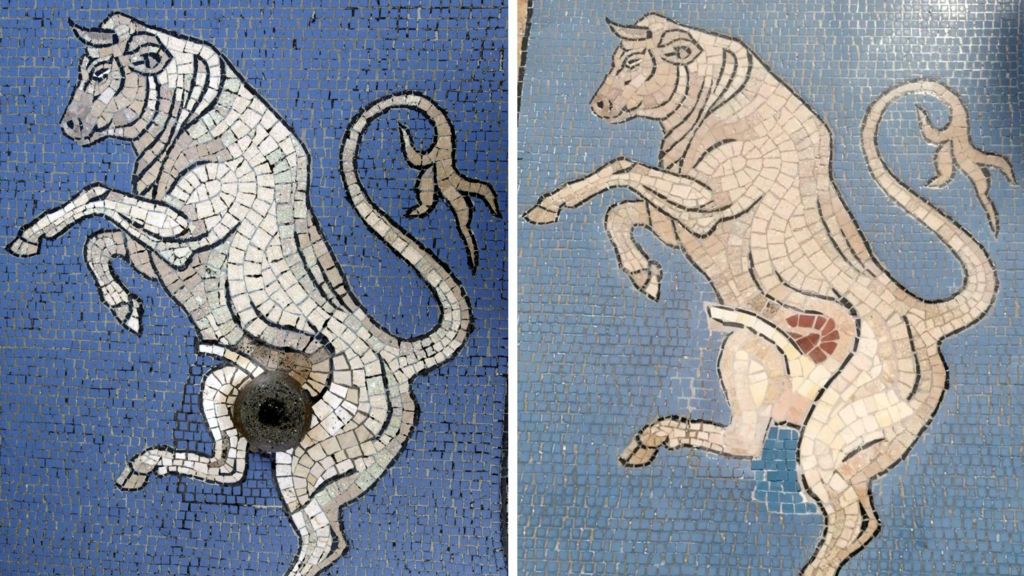
A decades-old tourist tradition targeting a beloved 19th-century mosaic in one of Milan’s most famous historic landmarks has sparked unexpected social media uproar, as locals and travelers alike question the fate of the artwork’s most iconic—if irreverent—feature. The piece in question is a blue and beige mosaic depicting a prancing bull, set into the floor of Milan’s Galleria Vittorio Emanuele II, the iconic glass-vaulted shopping arcade at the heart of the city. Designed to represent Turin, Italy’s first national capital, the mosaic has over generations become a bucket-list stop for visitors thanks to a folksy good luck legend. The tradition holds that spinning one’s heel three times clockwise on the bull’s genital region will bring good fortune and guarantee a return trip to Milan. For years, thousands of tourists have followed the ritual, and the constant friction gradually wore away the stone tiles, leaving a noticeable small crater on the mosaic’s surface. Last week, municipal authorities launched long-planned restoration work to repair the damaged section of the artwork, with master artisan Gianluca Galli carrying out the handcrafted repairs to the 100-plus-year-old floor. Over the weekend, Milan local councillor Marco Granelli announced that the mosaic had been “completely restored,” sharing the update on his social media channels. But what was meant as a routine cultural heritage update quickly went viral, as hundreds of social media users pointed out an apparent change to the famous feature: the bull’s iconic “lucky charm” testicles seemed to have vanished entirely. Comments flooded Granelli’s post, with users joking that the bull had been “castrated,” and many questioning why the landmark’s most famous feature was removed. “What happened to the testicles?” one user asked, while another simply noted, “Something is missing.” The widespread online bemusement and criticism quickly prompted a response from Milan’s city council, which moved quickly to clarify that the restoration project is not actually complete. Officials explained that the restored section remains partially covered to allow the new stone tiles’ color to set properly, and the feature was never intentionally removed. The council added that restorers chose light pink marble for the repaired area, a material selected to match the original 19th-century color palette more closely than the darker marble used for the mosaic’s previous repair in 2017. Master restorer Galli confirmed the timeline in an interview with Italian daily newspaper Corriere della Sera, noting that his work is still in progress, and he has not received any formal objections to the work, which is being carried out under direct municipal supervision. For now, tourists and locals alike will have to wait a little longer to see the fully restored iconic bull—and confirm that its famous good luck charm remains intact for future generations of visitors.