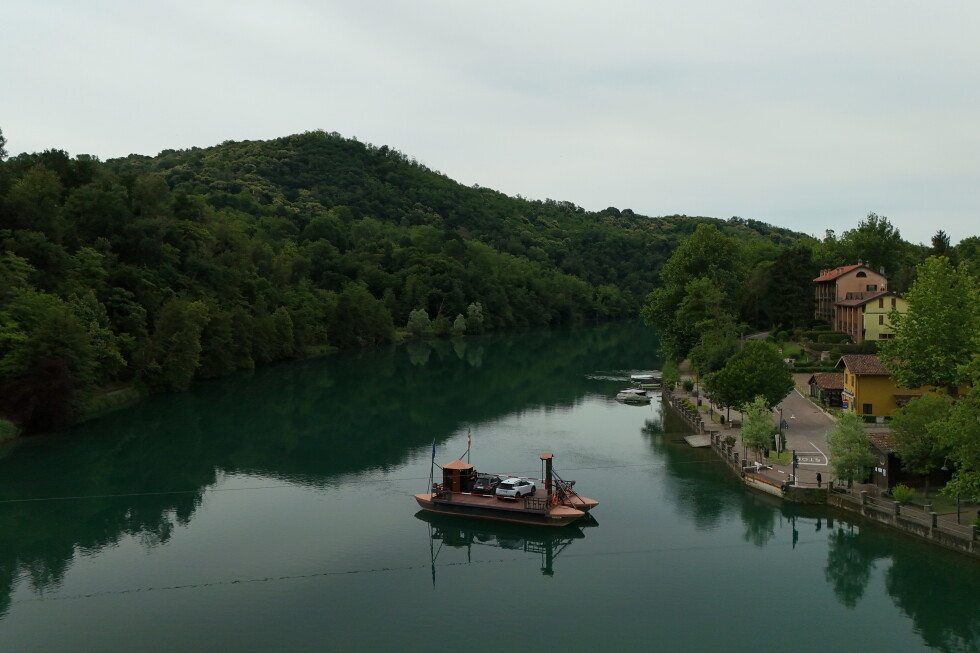
Nestled along the scenic Adda River in northern Italy’s Lombardy region, a one-of-a-kind vessel has reclaimed its historic purpose, offering local commuters and visitors a quiet, eco-friendly alternative to gridlocked roads after a nearby bridge shutdown for maintenance.
Known popularly as Leonardo’s Ferry, this cable-guided reaction ferry operates on a 500-year-old design first sketched by Renaissance polymath Leonardo da Vinci in 1513, during his detailed studies of northern Italian waterways including Milan’s famous canal network. The original drawing is held in the Royal Collection at Windsor Castle, outside London, and while historians debate whether da Vinci personally invented the reaction ferry concept, his detailed rendering has cemented the vessel’s place in engineering and cultural history. Today, it is the last fully operational reaction ferry of its kind remaining on the entire Adda, which stretches from the Alpine foothills to join the Po River.
Unlike modern motorized ferries, the vessel relies entirely on the natural current of the Adda for propulsion, making it a zero-emission form of transport. Its ingenious operating principle relies on basic high school physics: a fixed cable tethers the ferry to both banks, and the force of the downstream river current is split per the parallelogram rule of force, with one component creating resistance along the cable and the other generating lateral movement that carries the craft across the water. The ferry’s rudder adjusts the vessel’s angle to the current, fine-tuning its speed and trajectory across the 5-minute crossing.
The historic ferry almost vanished permanently last year, when its long-time concession operator stepped down, leaving the service without a steward. Refusing to let the centuries-old community link disappear, Imbersago mayor Fabio Vergani took matters into his own hands: he earned a commercial ferryman’s license himself, then partnered with the local tourism association to recruit and train a team of local volunteers to run the service.
Through 2024, the volunteer team primarily catered to weekend tourists drawn to the ferry’s historic charm and riverside scenery. That changed this spring, when a nearby connecting bridge was closed for extensive repairs, sending road traffic into hours-long gridlock and forcing local residents to take a 20-kilometer detour to cross between Imbersago on one bank and Villa d’Adda on the other. Stepping up to fill the gap, the volunteer crew added a daily commuter service to their schedule, operating from 7 a.m. to 7 p.m. daily with a two-hour midday break.
Fares are modest: 1.50 euros (around $1.75) for foot passengers, 2 euros ($2.30) for cyclists, 2.50 euros ($2.88) for motorbikes, and 3.50 euros (roughly $4) for cars. For local residents, the ferry has become more than a tourist attraction — it’s a vital, welcome shortcut that cuts hours off daily commutes.
Gianpaolo Graffagnino, who lives in Villa d’Adda and works on the opposite bank, now bikes to work and uses the ferry to avoid the detour. “Right now this is the fastest system, but above all the nicest because you get five minutes of peace,” he said of the quiet crossing. Another local commuter, Mauro Carnati, who drives his car across the ferry to take his daughter to school, says the small fare is worth the unique experience. “It’s true that we spend a little money, and it’s not possible every day, but the romance and added value of the Adda and the ferry are truly amazing. It makes for a better start to the day,” he noted.
For volunteer ferryman Massimo Zoia, the ferry’s new role as a modern community link is a perfect full-circle moment for the centuries-old design. “This is a means of transport that has been here for 500 years and has always connected the two banks of the Adda,” he said. “And now it has returned to its original purpose: connecting two populations living on different banks of a river.”