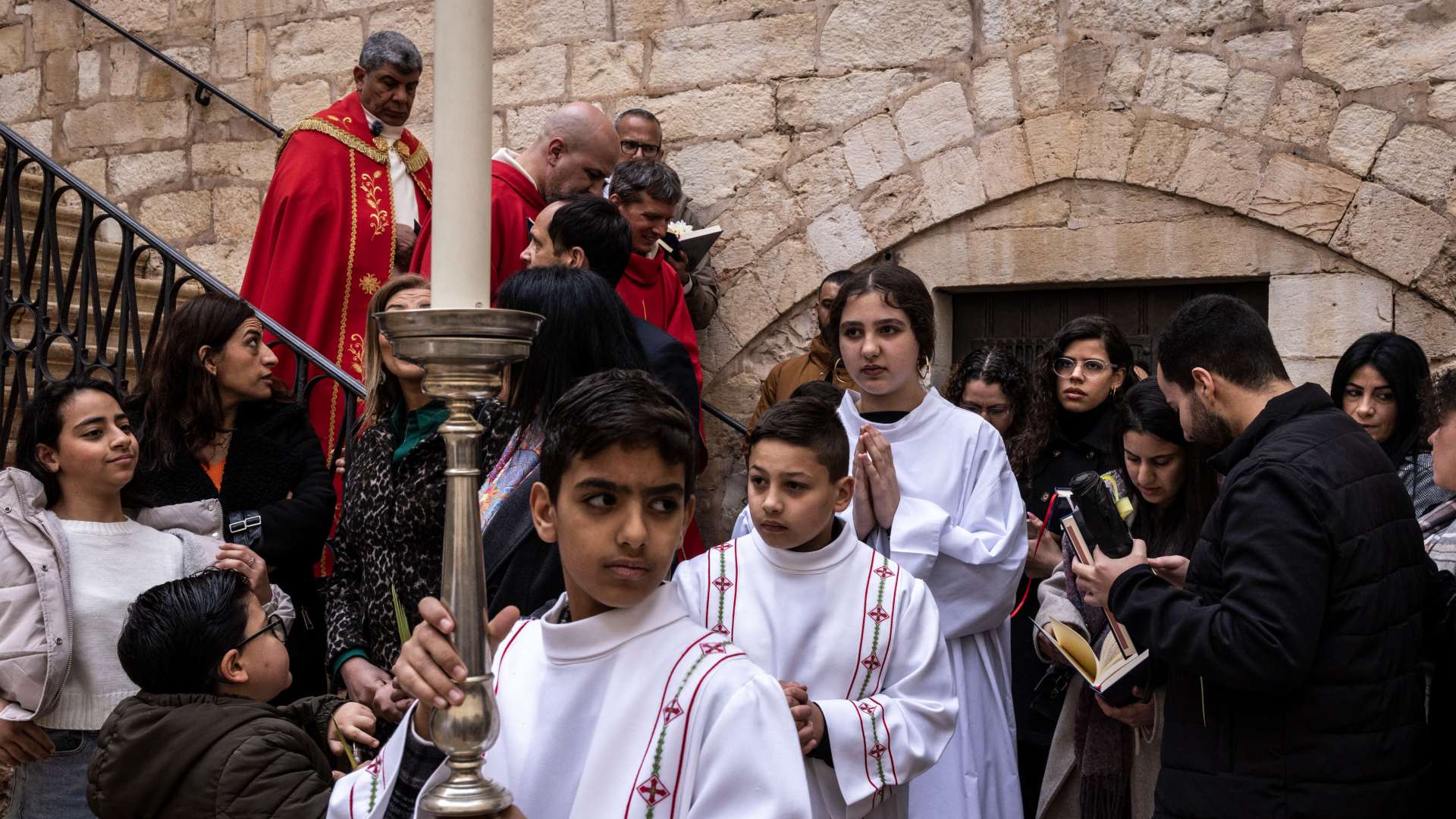
The centuries-old continuous presence of Christian communities across Israel and Palestine is facing an unprecedented existential threat, driven by a growing pattern of intimidation and violence targeting the minority group, a leading Jerusalem-based interfaith research institution has warned in a major new report.
The Rossing Center, an organization dedicated to advancing constructive Jewish-Christian relations, has documented a steady escalation of targeted aggression against Christian communities in occupied East Jerusalem — including the historic Old City — and wider Israel, labeling the trend as sustained and expanding in its latest analysis. The report confirms that Christians are targeted explicitly for their religious identity, while Palestinian Christians face additional persecution as a marginalized national minority.
The document places direct blame for the recent surge in open anti-Christian animosity on the far-right national government led by Israeli Prime Minister Benjamin Netanyahu. The report notes that a renewed emphasis on exclusive Jewish identity has found its most extreme expression in right-wing ultranationalism, a force that has become increasingly dominant in mainstream Israeli society. This ideological shift, the authors add, has been amplified by the collective national trauma following the October 7, 2023 attacks, embedding extremist attitudes more deeply within governing circles.
While the report avoids naming National Security Minister Itamar Ben Gvir explicitly, its findings are widely understood as a direct rebuke of his leadership, which carries formal responsibility for policing across Israel and occupied Palestinian territories including Jerusalem’s Old City. In late 2023, after a wave of documented incidents where Jewish extremists spat on Christian worshippers and holy sites, Ben Gvir defended the behavior as an “old Jewish tradition” and argued it did not qualify as criminal conduct. Earlier this year, he pushed through a sweeping expansion of firearms access that now makes more than 300,000 Jewish residents of Jerusalem eligible to carry concealed weapons, according to local Israeli outlet *Times of Israel*. Private conversations with Christian leaders held with Middle East Eye reveal widespread fear in the community that a potential future premiership for Ben Gvir would be catastrophic for Christianity’s place in the Holy Land.
The Rossing Center recorded 155 verified incidents of anti-Christian harassment in 2025 alone, but the report emphasizes that this number represents only the small tip of a much larger iceberg, with countless unreported cases going uncounted. The majority of documented incidents involved physical assaults, with clergy — including monks, nuns, friars, and priests — disproportionately targeted due to their distinct religious vestments and visible Christian symbols. In high-risk areas such as Mount Zion and the Old City’s Armenian Quarter, clergy reported that harassment has become so daily and routine that stepping outside their places of residence virtually guarantees verbal or physical abuse.
One of the report’s most concerning findings is the near-total lack of legal accountability for these attacks. The think tank has supported dozens of victims in filing formal police complaints, but the vast majority of these cases have been closed without action; only a tiny fraction have resulted in indictments, a rate wildly disproportionate to the scale of the violence. The report also notes a critical institutional gap: there is no designated police liaison to work with and address concerns from the Christian community across the country. This systemic failure has reinforced a widespread perception among Christians that they are not seen as an integral part of the region’s social fabric, but rather as unwelcome outsiders in the land their community has inhabited for millennia.
Beyond attacks on people, the report documents 59 separate acts of vandalism targeting church property, including defacement with extremist graffiti, damage to religious statues, arson attacks, illegal garbage dumping on sacred grounds, and targeted spitting at holy sites. These attacks, the authors note, erode a sense of safety around sacred spaces and fuel growing anxiety over the steady collapse of public respect for Christian religious life in Israel’s public sphere. An additional 18 incidents involved the defacement of Christian-owned public signage. Cumulatively, the persistent aggression creates a humiliating, draining climate that pushes many Christians to conceal their religious identity in public and leaves community leaders uncertain about the long-term survival of their congregations.
In its concluding analysis, the report emphasizes that Christian communities have been continuously and proudly rooted in the Holy Land for more than 2,000 years. But growing pressure from multiple directions is now pushing younger generations to consider leaving the region entirely. A 2024 survey conducted by the center found that nearly half of all Christians under the age of 45 are actively considering relocating out of Israel and Palestine.
The report’s release coincides with a high-profile incident that underscored its findings: just days before publication, Israeli police blocked Cardinal Pierbattista Pizzaballa, the Latin Patriarch of Jerusalem, from entering the Church of the Holy Sepulchre — the site Christian tradition holds as the place of Jesus’ crucifixion, burial, and resurrection — to lead the annual Palm Sunday Mass marking the start of Holy Week. Pizzaballa’s office confirmed that this was the first time in centuries that the patriarch had been blocked from leading the iconic service at the site.
Israeli security forces maintained a pervasive, overwhelming presence across the Old City throughout Holy Week, with an armed officer posted outside the locked doors of the Church of the Holy Sepulchre to prevent worshippers from approaching. A permanent Israeli police security post, labeled the “Israeli Police Division of the Holy Sepulchre Church,” operates just outside the church’s outer courtyard, flying an Israeli flag directly outside one of Christianity’s most sacred sites. Multiple worshippers told Middle East Eye that armed Israeli police routinely enter the ancient church in intrusive patrols, even accessing the Tomb of Christ itself, and that Palestinian worshippers routinely feel intimidated by the armed presence inside sacred spaces. Middle East Eye requested comment from Israeli police on these claims, but received no response prior to publication.
The incident comes more than a year after the International Court of Justice issued a landmark 2024 ruling that Israel’s ongoing occupation of East Jerusalem is illegal under international law, and ordered the Israeli state to end its illegal security presence and occupation. The Israeli government has rejected the ruling outright, maintaining that all of Jerusalem is its undivided capital. Netanyahu has repeatedly framed Israel as the “guardian of Christianity” in the Middle East — a claim that stands in stark contrast to the dire picture of escalating anti-Christian persecution laid out in the Rossing Center’s report, released in Christianity’s holiest city during its most sacred week of the year.