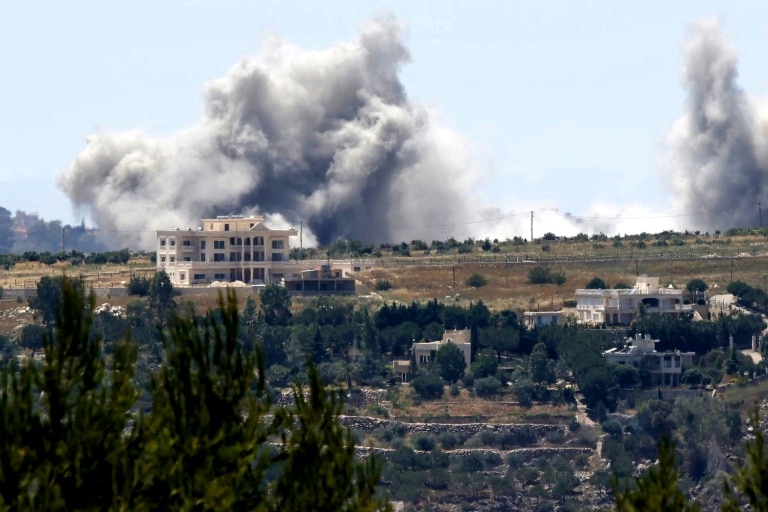
Just days after Lebanese and Israeli negotiators announced a new conditional ceasefire during US-mediated talks in Washington, an Israeli airstrike on a military vehicle in southern Lebanon has left three Lebanese army personnel dead, throwing already fragile diplomatic efforts into further doubt, Lebanon’s military confirmed Saturday.
The deadly incident marks the latest breakdown in a months-long conflict that began when Tehran-aligned armed group Hezbollah launched missile attacks against Israel in March, dragging Lebanon into the broader ongoing Middle East war. In response, Israel launched a cross-border ground and air operation aimed at eliminating Hezbollah’s presence in southern Lebanon. Lebanon’s government has committed to eventually disarming Hezbollah, but has strongly condemned Israel’s incursion, accusing Israeli forces of using scorched-earth tactics to force civilian populations to flee southern Lebanese communities.
According to the Lebanese military statement, the attack killed two officers and one enlisted soldier when their vehicle was hit on the highway linking the towns of Khardali and Nabatieh. The Israeli Defense Force (IDF) responded to the incident by saying the targeted vehicle had been moving in a suspicious manner within an active combat zone, an area where the IDF had already ordered civilian evacuations ahead of military operations. The IDF emphasized that its campaign targets only Hezbollah, which it designates a terrorist organization, not official Lebanese state military forces, and confirmed that it is conducting an internal review of the strike.
Hezbollah has condemned the attack as a “heinous crime”, and lashed out at the Lebanese government, accusing it of exposing the nation to bloodshed through what it called “complete surrender to the enemy’s demands” reached during the Washington talks.
This latest violence comes amid a long history of unfulfilled ceasefire agreements between the two sides. A previous truce between Israel and Hezbollah was meant to enter into force on April 17, but it was never fully implemented, with both sides routinely accusing one another of violations and justifying their own attacks as responses to the opposing side’s breaches of the truce terms.
The new conditional truce announced by envoys this week would require Hezbollah to cease all cross-border fire, withdraw its fighters from areas near the Israeli-Lebanese border, and allow the Lebanese army to deploy to new “pilot zones” in the region where it would exercise full security control. However, Hezbollah has already rejected the deal, demanding a complete withdrawal of all Israeli forces from what it considers Lebanese territory before any agreement can take hold.
The Lebanese army issued a fierce condemnation of Saturday’s strike, saying that “the continuation of the deliberate and repeated brutal Israeli aggression… is aimed at thwarting all efforts to reach a solution”. Lebanese President Joseph Aoun joined in the denunciation, calling the attack a “flagrant violation of Lebanese sovereignty… despite Lebanon’s efforts in the Washington negotiations to put an end to the continued Israeli aggression that goes unchecked.”
On the same day as the strike, Israel issued updated evacuation orders for five villages across southern and eastern Lebanon, ordering all remaining residents to relocate north of the Zahrani River. Lebanese state media also reported multiple additional Israeli airstrikes across southern Lebanon over the course of Saturday. In response, Hezbollah announced that it had carried out its own attack targeting Israeli troops.
More than 3,500 people have been killed in Lebanon since Israel launched its large-scale military campaign in response to Hezbollah’s March incursion. Iran has repeatedly insisted that Lebanon must be included in any broader ceasefire agreement it reaches with the United States to end the wider regional war. However, in a CNN interview aired Friday, President Aoun pushed back against Iranian interference in Lebanese affairs, saying “It’s not your country, it’s our country. It’s not your job to interfere into our country.” He added, “They are using Lebanon as a bargaining chip in their negotiation with the United States. It’s unacceptable. The majority of the Lebanese people are fed up with war.”