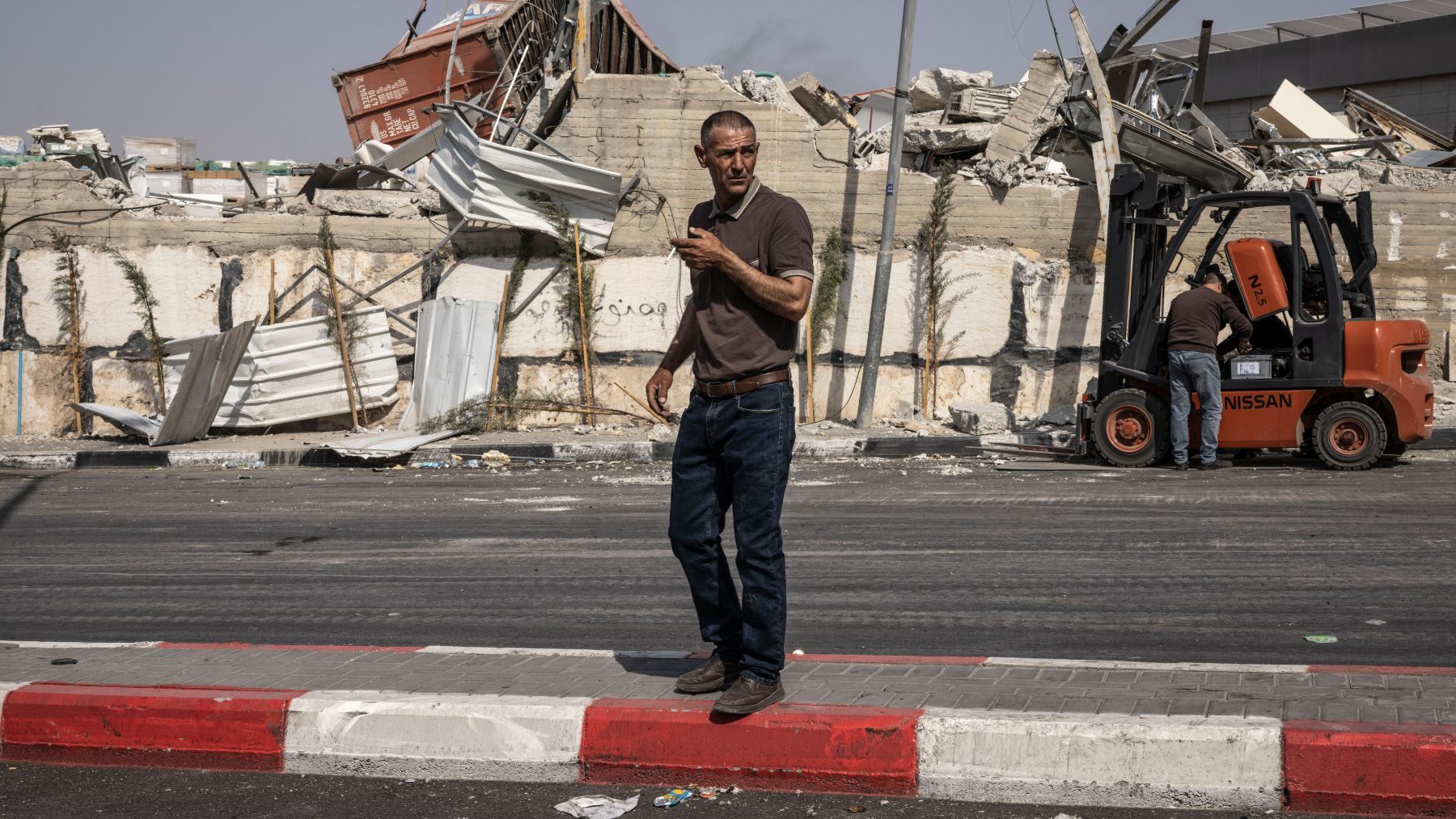
A cascade of interconnected developments has unfolded across Israel and the occupied West Bank in the lead-up to Tuesday’s Israeli national election, spanning sweeping movement restrictions on Palestinian communities, a high-stakes legal tussle over ruling party voter surveillance, widespread economic warnings against a proposed cryptocurrency sanctions workaround, and a violent racist assault targeting Druze citizens in Tel Aviv. First, the Israeli military announced via an official X (formerly Twitter) post on Saturday that all land border crossings in the occupied West Bank will be fully closed to Palestinian residents for the entirety of election day. The military further stipulated that Palestinian laborers will be barred from entering any Israeli settlements located in the West Bank from Sunday through Tuesday, a measure that cuts off a critical livelihood stream for tens of thousands of Palestinian households. As documented by Israeli outlet Haaretz, similar sweeping movement curbs were imposed on West Bank Palestinians during prior Israeli election cycles, with past restrictions extending to barring Palestinian entry into Israel proper on both election day and the day immediately following the vote. This latest series of lockdown orders was issued barely 24 hours after Israeli Prime Minister Benjamin Netanyahu directed the military to prepare for a full West Bank-wide closure, a punitive response to a Friday shooting by Palestinian gunmen that killed two Israeli soldiers at a checkpoint near the city of Hebron. Netanyahu also ordered a full military siege on Hebron, the most populous city in the West Bank home to roughly 250,000 Palestinian residents, framing the move as collective punishment for the fatal attack. The Israeli premier publicly vowed to raze the Hebron neighborhood where the suspected assailants are believed to originate, noting that military forces would evacuate all residents of the area. Since the Friday shooting, Israeli forces have already displaced hundreds of Palestinian families from their Hebron homes, with Hebron Mayor Yousef Jaabari telling Middle East Eye that the city now resembles a full-blown disaster zone. The movement restrictions come on top of already strained Palestinian employment access: following the October 7, 2023, Hamas-led attacks on Israel, the Israeli government blocked tens of thousands of Palestinian workers from entering Israel, pushing local unemployment to sharply elevated levels. Data from the International Labour Organisation shows that nearly 200,000 West Bank Palestinians held jobs in Israel or Israeli settlements prior to the October 7 attacks, a figure that has plummeted to just 44,000 authorized workers today. In a separate election-related development, Haaretz reported on Sunday that Netanyahu’s ruling Likud party is actively developing a workaround to bypass a recent Israeli Supreme Court ban on the party using a massive 1-million-person voter database to track and mobilize its supporters on election day. In previous election cycles, Likud deployed a dedicated mobile application at polling stations to log which registered supporters had cast their ballots, enabling campaign teams to follow up with non-voters via targeted phone calls, text messages, and audio recordings to drive up turnout. Party officials have described this voter monitoring system as operationally critical, as Netanyahu’s on-the-ground election day campaigning in past cycles was directly guided by real-time data identifying neighborhoods with low Likud supporter turnout. Opposition party representatives have warned that without explicit, enforceable rules from Israel’s Central Elections Committee to block all of Likud’s attempts to leverage voter data for turnout operations, the right-wing party will successfully circumvent the Supreme Court’s ruling. A spokesperson for the Central Elections Committee confirmed to Haaretz that official notices explicitly banning the collection and transmission of voter personal data will be posted at every single polling station across the country on election day. Meanwhile, a coalition of leading Israeli economists issued a stark public warning that Netanyahu’s recently floated proposal to use cryptocurrency to evade international sanctions would cause irreversible, catastrophic harm to the Israeli economy. The economists, whose remarks were published by Israeli news site Ynet, stated that Netanyahu is knowingly steering Israel toward widespread international boycotts and total economic isolation, describing his proposed cryptocurrency workaround as a tactic normally associated with transnational criminal organizations. They added that the prime minister’s public comments on the policy reveal a fundamental lack of economic literacy at a time when Israel’s global diplomatic standing is rapidly eroding. The warning was issued two days after Netanyahu stated during an appearance on Israel’s Channel 10 that adopting cryptocurrency for cross-border transactions would blunt the impact of sanctions recently imposed on Israel by the United Kingdom and other allied nations. The Bank of Israel has already formally rejected Netanyahu’s proposal, releasing a public statement clarifying that digital currencies cannot serve as a functional mechanism to bypass international sanctions. Netanyahu has refused to back down from the plan, telling Channel 14 News that he will implement any policy he deems in the national interest of Israel. The group of top economists further outlined that the widespread adoption of crypto to evade sanctions would collapse Israel’s banking system, trigger mass unemployment, drive an exodus of skilled foreign workers, and lead to a total breakdown of the country’s public healthcare system. They noted that the resulting sanctions regime would dismantle the advanced, modern economic model Israel has built, leading to a precipitous drop in living standards comparable to the economic collapses seen in apartheid South Africa, Russia, and sanctioned Iran in recent decades. Separately, Israeli independent journalist Daniel Amram reported on Saturday that three Druze Israeli citizens were the victims of a violent hate attack at a Tel Aviv nightclub the prior Thursday evening, targeted solely for speaking Arabic among themselves. A group of Jewish Israeli patrons reportedly confronted the three young men inside the venue, yelling that “You will not speak Arabic here, get the hell out of our country” before the altercation escalated into a physical assault outside the nightclub. One of the Druze victims was stabbed during the attack, and was transported to a local hospital in serious condition with multiple stab wounds and extensive bruising. As of the time of the report, no suspects had been arrested in connection with the assault, prompting residents of the victims’ hometown of Isfiya to publicly declare that they will not remain silent in the face of the violence. On Sunday, Yair Golan, leader of the left-wing Zionist party The Democrats, visited the wounded victim in hospital to express solidarity, stating that Druze and Arab communities are core, integral parts of Israeli society. Golan directly accused Netanyahu, far-right National Security Minister Itamar Ben Gvir, and far-right Finance Minister Bezalel Smotrich of orchestrating a sustained campaign of public incitement and hate that has normalized racist violence across the country, noting that the assault is a direct product of the government’s deliberate legitimization of bigotry. Golan, whose party is actively campaigning to win Druze and Arab electoral support in the upcoming vote, pledged that if his party secures power, it will restore public safety across Israeli cities, pursue uncompromising action against all forms of racism, and build a more equitable society that guarantees full equal rights for all marginalized groups.
Israeli press review: Israel to lockdown West Bank as Netanyahu orders Hebron siege