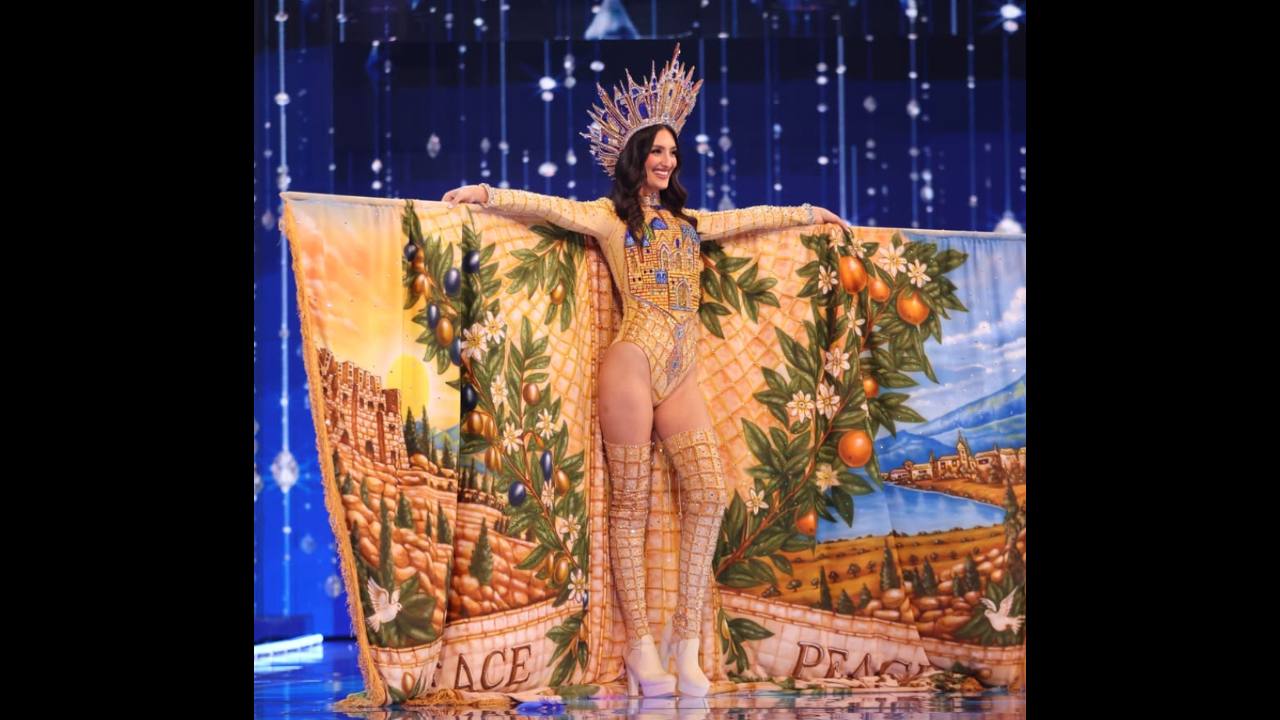
During the 2026 Miss Universe national costume segment hosted in Puerto Rico over the weekend, 25-year-old Miami-born Miss Israel Danielle Yablonka was met with immediate, unignorable loud boos from the audience the moment she finished posing for the judging panel, with the pageant’s background music failing to muffle the widespread jeers.
Yablonka’s elaborate costume included a gold jewel-encrusted bodice, paired with matching boots and a ceremonial crown. The attached cape was decorated with illustrations of olive trees and Jaffa oranges, with the word “peace” printed along its lower edge in three languages: English, Hebrew, and Arabic. When she turned to display the back of the garment, the audience saw a stylized, illustrated depiction of East Jerusalem, with the iconic gold and blue Al-Aqsa Mosque complex positioned at its center, surrounded by a rendering of the Old City, and the word “Jerusalem” printed across the design in English, Hebrew, and Arabic. Under established international law, East Jerusalem is classified as occupied territory, and is universally recognized as the designated capital for a future independent Palestinian state, rather than part of Israeli sovereign territory. Critics quickly pointed out that the idealized, non-photographic artwork on the cape deliberately omitted the well-documented ongoing demolitions of Palestinian residential structures across the city.
The costume choice sparked an immediate firestorm of condemnation across global social media platforms, where users drew direct links between the pageant outfit and the ongoing mass displacement of Palestinian communities in the occupied West Bank, as well as the large-scale humanitarian crisis and mass casualties in Gaza. One X (formerly Twitter) user argued that the display of a “peace” themed costume by the Israeli representative was deeply hypocritical, given that the Israeli state’s military operations and occupation are widely seen as the primary barriers to a lasting regional peace. Many commentators also noted that the olive tree and Jaffa orange motifs featured prominently on Yablonka’s cape are core, culturally defining symbols of Palestinian national identity, tied to generations of agricultural heritage and livelihood. A top-voted Reddit post highlighted the sharp irony of the costume’s olive tree imagery, pointing to data showing that during the 2025 olive harvest season alone, Israeli settlers carried out 1,369 recorded attacks on Palestinian communities in October, with hundreds of Palestinian residents assaulted while tending to their groves. The Israeli military has also systematically demolished thousands of mature olive trees across occupied Palestinian territories, destroying a critical source of income and erasing Palestinian cultural heritage.
Critics further called out the pageant host’s accompanying introduction for Yablonka, which framed Israel as “the land where history lives, cultures meet, and even the desert blooms” and claimed the nation had transformed barren, arid landscapes into thriving agricultural communities. This decades-old official Israeli narrative has long been rejected by Palestinian activists and historians as a colonial talking point that erases centuries of existing Palestinian agricultural development, trade networks, and settled communities across the land, falsely implying the territory was empty and uncultivated before the arrival of Jewish settlers. Multiple social media users shared historical archival evidence documenting the thriving Ottoman-era Palestinian agricultural economy, including the world-famous Jaffa orange export industry, to refute the “desert wasteland” myth.
Many online observers also noted striking design parallels between Yablonka’s costume and the 2025 national wardrobe worn by Nada Ayoub, the first ever Miss Palestine to compete in the Miss Universe pageant, who finished in the top 30 the previous year. Ayoub’s 2025 garment, designed by prominent Palestinian artist Neven Elkady, also centered the Dome of the Rock at the Al-Aqsa Mosque and the Church of the Holy Sepulchre in its Jerusalem-themed design. Ayoub addressed the uncanny similarities directly in an Instagram video after the backlash went viral, noting that after she showcased Jerusalem to the global pageant audience in 2025, the Israeli representative’s near-identical design choice raised a critical question: “Where is the Palestinian voice?” She also highlighted the deep irony of a representative of a state that regularly carries out raids and restrictions on worshippers at the Al-Aqsa Mosque featuring the site prominently on a global stage.
Many pageant fans were quick to notice that no Palestinian representative appeared in the 2026 Miss Universe lineup, and reached out to Ayoub for an explanation. Ayoub explained in her video that competing on the global Miss Universe stage requires massive financial and logistical resources that the Miss Palestine project currently lacks, as local and national Palestinian pageant organizing bodies have no access to the structural funding and institutional support that other national delegations rely on. These challenges have been drastically exacerbated by the ongoing Israeli military campaigns in Gaza and mass displacement operations in the West Bank, which have made it nearly impossible to create safe spaces to scout, train, and prepare a new generation of Palestinian representatives. Ayoub, who revealed she has largely self-funded the Miss Palestine initiative to date, issued a public appeal to Palestinian business leaders, nonprofits, and institutional stakeholders to provide the necessary backing to field a full, competitive Palestinian delegation for the next Miss Universe cycle, emphasizing that international representation for Palestinian voices is an urgent, high-stakes priority for global cultural visibility.
Israeli contestant with ‘peace’ costume booed at Miss Universe 2026