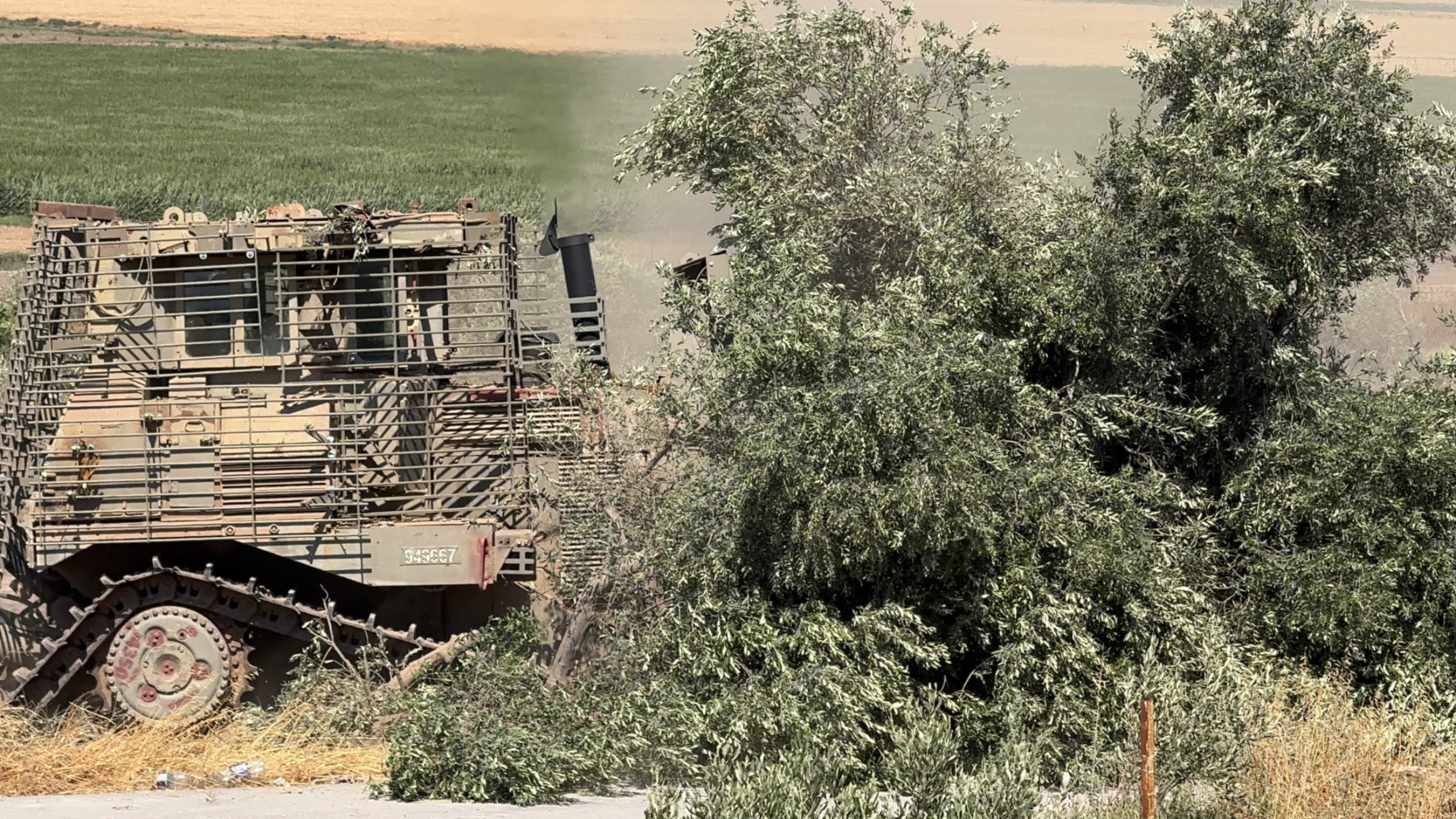
On Sunday, Israeli military bulldozers carried out a large-scale destruction of Palestinian agricultural land in the village of Zububa, located near the city of Jenin in the occupied West Bank, just meters from the controversial separation wall that splits Israeli and Palestinian territory. Local officials confirm that at least 500 mature olive trees across 50 dunams (roughly 12.4 acres) of farmland were completely uprooted – a devastating blow to local communities just three months ahead of the annual olive harvest, the primary economic lifeline for tens of thousands of Palestinian families across the West Bank.
What makes the destruction even more alarming for Zububa’s residents is that the operation is far from over. Zaki Jaradat, head of the Zububa Village Council, confirmed to reporters that an additional 120 dunams (nearly 30 acres) of established olive groves are at imminent risk of being razed in the coming days. For affected landowners like Mahmoud Jaradat, the destruction has already erased years of labor and eliminated any prospect of income from this year’s harvest. “All my hard work and years of toil vanished in a single moment,” Mahmoud Jaradat, a Zububa resident whose entire plot of dozens of trees was destroyed, told Middle East Eye. “I’ll have to buy olive oil instead of selling it this year. This is a heartbreaking scene I have no words for.”
Israeli military officials had previously notified local residents that the land clearing was being carried out to expand a security buffer zone along the separation wall, which already cuts through vast swathes of land that Zububa’s residents have owned and cultivated for generations. The entire at-risk zone holds roughly 2,000 productive olive trees, all of which were being carefully tended by local families in preparation for the critical October harvest. Even more disconcerting for villagers, Sunday’s bulldozing extended far beyond the 127 dunams the military had previously marked for clearing. According to Zaki Jaradat, the total area slated for destruction could ultimately exceed 250 dunams (more than 61 acres), all under the guise of security needs. “They told us they would bulldoze 127 dunams, but from what we see now, what they will bulldoze will exceed 250 dunams from all directions, all under the pretext of security,” Zaki Jaradat said.
This latest operation is just the latest chapter in a years-long pattern of land dispossession for Zububa. Once encompassing roughly 14,000 dunams (3,459 acres) of territory, the village has lost more than 89 percent of its total land since the 1948 Nakba and the 1967 Israeli occupation of the West Bank. Today, local Palestinian residents can only access roughly 1,500 dunams (371 acres) of their historic territory, with the remainder seized for Israeli infrastructure, settlements, or the construction of the separation wall. The village is already one of many Palestinian communities in the occupied West Bank subjected to routine collective punishment measures, including frequent movement restrictions, road blockades, near-daily home raids, and mass arrests.
Following Sunday’s destruction, the Israeli military distributed leaflets to Zububa residents warning young people against approaching the separation wall or adjacent security fence, threatening collective consequences for the entire village if any such movement occurs. Data collected by the Colonisation and Wall Resistance Commission, a Palestinian grassroots organization tracking land violations, confirms that this destruction is part of a rapidly accelerating trend across the occupied West Bank. Since 2020, the commission estimates that Israeli forces have uprooted, damaged, or poisoned at least 120,000 Palestinian-owned trees, the vast majority of them productive olive trees critical to local livelihoods.
Attacks on olive groves have surged sharply in recent years: in 2024, 14,212 trees were destroyed, 10,459 of them olive trees. That figure more than doubled in 2025, when 35,273 trees were uprooted or damaged, including 26,988 olive trees. In the first five months of 2026 alone, more than 10,000 trees have been destroyed, 6,700 of them olive trees, with 4,414 destroyed in April 2026 alone.