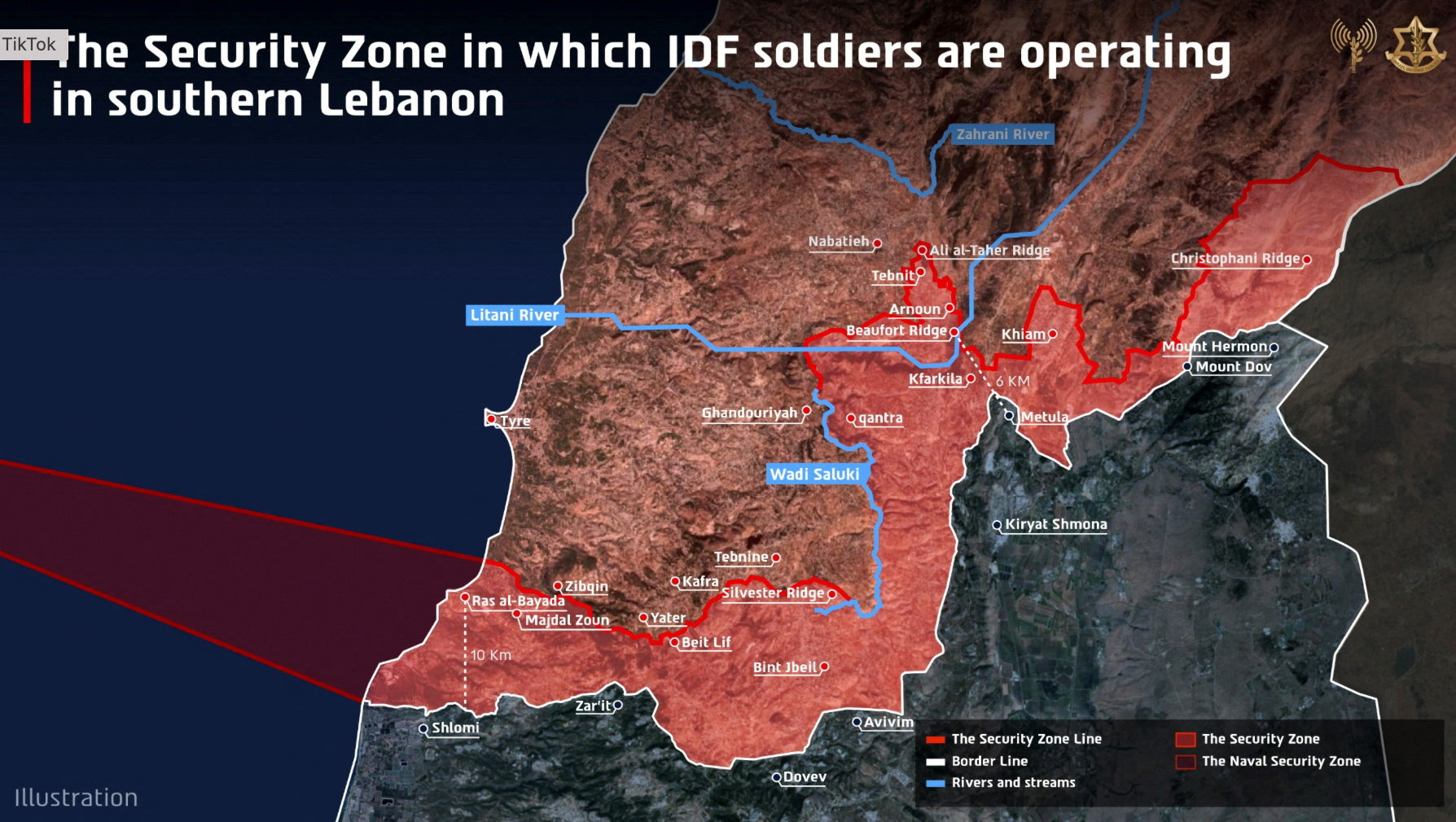
On Thursday, the Israeli military made public an official map marking an expanded zone of military control deep inside southern Lebanese territory, a move that directly undermines a recently reached ceasefire memorandum brokered between the United States and Iran. According to reporting from Reuters, the new map, which marks the expanded occupied area in dark red, confirms that Israeli forces have pushed far past their previous operational boundaries, extending their hold on both land and maritime areas roughly 10 kilometers along the contested Yellow Line that separates Israeli and Lebanese territory. This newly claimed control encompasses eight additional Lebanese villages that were not previously listed as falling under Israeli occupation: Mazraat Byout El Saiyad, Majdal Zoun, Haddatha, Beit Yahoun, Zawtar El Charqiyeh, Arnoun, Yohmor, and Kfar Tebnit, details confirmed by architect and spatial researcher Ahmad Baydoun. While Israeli troops have operated in these newly marked areas for several weeks, Thursday’s publication marks the first official acknowledgment of the expanded occupation. The disclosure comes at a moment of sharp tension, as Israel openly rejects the terms of the U.S.-Iran Islamabad Memorandum of Understanding, a deal that requires an immediate and permanent end to all military operations across every front, including Lebanon, and guarantees full respect for Lebanon’s territorial integrity and national sovereignty. Even after the memorandum was signed, Israeli forces have continued offensive strikes across southern Lebanon and have repeatedly refused international and diplomatic calls to withdraw its troops from occupied southern Lebanese territory. Israeli officials speaking to Reuters confirmed that tough, ongoing negotiations are still underway with the Trump administration over Israel’s demand to keep its military deployed inside Lebanese territory south of the Litani River, adding that the outcome of these talks will hinge on whether President Trump chooses to pressure Israel to comply with the ceasefire terms by threatening consequences for noncompliance. The day before the map’s release, U.S. President Donald Trump publicly voiced sharp irritation with Israel’s heavy-handed military tactics in Lebanon, marking a rare public rift between the American leader and his long-time Israeli ally. In comments made at the G7 Summit in Evian, France, Trump criticized Israel for disproportionate and indiscriminate tactics that have led to mass civilian casualties, saying that Israeli forces do not need to destroy entire residential apartment buildings to target individual members of Hezbollah. “You don’t have to knock down an apartment house every time you’re looking for somebody, because there are a lot of people in those apartment houses, and they’re not all Hezbollah,” Trump told reporters. He added that the conflict between Israel and Hezbollah has dragged on for far too long, noting that “too many people have been killed in Lebanon.” This public rebuke follows a heated exchange one week prior, when Trump excoriated Israeli Prime Minister Benjamin Netanyahu for launching new strikes that threatened to derail the ceasefire deal just hours before its official announcement. In unusually blunt comments, Trump called Netanyahu “a very difficult guy” and reminded Israel that the U.S.-brokered deal prevents Iran from acquiring nuclear weapons, a outcome he claimed saves Israel from annihilation. In an even more provocative remark made on the sidelines of the G7 alongside Qatar’s ruler, Trump said he has suggested that Syria should be allowed to handle Hezbollah instead of Israel, arguing that Syrian President Ahmed al-Sharaa’s forces are more than capable of defeating the group and would do a better job than the Israeli military. “If Israel can’t do the job without killing everyone else, he’ll do the job. Syria will do the job,” Trump stated. Even as diplomatic clashes continue between Washington and Jerusalem, violence on the ground continues to escalate. Lebanon’s National News Agency reported that on the same day Israel released its control map, an Israeli drone strike targeted a civilian vehicle near Kfar Tebnit, killing two people. A separate strike in Zebdine killed one additional person, and a drone strike on Beit Yahoun wounded two more. Since the launch of the U.S.-backed Israeli campaign against Iran, Lebanon’s health ministry reported that at least 3,826 people have been killed across the country, and more than 11,800 others have sustained injuries. Israeli military officials have also made clear that they do not rule out expanding offensive strikes even further beyond their newly declared occupation lines, a stance that puts the entire U.S.-Iran ceasefire agreement at risk of total collapse, as regional tensions continue to rise.