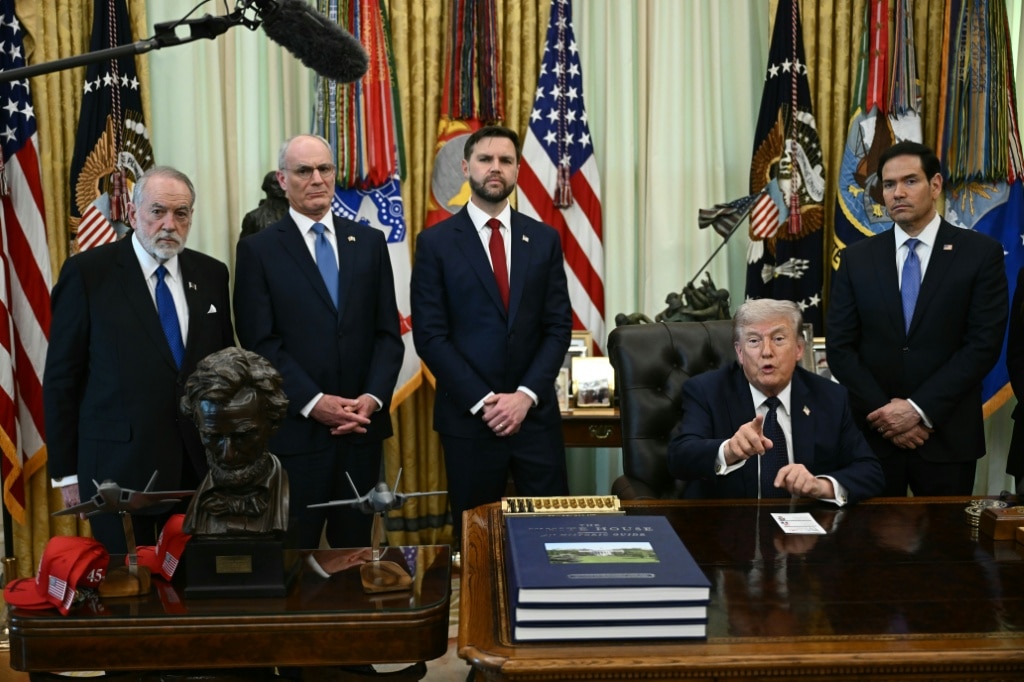
In a development that keeps fragile peace hopes alive along the Israel-Lebanon border, US President Donald Trump announced Thursday that the two rival nations have agreed to extend their existing temporary ceasefire for an additional three weeks. The announcement came as the US leader laid out his vision for a landmark three-way summit at the White House to advance a potential full peace deal, even as fresh deadly exchanges of fire underscored the truce’s deep instability.
Speaking alongside Israeli and Lebanese ambassadors at the White House – the first high-level direct encounter between the two states, which have no formal diplomatic relations, since 1993 – Trump struck an optimistic tone about the prospect of ending decades of open conflict between the two nations. “I think there’s a very good chance of having peace. I think it should be an easy one,” he told reporters, adding that he expects Israeli Prime Minister Benjamin Netanyahu and Lebanese President Joseph Aoun to travel to Washington for talks during the newly extended truce window.
The original ceasefire was first agreed on April 14 following initial ambassador-level talks and was set to expire Sunday. Lebanese officials had previously pushed for a one-month extension, with Aoun demanding the truce explicitly include commitments to halt destruction of civilian infrastructure, and end attacks on civilians, places of worship, medical and education facilities, and journalists. The demand gained urgent traction after a Lebanese journalist, Amal Khalil, was killed in an Israeli strike in Lebanon Wednesday, with mourners holding a funeral procession for her in the southern Lebanese town of Bissariye this week.
The current round of open conflict between Israel and Hezbollah dates back to late February, when Israel launched a major offensive in Lebanon in response to Hezbollah rocket fire. The Iran-aligned militant group had pledged retaliation after Israel killed Iran’s supreme leader Ayatollah Ali Khamenei at the opening of the US-Israel war on Iran that began February 28. According to Lebanese authorities, the Israeli offensive has killed more than 2,450 people and displaced over one million, while Israeli forces have occupied a 10-kilometer deep “security zone” along the southern Lebanese border.
Even as the ceasefire extension was being announced at the White House, new violence erupted Thursday: Hezbollah confirmed it had launched a fresh barrage of rockets into northern Israel, saying the attack was retaliation for repeated Israeli violations of the original truce. Israeli officials reported that all incoming rockets were intercepted by their defense systems. The exchange followed a deadly day of Israeli strikes Wednesday that killed five people across Lebanon, including Khalil. On Thursday, Lebanon’s state-run National News Agency reported an Israeli drone strike targeted a vehicle near the southern city of Nabatieh, roughly 35 kilometers north of the Israel-Lebanon border. Israel has repeatedly argued that truce terms allow it to carry out operations against what it frames as imminent or ongoing Hezbollah attacks, while Hezbollah has launched multiple small-scale attacks on Israeli troops and military assets in southern Lebanon in recent days.
Israeli ambassador to the US Yechiel Leiter struck a conciliatory tone Thursday, saying Israel seeks a formal peace agreement with the Lebanese government and claimed the campaign against Iran has significantly weakened Hezbollah’s military capacity. “We’re united with the Lebanese government in wanting to rid the country of this malign influence called Hezbollah,” he said.
The ceasefire extension comes against a backdrop of stalled US-Iran negotiations. Iran had made a full ceasefire in Lebanon a precondition for resuming talks with Washington aimed at ending the ongoing war, but refused to attend a planned second round of negotiations this week in protest of a continuing US naval blockade of Iran. Despite the breakdown, Trump announced Thursday he was extending an existing truce with Iran indefinitely. Notably, Lebanese President Aoun has already pushed back on a prior Trump claim that he would hold a direct telephone call with Netanyahu, signaling ongoing divisions remain even as diplomatic efforts move forward.