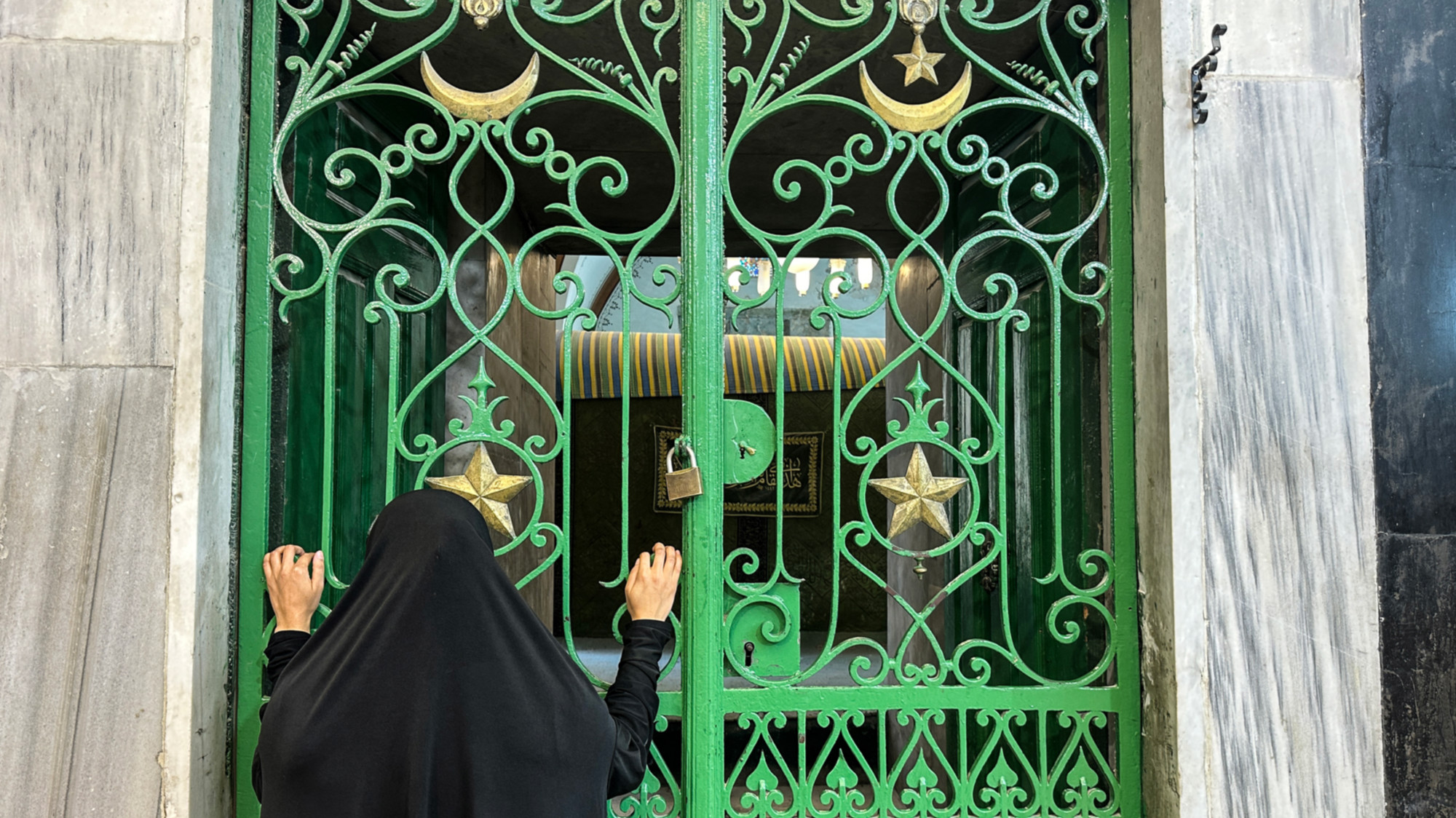
For five straight days, Israeli forces have blocked the broadcast of the Muslim call to prayer, known as the adhan, at the Ibrahimi Mosque in the occupied West Bank city of Hebron, marking the latest escalation of Israeli efforts to reduce Palestinian access and control at the contested religious site. The ongoing ban, which began last Sunday, has been paired with punitive entry bans for two senior mosque officials: Sheikh Mutaz Abu Sneineh, the mosque’s director, and Hammam Abu Murkhiya, head of the site’s custodial team, who have been barred from entering the Ibrahimi Mosque for 12 days under Israeli military orders.
Israeli authorities have framed the restrictions as a side effect of planned infrastructure work, saying the ban is tied to preparations to install a new roof over the mosque’s central courtyard. But Palestinian sources familiar with the situation say the real barrier to the call to prayer is deliberate Israeli access denial: the room from which the adhan is broadcast sits in the portion of the site currently under direct Israeli control, and Israeli soldiers have repeatedly refused to let the mosque’s muezzin enter the space to deliver the five daily calls to prayer. While worship is still permitted to take place inside the mosque, the adhan has been completely silenced since the ban went into effect.
The Ibrahimi Mosque, revered by Muslims, Jews, and Christians as the burial site of the shared patriarch Abraham, has a long history of contested control in Hebron. The 1994 massacre of 29 Palestinian worshippers by an American-Israeli settler set off a major shift in the site’s administration: after the attack, Israel partitioned the holy compound, allocating nearly 60 percent of the space to Jewish worshippers and leaving the remaining portion for Muslim worshippers. Palestinian stakeholders and local activists say Israel has steadily expanded its control over the entire site in the decades since the partition, implementing a series of incremental policies designed to reduce Palestinian presence and entrench exclusive Jewish control.
These long-running restrictions have accelerated sharply since the outbreak of the Israel-Gaza war in October 2023. The new wave of measures includes stricter access controls for Palestinian worshippers, the expulsion of imams and other mosque staff, and the gradual transfer of administrative authority away from the Palestinian Authority.
The Palestinian Authority’s Ministry of Awqaf and Religious Affairs has issued a strong condemnation of the latest restrictions, calling them “escalating repressive and arbitrary measures” targeting the holy site. The ministry said it views the entry bans on Abu Sneineh and Abu Murkhiya “with grave concern,” noting that the orders constitute a direct attack on the mosque’s officially recognized religious leadership and a deliberate attempt to remove the legally and religiously authorized administration from the site. The ministry added that the latest actions are part of a systematic, escalating policy to tighten full Israeli control over the Ibrahimi Mosque.
Local activists emphasize that the current five-day ban is not an isolated or temporary measure tied to maintenance work, but rather the intensification of a decades-long Israeli policy. Hisham Sharabati, coordinator of the Hebron Defence Committee, explained that adhan bans have been a routine practice at the site since the mid-1990s, with the call to prayer regularly blocked on Saturdays and during Jewish religious holidays. Soldiers also frequently block muezzins from accessing the broadcast room arbitrarily, leading to dozens of missed calls to prayer every month.
“In a single month, there can be 70 to 90 missed calls to prayer. The ban on the call to prayer has been ongoing. It’s an old policy,” Sharabati told Middle East Eye.
Sharabati added that restrictions have grown far more severe since Israel’s current far-right government took office in late 2022. Over the years, successive Israeli governments have justified restrictions under different guises: during the COVID-19 pandemic, bans were framed as public health measures, while after the outbreak of the Gaza war, restrictions were justified on security grounds. Even when Israel relaxed gathering limits for other public spaces across the country, those relaxations were never extended to the Ibrahimi Mosque, Sharabati said. Today, Israeli soldiers routinely turn away Palestinian worshippers of all ages and genders at the site’s only Israeli-controlled entrance without explanation, further limiting Palestinian access to the holy site.
Hebron has been under Israeli military occupation since the 1967 Six-Day War, and the broader Israeli occupation of the West Bank is widely recognized as illegal under international law.