As 27-year-old Slovenian cycling star Tadej Pogacar stands on the cusp of matching the all-time record of five Tour de France titles, a fierce debate has broken out across the global cycling community over one pressing question: does his unprecedented dominance of the sport’s most prestigious race make professional cycling boring to watch?
The conversation is not a new one, either. Periods of prolonged dominance by all-time greats have sparked the same discussion for decades. When Spanish legend Miguel Indurain claimed five consecutive Tour de France titles between 1991 and 1995, and when British star Chris Froome took four wins in five editions from 2013 to 2017, critics leveled the exact same accusation that is being aimed at Pogacar today. Interestingly, both Indurain and Froome were 27 and 28 respectively when they claimed their first Tour titles, putting Pogacar’s trajectory in a striking historical context.
What makes Pogacar’s run even more remarkable is that according to conventional cycling wisdom, the 27-year-old is only just entering what should be his physical peak. That means fans could be looking at several more Tour de France titles from the Slovenian in the coming years. For his part, Pogacar makes no apologies for loving the feeling of crossing the finish line first. “Winning is nice. I will never deny it’s a nice feeling to cross the line first,” he told reporters this week.
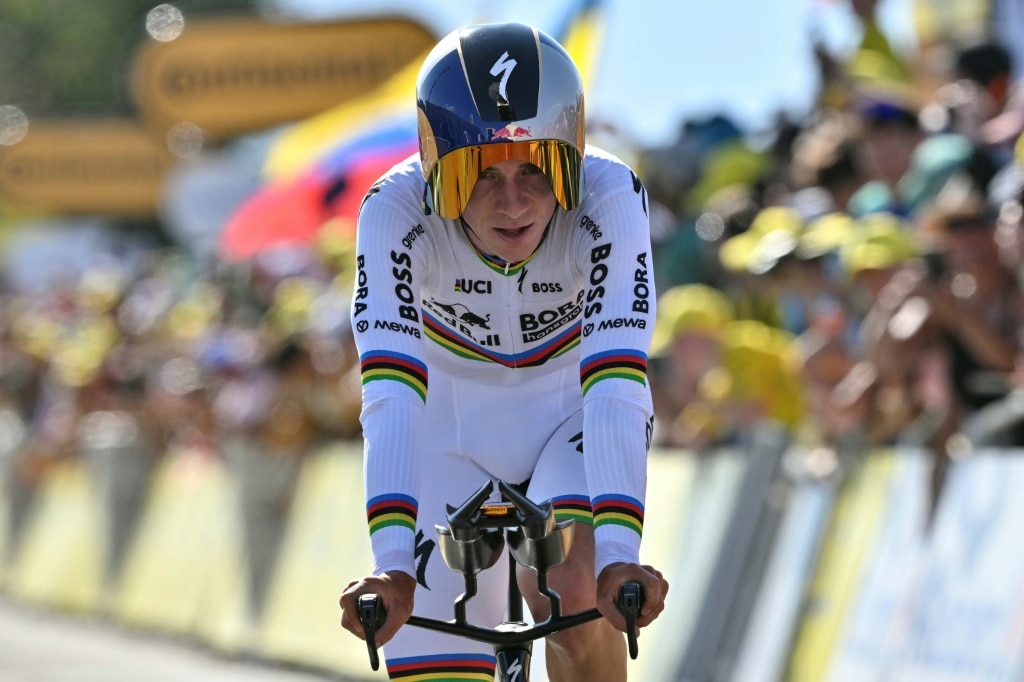
Not everyone in the peloton sees his dominance as a bad thing, however. Pogacar’s top rival, 26-year-old Belgian rider Remco Evenepoel, who currently sits second in the general classification after Thursday’s 18th stage, says racing against the Slovenian superstar is anything but boring. Evenepoel, who has pushed Pogacar hard in this year’s race, earning back-to-back stage wins on a mountain top finish and an individual time trial, says he views Pogacar’s historic performances as a benchmark to aspire to.
“I see it as being super impressive, the performances that he’s putting out,” Evenepoel said. “I’m looking up to that, I try to learn from that and I try to reach that level as well. He’s a superstar, he’s the best rider ever, so I don’t think people should consider it as boring. I understand if you watch television and he goes whenever he wants, it looks boring. But for us, it’s a challenge and it’s a big honour to race against a champion like that. You should not forget, we are witnessing history.”
Evenepoel’s admiration is shared by veteran cycling journalist David Walsh, who has covered the sport since the 1980s and witnessed first-hand the dominant eras of Indurain, Froome, and the drug-fueled reign of Lance Armstrong. Walsh, who famously exposed Armstrong’s decades-long doping scheme, says he has no doubts about the legitimacy of Pogacar’s success, and argues that the Slovenian makes domination feel exciting, unlike past dominant riders.
“There were Tours where other riders were just as dominant,” Walsh told AFP. “Laurent Fignon for example in 1984 was really dominant. In a much less exciting way Miguel Indurain was dominant in the early 90s. That left me a little bit cold. This one doesn’t. Pogacar makes domination exciting.”
Walsh drew a comparison to tennis legends Pete Sampras and Roger Federer, noting that unlike those two greats, who struggled on certain court surfaces, Pogacar wins across every type of terrain, even on routes that experts argue should not play to his strengths. “He’s a generational talent and my argument would always be, enjoy him because we shall almost certainly not see his like again,” Walsh added.
Other outlets have offered a different perspective on the root of the perceived boredom. British publication *Cycling Weekly* argues that it is not Pogacar’s aggressive, high-risk riding style—marked by daring long-range attacks and superhuman uphill acceleration—that makes races feel dull, but rather the unmatched strength of his UAE Emirates-XRG team, which controls races from start to finish to support their star leader.
French journalist Alexandre Roos of *l’Equipe* offered a historical perspective, noting that what feels boring to contemporary viewers often becomes legendary when viewed through the lens of history. Roos pointed to Eddy Merckx’s iconic 1969 stage 17 victory on the route to Mourenx, a ride that was dismissed as boring by spectators at the time but is now celebrated as one of the greatest performances in Tour de France history. “The stage to Mourenx was boring,” Roos said. “But almost 60 years later, we still talk about that stage to Mourenx as a legendary Tour stage.”
As the 2024 Tour de France heads into its final stages, all eyes remain on Pogacar as he chases history, and the debate over whether his dominance is a curse or a gift to cycling looks set to continue for years to come.