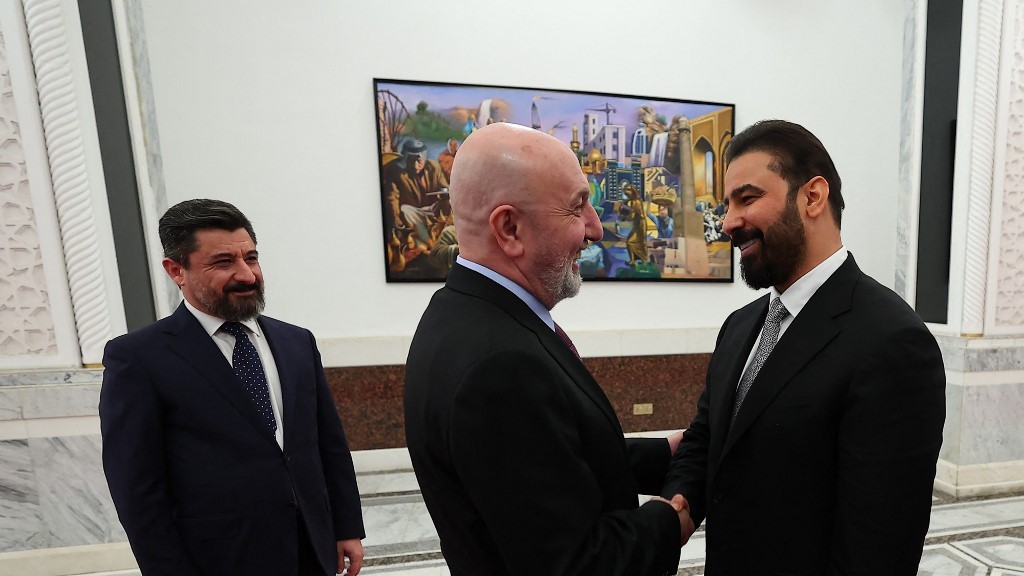
Five months after Iraq held its national parliamentary elections, the largest legislative bloc, the Shia-led Coordination Framework, has tapped Ali al-Zaidi, a little-known low-profile businessman with no prior elected office experience, to step into the role of prime minister-designate and lead efforts to form a new national government. Following the bloc’s formal selection, Iraq’s presidential office issued an official statement confirming that President Nizar Amede had officially assigned Zaidi the mandate to assemble a new cabinet, giving him a 30-day window to complete the negotiations and finalize his government.
A native of southern Iraq’s Dhi Qar province, Zaidi brings a deep private sector background to the political role. Until 2019, he served as chairman of Al-Janoob Islamic Bank, one of Iraq’s largest private financial institutions; he currently leads Al-Watania Holding Group, a sprawling multinational conglomerate with diverse business interests across the region. Notably, in 2024, the United States imposed sanctions on Al-Janoob Islamic Bank over allegations of money laundering, financial fraud, and unauthorized use of U.S. currency, and Iraq’s own Central Bank subsequently moved to ban the institution’s operations.
Zaidi’s nomination marks an unexpected outcome that sidelines two high-profile Shia political figures who were widely tipped as the Coordination Framework’s leading candidates: incumbent Prime Minister Mohammed Shia al-Sudani and former Prime Minister Nouri al-Maliki. In a public statement, the coalition praised both Sudani and Maliki for what it called their “historic and responsible stance” in stepping aside to clear the way for Zaidi’s selection.
Maliki’s withdrawal from contention came against clear external pressure: in January, former U.S. President Donald Trump threatened that Washington would “no longer help” Iraq if Maliki secured the nomination. Once counted as a close U.S. ally, Maliki has shifted sharply toward alignment with Iran in recent years, and has faced longstanding criticism over his tenure, including accusations of stoking deadly sectarian tensions across Iraq and presiding over systemic government corruption that contributed to the collapse of the Iraqi military and the loss of large swathes of Iraqi territory to the Islamic State group in 2014.
The nomination process unfolds against a backdrop of heightened regional tensions that have repeatedly threatened to drag Iraq into open conflict. In recent weeks, a fragile ceasefire has held between the United States and Iran, with intermittent diplomatic talks underway to de-escalate a two-month cross-regional conflict that began amid the Israel-Gaza war. Since the outbreak of hostilities in Gaza in 2023, Iran-aligned armed groups operating in Iraq have launched frequent sporadic attacks on U.S., Israeli, and Gulf state interests within Iraqi territory. The United States has long demanded that these armed groups be disarmed, while Iraqi political factions aligned with Iran have pushed for the full withdrawal of all remaining U.S. military forces from Iraqi territory.
International reaction to Zaidi’s nomination has been measured so far. The United Kingdom’s ambassador to Iraq, Irfan Siddiq, issued a public post on X welcoming the development. “The United Kingdom welcomes the nomination of a new Prime Minister in Iraq,” Siddiq wrote. “We wish Mr. Ali al-Zaydi success in swiftly forming a new government and look forward to working with the new government on the urgent challenges facing Iraq – particularly on security and the economy.”