Barcelona’s iconic Sagrada Familia basilica has captivated visitors and worshippers for decades with its dreamlike sandcastle-inspired spires, intricately carved stone foliage that mimics nature, and a light-drenched kaleidoscopic interior filled with untold secrets. Even those who attend services regularly at Antoni Gaudí’s unfinished masterpiece still find themselves stopped in their tracks by new details that slip past unnoticed on first, or hundredth, view. Ahead of Pope Leo XIV’s highly anticipated papal Mass scheduled for Wednesday night, the basilica’s Catalan rector Josep Turull — who has overseen parish activities here for eight years — gave The Associated Press an exclusive private tour to highlight some of the site’s most underappreciated hidden treasures. As Turull puts it: “We say that one of the elements of the Sagrada Familia Basilica is that you never exhaust it. I have spent the last eight years as its rector, and each day I discover something new.”
### Mysteries Carved Into the Basilica’s Façades
Every intricate detail woven into the Sagrada Familia’s multiple elaborately decorated façades carries intentional meaning, ranging from straightforward religious imagery to cryptic puzzles that reward close observation. The stark Façade of the Passion, which faces west, was designed by Gaudí to embody the agony of Christ’s final days. Its angular, contorted figures with strained bodies are intentionally harsh and unforgiving, “as if made of bones,” in Gaudí’s own words. Decades after Gaudí’s death, sculptor Josep Subirachs added subtle playful touches to soften the unrelenting misery of the narrative: Gaudí himself is carved above the central entrance, gazing across at Christ as he carries his cross toward Calvary. Next to the iconic scene of Judas betraying Jesus with a kiss sits a Sudoku-style numbered grid, a “magic square” that adds up to 33 — Jesus’s age at crucifixion — in every direction, a subtle reminder of the inevitability of Christ’s sacrifice. Further along the façade, tucked into the scene of Peter denying Jesus, a tiny square labyrinth carries its own message: Turull explains it symbolizes the need to hold fast to faith when one feels lost in life.
### Living Nature Atop the World’s Tallest Church
When the Tower of Jesus Christ was completed in October 2022, the Sagrada Familia claimed the title of the world’s tallest church, and following his Mass on Wednesday, Pope Leo XIV will step outside the basilica to bless this iconic new addition. The soaring spires of Gaudí’s design are packed with natural imagery: from the rooster that marks Peter’s denial to reptile-shaped gargoyles and overflowing cornucopias of fruit that crown each tower. Most surprisingly, the heights are also home to living, breathing wildlife: a breeding pair of peregrine falcons and their offspring have made the St. James Tower their nest for more than 20 years. The falcons do double duty, keeping the nuisance pigeon population under control and restoring a natural ecological cycle that broke down when the species disappeared from Barcelona in the 1970s. The Sagrada Familia was selected as an ideal reintroduction site because it was one of the falcons’ last remaining nesting spots in the city before their local extinction, and the population has thrived here ever since. Turull notes that the swift predators “recover the cycle of natural life” in the heart of central Barcelona, fitting perfectly with Gaudí’s philosophy of drawing inspiration from the natural world.
### The Spiritual Heart Underground: Gaudí’s Final Resting Place
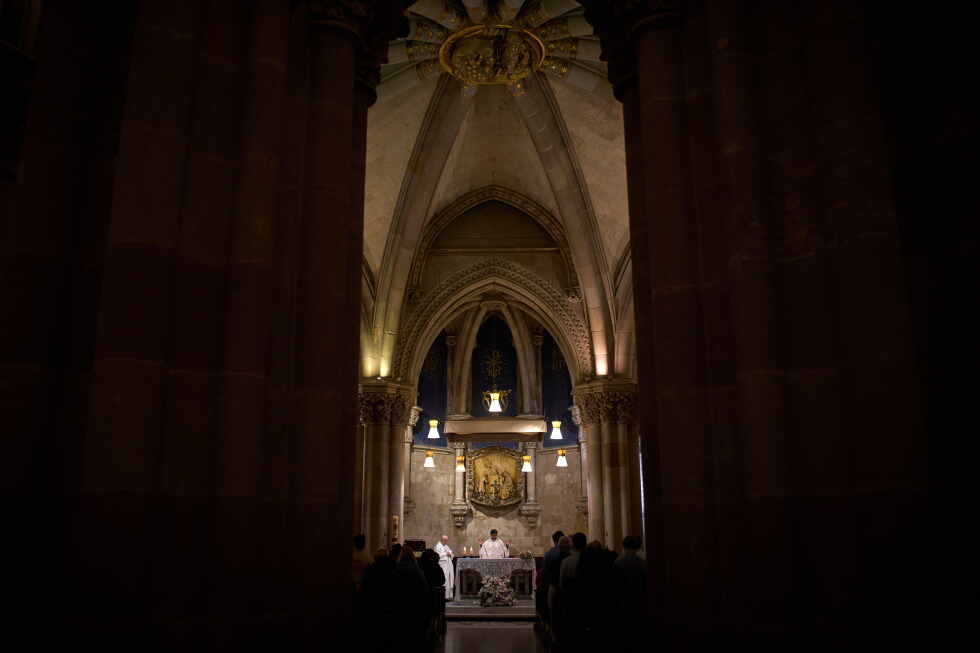
For the more than 4.5 million tourists that visit the Sagrada Familia each year, jostling for photos of the colored light pouring through stained-glass windows and following guided tours of the main nave, the basilica’s “spiritual heart” is easily overlooked. To find it, visitors must slip through a unassuming side entrance and descend a short staircase to a small, quiet underground chapel. Here, the noise of tourism fades away, leaving space for small groups of worshippers to gather for silent Mass. It is also here that Antoni Gaudí — a devout Catholic who dedicated more than 40 years of his life to the Sagrada Familia — is buried in a simple, discreet tomb in a wall nook. Gaudí died exactly 100 years before Pope Leo XIV’s visit, killed instantly when he was struck by a streetcar in 1926. Today, worshippers and visitors come to the crypt to ask for Gaudí’s intercession, leaving candles at his tomb out of trust that their prayers will be answered. The Vatican is currently in the late stages of the canonization process for Gaudí: Pope Francis declared him venerable in 2025, and the Vatican is now reviewing a claimed miracle attributed to his intercession. If confirmed, Gaudí will be beatified, followed by canonization as a saint after a second verified miracle. The basilica has invited Pope Leo XIV to pray at Gaudí’s tomb during his visit, though it remains unconfirmed whether he will do so.
### Small Surprises: A Natural Holy Water Basin and a Papal Changing Room
Even on the path to and from the crypt, small details reflect Gaudí’s obsession with integrating nature into his design. Before ascending back to the main level of the basilica, Turull pauses at a large, genuine seashell brought to Barcelona from the Philippines, set in hand-wrought iron and mounted on a column to serve as a holy water basin. It is a quiet example of Gaudí’s core design philosophy: “Gaudí always takes nature as an example,” Turull explains.
Higher up in the basilica, up a winding staircase, a sunlit private changing room prepared specifically for Pope Leo XIV holds two intricately designed oak cabinets crafted by Gaudí himself, which hold the basilica’s most precious clerical relics and vestments. One of the most treasured pieces already stored there is the chasuble worn by Pope Benedict XVI when he consecrated the Sagrada Familia in 2010. For his visit, a brand-new chasuble is being hand-sewn at a local workshop specifically for the Mass, featuring custom details tied to the newly completed Tower of Jesus Christ and the historic occasion. Turull is keeping the full design under wraps for now: some details, he says, are meant to be a surprise for the day.
This report includes contributions from AP videojournalist Hernán Muñoz.