In the border town of O’Smach straddling Thailand and Cambodia, a recently seized illicit operation laid bare the staggering, industrial-scale expansion of transnational cyber scam networks that have exploded across Southeast Asia in the years since the COVID-19 pandemic.
For a journalist who has tracked the rise of these criminal compounds for years from a base in the region, and visited multiple scam centers before, the size of the O’Smach Resort complex—seized by Thailand’s military during a December border conflict with Cambodia—still defied prior expectations. Covering roughly 197 acres, an area equal to 150 full-sized American football fields, it dwarfed every other scam facility the reporter had previously observed.
Thailand’s military organized a guided media tour of the seized compound this week, revealing the full scope of the well-established criminal operation that once operated from the site. Thai officials stated they seized the territory after Cambodian actors used the complex as a base for cross-border attacks during the December dispute.
The compound, bearing the innocuous name O’Smach Resort, is linked to Cambodian politician Ly Yong Phat, who is already sanctioned by the United States for documented human rights abuses tied to the same site. While it remains unconfirmed whether ongoing expansion work at the complex is also tied to Ly, visible signs of new construction are scattered across the self-contained facility: stacks of unused bricks and idle construction cranes dot the landscape, indicating the criminal network was actively growing its operations before the seizure.
Inside the complex, the infrastructure is built explicitly to support large-scale coordinated fraud. In total, the site holds 157 separate structures. Twenty-nine of these are dedicated office buildings for scam operating companies, while the rest include mass worker dormitories, luxury staff apartments, and even three-story private villas for senior criminal leaders. Thai military estimates suggest at least 10,000 people resided and worked within the compound at the height of its operation. To accommodate the majority Chinese workforce that ran the scams, the compound even hosts a range of regional Chinese dining options, from spicy Hunan dishes and southern Chinese Shaxian delicacies to Sichuan-style hot and sour rice noodles.
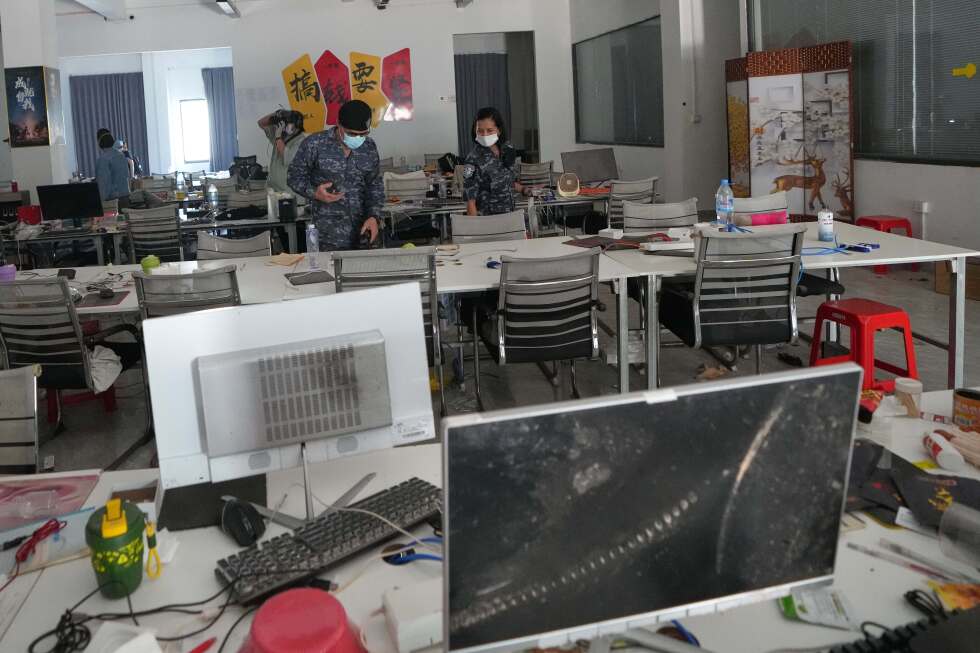
During the tour, reporters were led to a four-story office building where scammers specifically targeted American victims. The office was left largely intact after the seizure: half-eaten snacks remained on desks, and every workstation held detailed scam scripts and notes written in Chinese. American SIM cards were scattered across surfaces, confirming the operation’s direct targeting of United States consumers.
One of the recovered scripts illustrates the sophisticated, long-con tactics scammers use to manipulate victims. The 24-page document builds out an elaborate backstory for a fake female persona named Mila, who is framed as a successful trader with huge earnings from gold options trading. The script goes far beyond basic financial fraud framing: it adds deeply personal details, including the death of Mila’s husband from leukemia when their daughter was an infant, childhood bullying, and a move to South Africa to live with her uncle as a teenager. These manufactured emotional details are designed to build trust with targets over weeks or months before scammers move to steal their money.
The revelation of this massive single compound lines up with broader estimates from global authorities. The U.N. Office of the High Commissioner for Human Rights currently estimates that roughly 300,000 people are trapped in the scam industry across Southeast Asia, many of them coerced into committing fraud against victims worldwide. Newly released FBI data this week underscores the staggering human cost for one major target market: U.S. consumers lost nearly $21 billion to all types of scams in 2023 alone.
While both Thailand and Cambodia have made public pledges to crack down on cross-border cyber scam operations, senior Thai officials emphasized that the problem is fundamentally global in scope, and cannot be solved by two neighboring countries acting alone. “Every country of the world has to join together to solve this problem. We cannot do it alone with Cambodia and Thailand,” stated Air Chief Marshal Prapas Sornchaidee, one of the senior military officials leading the media tour.
Recent regional developments signal growing momentum to address the crisis: Cambodia has recently advanced new legislation that would impose penalties as severe as life imprisonment for operators of illicit scam centers, and multiple countries have already extradited high-profile scam suspects back to their home jurisdictions to face charges. Still, the discovery of a 10,000-person fully operational scam compound near the Thai-Cambodian border makes clear that transnational criminal networks have already built a far larger infrastructure than many global leaders had previously acknowledged.