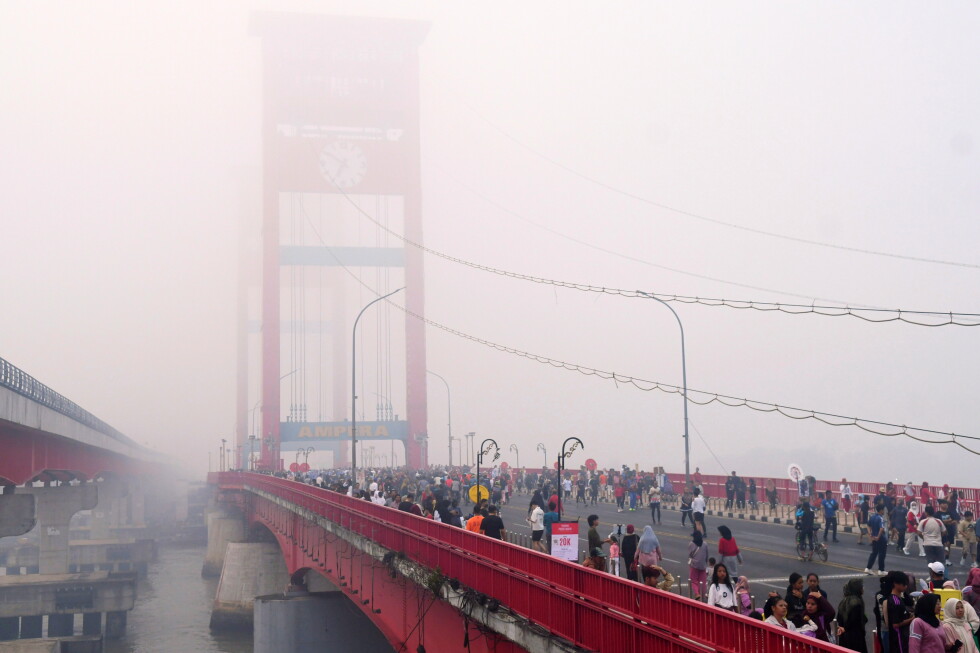
A major law enforcement crackdown is underway in Indonesia after a months-long crisis of rampant forest and peatland fires, which have spread dangerous choking haze across the country and into neighboring Malaysia. National police have taken 72 individuals into custody, all accused of igniting blazes that have ravaged vast swathes of land across key fire-affected regions, according to senior law enforcement officials.
The 2024 fire season has been amplified by a strengthening El Niño climate pattern, which has dragged the country into an extended, extreme dry season that creates ideal conditions for blazes to spread rapidly. Indonesia’s National Disaster Management Agency (BNPB) confirmed that smoke from the ongoing fires has drifted across national borders, creating public health emergencies in parts of Malaysia.
For decades, illegal slash-and-burn land clearing has been a persistent environmental and diplomatic challenge for Indonesia, repeatedly straining bilateral relations with regional neighbors that bear the brunt of transboundary haze. Mohammad Irhamni, director of special crimes at the National Police’s Criminal Investigation Agency, explained that the practice is overwhelmingly driven by economic incentives: plantation operators and small-scale traditional farmers commonly set fires to clear new agricultural land for a fraction of the cost of legal clearing methods.
As of Sunday’s official update, the 72 detained suspects are tied to 89 open forest and land fire investigations spanning nine provinces across two of Indonesia’s most fire-prone islands: Borneo and Sumatra. Irhamni emphasized that most suspects face allegations of deliberate arson carried out to clear land for commercial agricultural plantations. The investigation remains ongoing, with law enforcement currently tracing financial records to uncover whether larger corporations provided funding or ordered the illegal clearing operations. This means the net of suspects is likely to widen far beyond the low-level actors already taken into custody.
“We will not stop at the perpetrators on the ground,” Irhamni told reporters during a press briefing in Jakarta, the nation’s capital. “We will determine who benefited from these activities and who was ultimately behind them.”
Convictions on arson charges linked to illegal land clearing carry severe penalties under Indonesian law, with sentences ranging from substantial financial fines to maximum prison terms of 15 years, Irhamni added.
On Sunday alone, official data from Indonesia’s Ministry of Environment recorded more than 3,700 active hot spots across the Indonesian-administered portion of Borneo, the world’s third-largest island which it shares with Malaysia and Brunei. BNPB head Suharyanto, who like many Indonesians goes by a single name, confirmed that fire activity has spiked sharply across West, Central, and South Kalimantan provinces on Borneo. The prevalence of waterlogged peatlands in these regions makes fires particularly difficult to extinguish, as smoldering embers can burn underground for weeks even after surface flames are put out, prolonging haze production across populated areas.
“Land that appears extinguished on the surface may still contain embers underneath, so sufficient rainfall is crucial to rewet the peat and fully suppress the fires,” Suharyanto explained.
The situation is equally severe on the western island of Sumatra, where more than 1,700 hot spots were detected on Sunday. In some parts of South Sumatra province, dense hazardous haze has cut visibility to just 10 meters, or 33 feet, according to the Environment Ministry.
In response to the escalating crisis, Indonesian disaster management authorities have resumed cloud-seeding operations across Kalimantan to induce much-needed rainfall. A total of 52 helicopters have been deployed to fire zones across both islands: 30 are assigned to water-bombing and aerial patrol missions across Borneo, while an additional 22 aircraft are operating across Sumatra.
Across the border, the transboundary haze has triggered a major public health disruption in Malaysia. The eastern state of Sarawak, located on Borneo, has been the hardest hit. On Friday, one Sarawak district recorded “very unhealthy” air quality readings, while eight other districts posted unhealthy levels. In response, local authorities ordered the closure of nearly 600 schools, disrupting in-person learning for roughly 200,000 enrolled students, the Sarawak state government confirmed.