In the early hours of Sunday, Indonesia’s active Anak Krakatau volcano erupted, triggering widespread travel disruptions across the west of the country and forcing a four-hour halt to flight operations at Jakarta’s primary international hub, Soekarno-Hatta. The volcanic island, which sits in the strategically vital Sunda Strait between Indonesia’s two most populated islands, Java and Sumatra, began showing unusual signs of increased geologic activity on Saturday, according to Indonesia’s national Geological Agency. The brief but powerful eruption lasted just 30 seconds, starting at 3:53 a.m. local time.
As of Sunday morning, no injuries or fatalities had been confirmed, and no mandatory evacuation orders had been issued for surrounding areas. The closest populated settlement to the volcano’s crater is located more than 16 kilometers (10 miles) away, which officials say helped reduce immediate risk to human life. Even so, the Geological Agency issued a formal public warning, urging all local residents and traveling tourists to maintain a minimum 3-kilometer (1.9-mile) buffer zone around the volcano’s active crater to avoid exposure to sudden eruptions, flying debris and toxic fumes.
Indonesia’s Center for Volcanology and Geological Hazard Mitigation confirmed that fine, disruptive volcanic ash spread across multiple populated regions, including the national capital Jakarta and Lampung Province, which occupies the southern tip of Sumatra. In an official travel advisory released shortly after the eruption, Soekarno-Hatta International Airport—Indonesia’s busiest air gateway—announced it would suspend all flight operations between 5:30 a.m. and 9:30 a.m. local time to protect aircraft from ash damage, which can disable jet engines mid-flight.
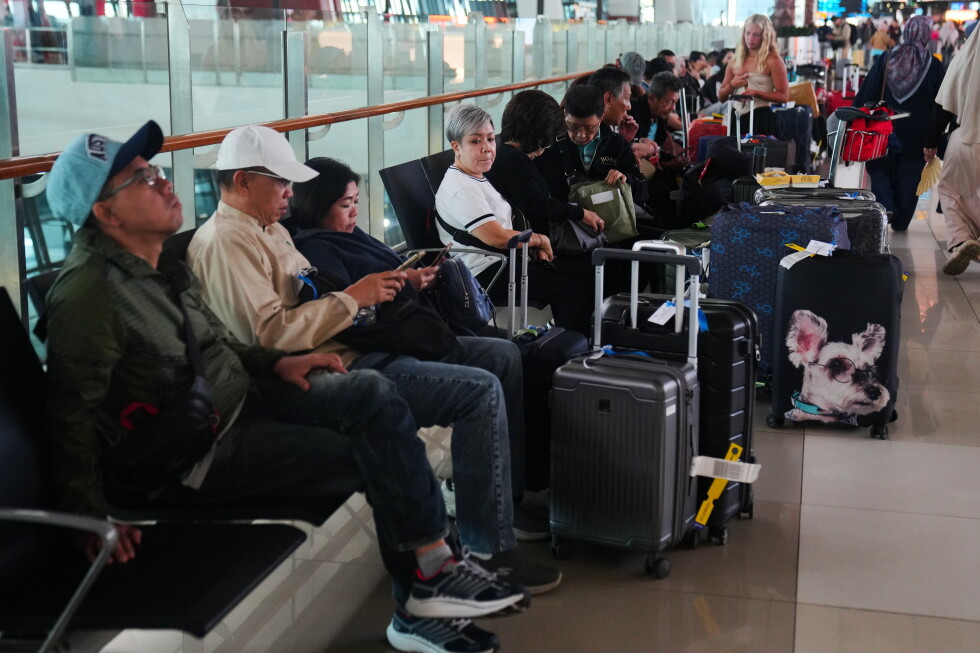
Stranded passengers at the airport described scenes of chaos as departure boards filled with canceled flight alerts, with hundreds of travelers lining up to request ticket refunds or retrieve their checked luggage after the shutdown.
Joint monitoring efforts by Indonesia’s national volcanology agency and the Darwin Volcanic Ash Advisory Centre in Australia identified two distinct ash plumes via satellite imagery. The lower plume reached an altitude of 20,000 feet (6,100 meters) as it drifted northeast, covering portions of Jakarta, Banten Province, West Java and nearby coastal waters. The second, much larger plume rose to 50,000 feet (15,200 meters) and moved west and northwest, covering parts of Banten, Lampung and Bengkulu provinces, the central Sunda Strait, and a large stretch of the Indian Ocean off Sumatra’s western coast.
Sunday’s eruption is one of the most significant events at Anak Krakatau since 2018, when an explosive collapse of the volcano’s cone triggered a devastating tsunami that killed at least 430 people across coastal communities in Sumatra and Java. Anak Krakatau formed in the caldera of the original Krakatoa volcano, which erupted in one of the most powerful volcanic events in recorded history in 1883.