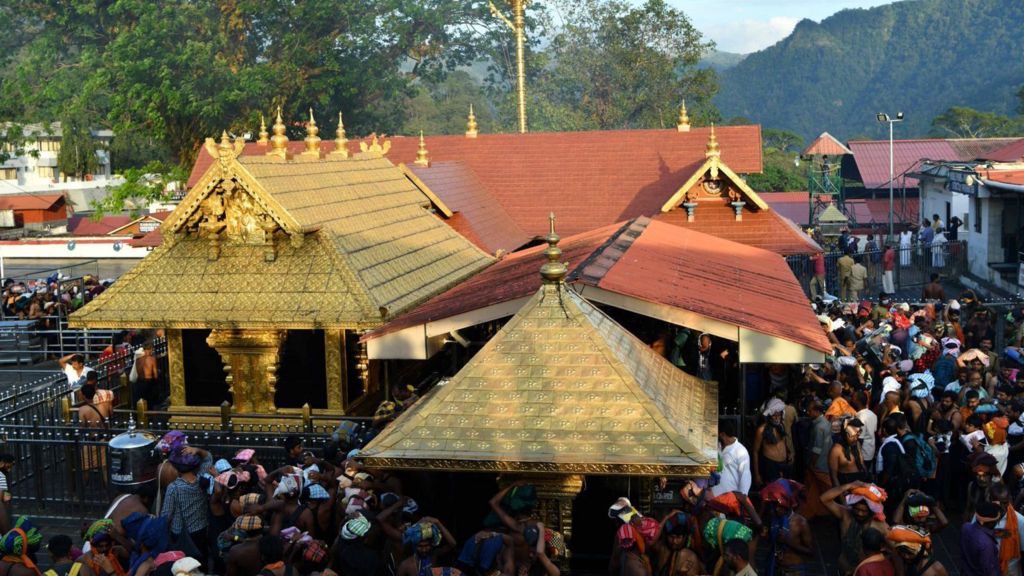
Decades of gender-based exclusion at one of Hinduism’s most revered pilgrimage sites will once again be put under constitutional scrutiny this month, as India’s Supreme Court prepares to hear a high-stakes review of a 2018 ruling that opened the iconic Sabarimala Temple to women of menstruating age.
Located in the southern Indian state of Kerala, the Sabarimala shrine dedicated to Lord Ayyappa has long enforced a ban on all women between 10 and 50 years of age, a restriction rooted in traditional Hindu beliefs that frame menstruation as a state of ritual impurity. For generations, only prepubescent girls and post-menopausal women have been permitted to enter the temple, which draws millions of male devotees from across India annually.
That centuries-old practice was upended in 2018, when a five-judge Supreme Court bench delivered a landmark 3-2 verdict striking down the entry ban as discriminatory and unconstitutional. The majority ruled that the constitutional right to practice religion is guaranteed equally to all people regardless of gender, rejecting arguments that long-standing tradition justified the exclusion. The ruling’s lone female justice, Indu Malhotra, who has since retired, issued a notable dissent, arguing that courts should avoid interfering with deeply held religious sentiments, and that secular concepts of rationality have no place in adjudicating religious customs.
The 2018 verdict sparked widespread, sometimes violent protests across Kerala, with conservative groups mobilizing to block women attempting to access the temple; many women who tried to enter were turned away, and some were physically assaulted. In response, hundreds of thousands of supporters of gender equality in religious spaces held counter-protests, while dozens of petitions for judicial review of the 2018 ruling were filed with the Supreme Court by groups seeking to reinstate the ban.
The Supreme Court accepted the review petitions in 2019, first convening a seven-judge bench that quickly expanded the scope of the case to include a range of parallel gender and religious freedom disputes across India’s different faith communities. A planned 2020 hearing before a nine-judge constitutional bench was derailed by the onset of the COVID-19 pandemic, leaving the case in limbo for years.
That changed this past weekend, when Chief Justice of India Surya Kant announced the reconstitution of the nine-judge constitutional bench to finally hear the petitions. The bench’s composition has drawn note for its deliberate diversity: it includes Justice BV Nagarathna, currently the only female judge on the Supreme Court and the justice in line to become India’s first female Chief Justice in 2025, with judges drawn from a cross-section of India’s religious, caste and regional communities. Legal analysts widely view this inclusive selection as an effort to build broader public legitimacy for a verdict that is certain to touch on deeply contested cultural and religious issues.
Beyond the future of Sabarimala, the bench’s ruling will set a binding precedent for a slate of other pressing questions around gender, religion and constitutional rights across India. These include challenges to entry bans for women in Parsi fire temples and Muslim mosques, the legal authority of religious institutions to excommunicate community members, and the long-debated legality of female genital mutilation practiced within the small Dawoodi Bohra Muslim community.
In the lead-up to the opening of hearings, the Travancore Devaswom Board, the government body that manages the Sabarimala temple, has urged the court to avoid intervening in faith-based traditional practices. India’s federal government has also formally signaled its support for the review petitions seeking to overturn the 2018 ruling. The hearings are scheduled to conclude on April 22, with a ruling expected in the coming months that will shape the contours of gender equality and religious freedom in India for decades to come.
Over the past decade, women’s rights activists across India have increasingly challenged centuries-old gender-based restrictions at religious sites, arguing that such exclusions violate the fundamental equal rights guaranteed to all citizens under India’s constitution. The outcome of the Sabarimala review is widely expected to either advance or set back that movement for equal access to religious spaces across the country.