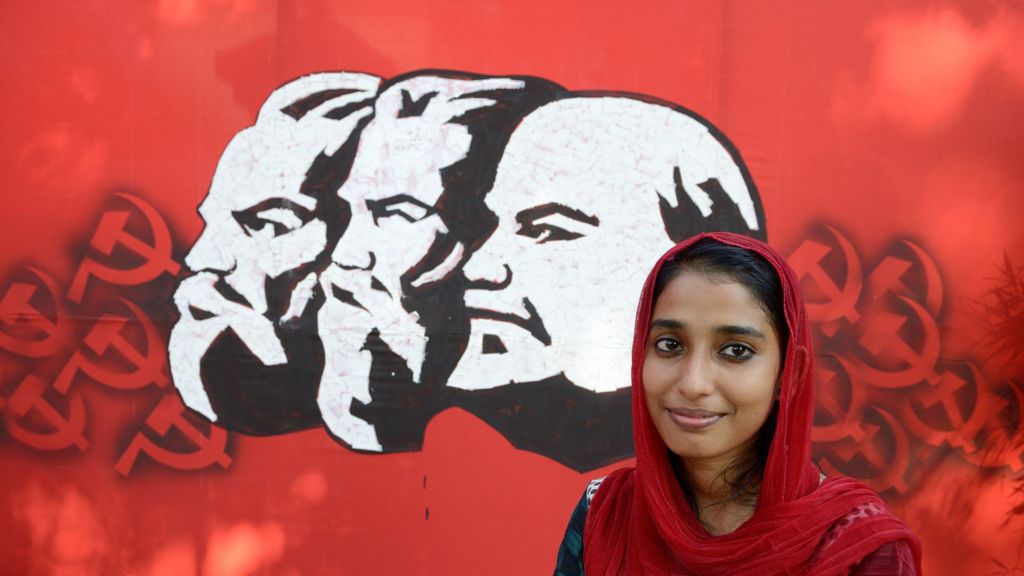
For the first time in 69 years, India is left without a single state government led by a communist party, marking a defining turning point for one of the world’s longest-running experiments in democratic communist politics. The recent electoral defeat of the Communist Party of India (Marxist)-led Left Democratic Front (LDF) in Kerala, which closed out a decade of Left rule, brings to a close a chapter that reshaped the country’s political landscape for generations.
At the height of their influence, India’s communist parties controlled governments across key states spanning West Bengal, Kerala, and Tripura, touching the daily lives of more than 100 million people through deep roots in trade unions, peasant movements, student organizations, and a tightly disciplined cadre network. In West Bengal, the Left Front held uninterrupted power from 1977 to 2011, standing as one of the longest-serving elected communist administrations in global history. Across Tripura, the Left governed for a total of 35 years, including a 25-year unbroken stretch before it was ousted by Prime Minister Narendra Modi’s right-wing Bharatiya Janata Party (BJP) in 2018. Today, West Bengal’s once-mighty communist bloc holds just one seat in the state’s 294-member legislative assembly, a stark marker of its collapse.
Kerala carved out a unique political trajectory from the start. In 1957, it became one of the first regions in the world to vote a communist government into power, led by iconic leader EMS Namboodiripad. For decades after, power rotated consistently between the Left and the national Congress party, cementing the communists as a durable, if never permanently dominant, political force. That democratic legacy made Kerala’s recent defeat all the more significant in closing the book on communist-led state government across India.
Nationally, Indian communism once exerted outsize influence on the country’s federal politics. In 1996, Jyoti Basu, CPI(M) founding member and then chief minister of West Bengal, came within a hair’s breadth of becoming India’s prime minister at the head of a national coalition government. The party ultimately rejected the offer, a decision Basu later famously called a “historic blunder.” A decade later, in 2008, Left parties pulled their parliamentary support from former Prime Minister Manmohan Singh’s government over its landmark civil nuclear deal with the United States. Holding 62 seats in the lower house of parliament at the time, the Left forced Singh into a high-stakes confidence vote before the deal ultimately passed.
Beyond electoral politics, communist thought shaped India’s economic, intellectual, and cultural life far beyond its regional strongholds, even as critics pointed to economic stagnation in West Bengal and slipping educational outcomes during decades of Left rule. Today, that influence has faded dramatically, and the movement survives in fragmented form across the country. While the LDF suffered defeat in Kerala, the party remains a major political force there; in Tamil Nadu, communists persist largely through alliance with larger regional parties; in Bihar, the breakaway CPI (Marxist-Leninist) has built an active grassroots presence in some rural pockets; and Left-backed student groups still perform well in the country’s top universities.
But in the former communist strongholds of West Bengal and Tripura, the movement has been reduced to a shadow of its former self. Nationally, the CPI(M)’s share of the national popular vote has plummeted from more than 6% at its 1980s peak to less than 2% in recent national elections.
Communist leaders attribute the decline to larger structural shifts that have reshaped Indian politics over the past 30 years. CPI(M) West Bengal secretary Mohammed Salim argues that the simultaneous rise of Hindu nationalism and market liberalization starting in the 1990s created a “religious, political and economic onslaught” that squeezed the Left from all directions. The new political order sold the middle class on a vision of development, modernization, and infrastructure growth that stoked new consumer aspirations, he says, while a growing politics of caste and religious identity fractured the class solidarity that formed the backbone of communist organizing. “Politics of division weakened class unity,” Salim notes.
Political analysts, however, argue the decline cannot be blamed solely on external forces. Unlike communist parties in China or Vietnam, India’s communist parties only ever governed states within the country’s federal democratic system, says Sanjay Ruparelia, a politics professor at Toronto Metropolitan University. This structure left regional communist governments under constant pressure to attract private investment and deliver rapid economic growth, creating internal contradictions that ultimately undermined their support. In West Bengal, that contradiction erupted publicly: the party that rose to power through landmark pro-peasant land reforms was later accused of forcibly dispossessing small farmers to clear land for industrial development.
Kerala’s communist model, while widely celebrated for its achievements, faced its own unaddressed strains. The state earned global acclaim for decentralized governance, top-tier social indicators, near-universal literacy, dramatic poverty reduction, and a robust public health system. But it remained heavily dependent on remittances from overseas workers, a revenue stream that has grown increasingly volatile, leaving the state with mounting fiscal pressures and chronic job shortages, particularly among young people. Most notably, Kerala’s communist leadership gradually shifted toward the very pro-market economic model it once opposed: a 2022 CPI(M) policy document explicitly embraced private investment, public-private partnerships, private universities, and global integration of the state’s technology sector. For Ruparelia, this shift reveals a deeper truth: India’s communist parties have long been better understood as social democratic movements than revolutionary communist ones. Rather than pursuing systemic overthrow, they functioned primarily as parliamentary parties focused on advancing welfare, labor rights, and economic redistribution.
CPI(M) general secretary MA Baby defends that trajectory, noting that state governments in India’s federal system always operated within tight constraints. “They have limited financial and administrative powers. The real power lies in Delhi,” he says. “We used state governments to show that even within the capitalist socio-economic structure, pro-people policies and alternatives are possible despite limited powers.”
Still, the social base that sustained that model has eroded steadily over time. Organized labor, the core of communist support, has always been a small minority in India’s vast informal economy. As welfare politics has shifted away from class-based mobilization toward direct cash transfers and identity-based electoral coalitions, the Left has lost its traditional foothold. The 2020 nationwide farmers’ protests against Modi’s controversial agriculture laws underscored this shift: while the Left joined the movement, serving as what analyst Shikha Mukherjee calls “the voice of conscience,” it no longer led the movement. That leadership role has been taken over by regional parties and independent farm unions.
“The Left has lost its place as the principal voice of rights and entitlements. It has struggled to adapt to the modern economy, and ideological confusion now lies at the heart of the movement,” Mukherjee says. The irony, analysts note, is that modern India is now grappling with soaring economic inequality, persistent youth unemployment, and deepening working-class insecurity – conditions that once would have created fertile ground for a resurgence of Marxist politics. As Ruparelia puts it, “the objective conditions, as leftists are wont to say, should benefit them.” Yet the Left has failed to capitalize on this discontent. “The Left should have been out on the streets. Where are they?” Mukherjee asks.
This paradox is not unique to India. After the 2008 global financial crisis, new left-wing parties emerged across Europe, but many have struggled to compete with nationalist populist movements that mobilize working-class voters around anti-immigrant sentiment and ethnonationalism rather than class solidarity, Ruparelia notes. India’s Left faces a parallel challenge from the BJP’s brand of majoritarian Hindu nationalism.
Even so, writing off the Indian communist movement entirely is premature. For decades, it has survived internal splits, state repression, and repeated electoral collapses, and its diminished organizational networks still maintain a presence across large swathes of the country. The question now is whether the movement can reinvent itself to rebuild political relevance. Mukherjee argues the CPI(M) must adapt to operate within the liberalized economic order created by 30 years of reform, rather than simply opposing it.
In West Bengal, Salim says the party is already in the process of “regrouping, repositioning and rejuvenating.” Eager to shed its reputation as an ageing, change-resistant movement, the party has elevated a new generation of younger leaders to prominent roles. “Communists must constantly rejuvenate themselves. The only constant is change itself,” Baby says.
The scale of the Left’s electoral decline remains undeniable, however: in West Bengal’s most recent election, the CPI(M) won just one legislative seat and captured barely 4% of the popular vote. Kerala remains the outlier: even in defeat, the LDF held roughly a third of the popular vote, confirming that the communists remain a major force in state politics there, while a return to power in Tripura remains distant for the foreseeable future. Still, party leaders insist that electoral results do not tell the full story of their ongoing social and political relevance. “Are we hopeful? Of course,” Baby says. “In fact, we ask: without us, what future is there? Seats matter, but our place in the hearts of the people matters more.”