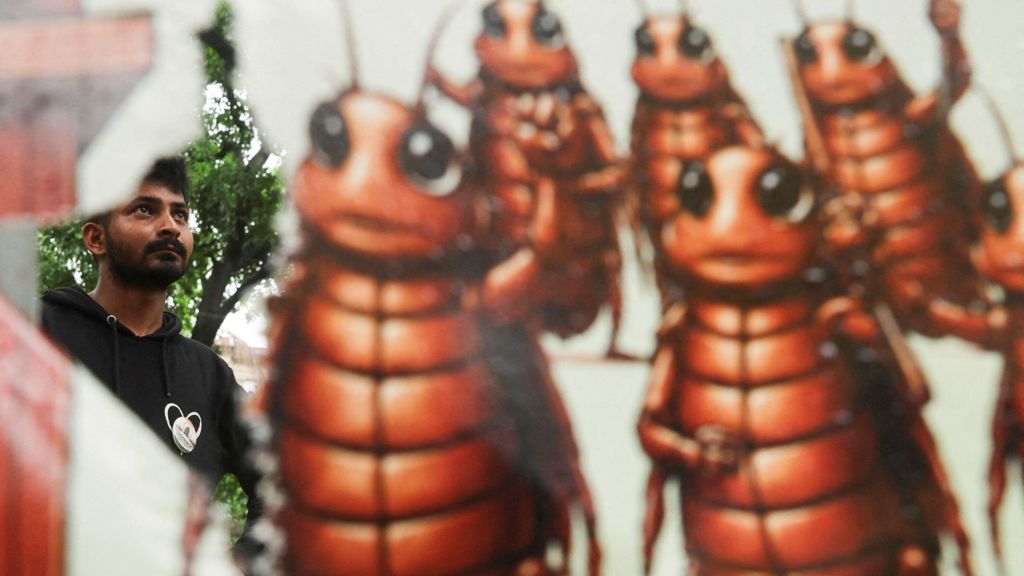
When tens of thousands of demonstrators with the Cockroach Janta Party (CJP), a youth-led Indian grassroots movement, marched toward India’s parliament in New Delhi on Monday to demand government accountability over a series of high-profile exam paper leaks and recruitment scandals, few could have predicted the defining image of the day would not be tear gas canisters or baton charges—but viral Instagram memes and deadpan jokes.
The CJP movement first emerged from widespread student anger over persistent exam irregularities, and has since expanded into a broader call for transparency, targeting Education Minister Dharmendra Pradhan with demands for his resignation. Pradhan has rejected these calls, instead accusing opposition parties of exploiting young people’s frustrations for political gain. The Monday demonstration, one of the largest anti-government gatherings in New Delhi in recent years, quickly escalated when police moved to disperse the crowd, firing tear gas and charging protesters with batons. Authorities also shut down mobile internet access across the protest zone to limit information sharing. By the end of the day, both sides reported injuries: protesters said dozens of demonstrators had been beaten by police, while law enforcement confirmed multiple officers were also hurt.
Once internet access was restored, a flood of first-person content—short video reels, personal dispatches, and sardonic memes—poured onto social media platforms, capturing the day’s chaos through a uniquely young, internet-native lens. Among the most viral content was a pre-protest “fit check” (a popular social media trend where creators show off their outfits) filmed by 20-year-old Chhavi, who smiled at her camera and joked, “Going to get beaten by cops, guys.” Hours later, after enduring the police crackdown, Chhavi still posted her content smiling—posing beside riot officers, flashing victory signs, and documenting the chaos unfolding around her.
Chhavi’s video was far from an anomaly. Other young protesters shared equally striking, dryly humorous content: one young woman calmly reapplied lipstick in front of a line of fully geared riot police; another quipped she was “serving face at the protest because the government couldn’t serve justice”; one reel cut abruptly from a casual outfit reveal to footage of protesters fleeing tear gas; another offered a deadpan “product review” of tear gas, rating its scent and stinging power like a new street food vendor.
To outside observers, this mix of humor and violence can seem contradictory. But for the young creators behind the content, the jokes are not a dismissal of danger—they are a way to live alongside it. Most of the self-deprecating humor centers on the absurdity of their own experiences: joking about the kilometers logged running from baton charges, or the strangeness of filming an outfit reveal moments before tear gas fills the street. The fear never disappears; it simply coexists with laughter.
Digital culture and political science experts argue this trend signals a fundamental shift in how a generation raised entirely online engages in political protest. “Older generations separated political life from everyday life,” explained Joyojeet Pal, a University of Michigan professor specializing in technology and society. “Younger generations grow up with politics alongside their memes, their family pictures and their daily commutes.”
Critics have accused some protesters of treating state violence as social media content, chasing viral engagement instead of taking the movement seriously. But Chhavi pushed back on that claim, saying the choice to laugh was a coping mechanism in the face of terror. “I was adrenaline-soaked, scared, petrified,” she said. “It was either laugh in the face of fear or cry.”
Payal Arora, a digital anthropologist at Utrecht University, notes that the instinct to document political upheaval with smartphones has grown increasingly common across global protest movements. What was once the exclusive work of professional journalists is now done by ordinary participants, preserving moments that would otherwise be lost to official erasure. “The act of capturing a protest is often an end in itself,” Arora said. “Their message is more like: ‘This happened. We were there. We will remember.’”
Nishant Shah, director of the Digital Narratives Center at the Chinese University of Hong Kong’s School of Journalism and Communication, says misinterpreting the protesters’ humor as detachment misses its core purpose. Humor has long been a unifying tool in protest movements worldwide, helping ease tension, build collective solidarity, and sustain participants through moments of intense fear. “Even when the cause is brutal and the fight fierce,” Shah said, “there is joy, laughter, songs and hope. Without those things, protests don’t sustain themselves.”
For 21-year-old first-time protester Ishaan, that purpose was clear when he posted his own viral reel after a tear gas canister landed near his position. Instead of fleeing immediately, he pulled out his phone to film, and captioned the clip of drifting white smoke: “Delhi Police doesn’t realise I’m from Jamuna Paar.” The joke is familiar to most Delhi residents: Jamuna Paar, the low-income eastern neighborhoods across the Yamuna River, has long been mocked for its chronically neglected civic infrastructure. “The smell there is worse than the tear gas,” Ishaan explained with a laugh. He emphasized the joke was never meant to trivialize what happened. “It was about refusing to let fear dictate the memory of the day,” he said.
Every generation of protest movement develops its own shared cultural language to bind participants together: India’s independence movement relied on rousing songs and speeches; trade unions carried iconic banners; 20th century student movements embraced hand-painted posters and street theater; more recent movements, from anti-citizenship law protests to the year-long farmers’ protest, used murals, constitutional readings, and border livestreams to build their community. The CJP movement’s language is that of a generation raised online, and experts say dismissing it as frivolous is a failure to understand how modern protest works.
The dynamic nature of memes sets them apart from older forms of protest communication, Shah explained: a meme gathers meaning as other protesters remake it, parody it, and share it across their own networks. Sharing the meme becomes an act of protest in itself. That was the case for 18-year-old engineering student Manit, who attended his first protest Monday and almost chose not to film anything. “I was scared,” he said. “Then I looked around. Everyone was recording, talking to the camera, just being themselves. So I asked my friend to record me.”
His viral reel looked identical to the casual workout content he posts regularly—until the final frame, which revealed the running distance logged on his fitness app had been accumulated while fleeing a police baton charge. “I escaped the lathi charge,” he laughed. “I ran and ran and ended up completing my workout too.” For Manit, the approach makes perfect sense. “Not all young people read the news,” he said. “If humour can make important conversations accessible, why wouldn’t we use it?”
*Names of some protesters have been changed to protect their identities.*