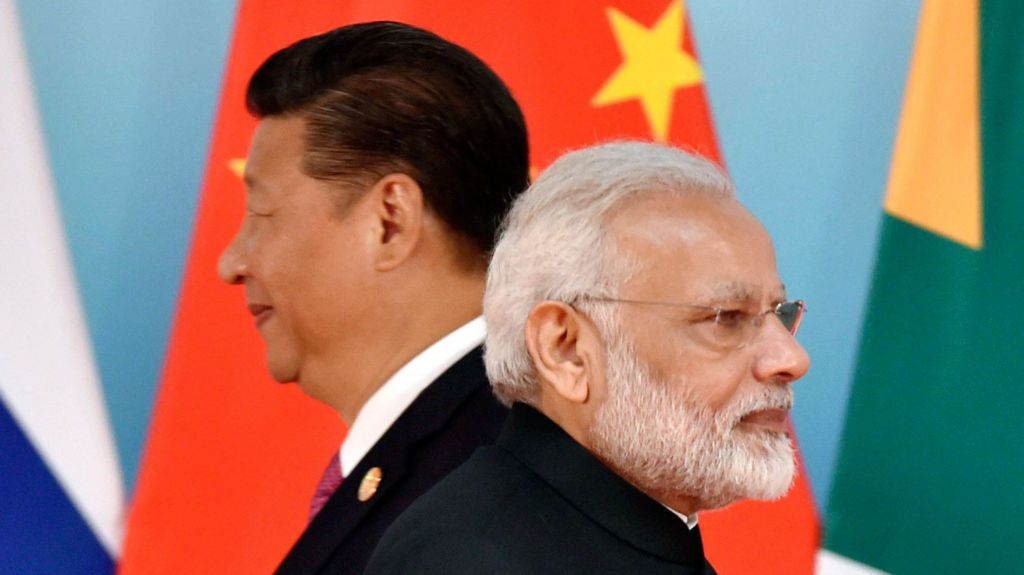
After four years of strained bilateral relations sparked by the deadly 2020 Galwan Valley border clash, India and China appeared to be on a cautious path to diplomatic detente in 2024, with high-level engagements, restored direct flights, and eased post-conflict visa restrictions stoking widespread optimism for full ties normalisation. Chinese President Xi Jinping’s September visit to India for the BRICS summit, his first trip to the South Asian nation in seven years, was widely hailed as a landmark milestone marking the end of the post-2020 freeze. However, recent on-ground developments along the 3,440-kilometre undemarcated Line of Actual Control (LAC) have exposed how precarious that perceived thaw truly is.
The controversy erupted after Shatrujeet Singh Kapur, Director General of India’s Indo-Tibetan Border Police (ITBP), made uncharacteristically public remarks at a recent officers’ gathering in Rajasthan, revealing that Chinese troops had begun advancing into India-claimed territories in Arunachal Pradesh as early as July 2025. Kapur stated that after initial mutual withdrawal following the first round of face-offs, Chinese forces returned in far larger numbers, setting up permanent encampments 6 to 7 kilometres inside the section of the LAC that New Delhi recognises as its sovereign territory. Such public disclosures from active serving security officials are extremely rare in India, as sensitive border matters are traditionally handled exclusively through formal channels by the national defence and external affairs ministries, immediately triggering a fierce domestic political backlash in New Delhi.
The long-simmering Himalayan border dispute dates back to the 1947 partition of British colonial India, and resulted in a full-scale 1962 Sino-Indian border war that ended in a crushing military defeat for India. To this day, the LAC remains a loosely defined, unmarked boundary, with overlapping territorial claims on both sides compounded by the region’s unforgiving, rugged terrain of shifting river courses, glacial lakes, and permanently snow-capped peaks that make formal demarcation nearly impossible. China has long laid formal claim to the entire state of Arunachal Pradesh, asserting it is part of southern Tibet, a position New Delhi has consistently and categorically rejected, framing the state as an inalienable core part of Indian national territory.
The 2020 Galwan Valley clash marked the first fatal confrontation between the two nuclear-armed neighbours in 45 years, leaving 20 Indian and 4 Chinese soldiers dead, and prompting a near-total breakdown of bilateral diplomatic, travel, and trade ties. After 20 rounds of tense military and diplomatic negotiations, both sides agreed in early 2024 to take incremental steps to de-escalate border tensions and gradually restore normal bilateral exchanges. The latest reported troop incursions have completely upended that fragile progress, with India’s main opposition Congress party launching scathing attacks on Prime Minister Narendra Modi’s administration, accusing it of remaining conspicuously silent on the alleged territorial encroachments and making unacknowledged concessions to Beijing. Senior Congress leader Jairam Ramesh posted on social platform X that the prime minister and his entire governing apparatus had failed to address the grave national security threat posed by the new Chinese deployments.
The Indian federal government has not issued an explicit refutation of the ITBP chief’s on-ground claims, with External Affairs Ministry spokesperson Randhir Jaiswal only noting that border stability is periodically disrupted when Chinese forces deviate from long-established mutual patrolling protocols, and affirming that both nations are employing joint military and diplomatic working groups to resolve outstanding border grievances without providing specific operational details. For its part, China’s Foreign Ministry maintained that it has always strictly abided by all existing bilateral border agreements, and that its patrol activities in the region are routine, legitimate exercises to safeguard national territorial sovereignty.
Veteran Indian diplomats and military analysts have framed the new border posturing as part of a broader, increasingly assertive pattern of Chinese military probing along the LAC designed to create new de facto facts on the ground without triggering a full-scale armed conflict. Former Indian Foreign Secretary Shyam Saran, who led multiple rounds of Sino-Indian border negotiations in the mid-2000s, noted that these incremental incursions are calibrated to fall just below the threshold that would spark open warfare, while steadily expanding China’s effective control over disputed zones. Retired senior PLA colonel and Tsinghua University scholar Zhou Bo added that both nations have drawn critical lessons from the 2020 Galwan bloodshed, and are intentionally taking measures to avoid a repeat of large-scale violent clashes, a dynamic that has allowed gradual, low-level territorial encroachment to proceed largely unreported in Chinese domestic media.
Beyond the immediate border standoff, the renewed tensions are casting a long shadow over the complex, deeply intertwined Sino-Indian economic relationship. Bilateral trade hit $151 billion in 2024, with a lopsided trade balance heavily favouring China, which accounts for the vast majority of India’s imports of critical industrial inputs including heavy machinery, electric vehicle batteries, rare earth magnets, and active pharmaceutical ingredients. Recent Chinese export restrictions on tunnel-boring machines, imposed on vague national security grounds, while not explicitly targeted at India, have already created major bottlenecks for New Delhi’s ambitious national infrastructure expansion plans, following similar 2024 curbs on rare earth magnet exports that disrupted Indian EV, renewable energy, and medical device manufacturing supply chains. University at Albany international relations professor Christopher Clary argues that current Chinese strategic policy toward India is intentionally structured to slow India’s technological and industrial rise by restricting access to core advanced components and materials.
For the tens of thousands of civilian residents living in remote Himalayan border villages, the latest escalation has immediate, tangible daily consequences. Local Arunachal Times senior journalist Tongam Rina reports that many high-altitude traditional grazing grounds and hunting zones that local communities have relied on for generations are now effectively off-limits due to Chinese military encroachments, barring villagers from accessing land used for yak rearing and subsistence activities and fostering widespread, pervasive public insecurity across border settlements.
Strategic analysts also warn that the simmering border tensions carry far broader global geopolitical ramifications, as the second Donald Trump administration’s stated priority of deepening U.S. economic engagement with China is widely expected to reduce Washington’s willingness to offer unqualified diplomatic or military backing to India in the event of a future large-scale border confrontation. Most experts agree that Beijing has no immediate interest in launching a full-scale war with India, but a prolonged, low-intensity stalemate along the LAC works to China’s long-term strategic advantage, as its rapidly growing economic and military power will leave it in an increasingly dominant negotiating position over time. The latest troop standoffs serve as a stark reminder that superficial diplomatic goodwill and high-profile bilateral summits have not translated to tangible, lasting stability along one of the world’s most dangerous active disputed borders.