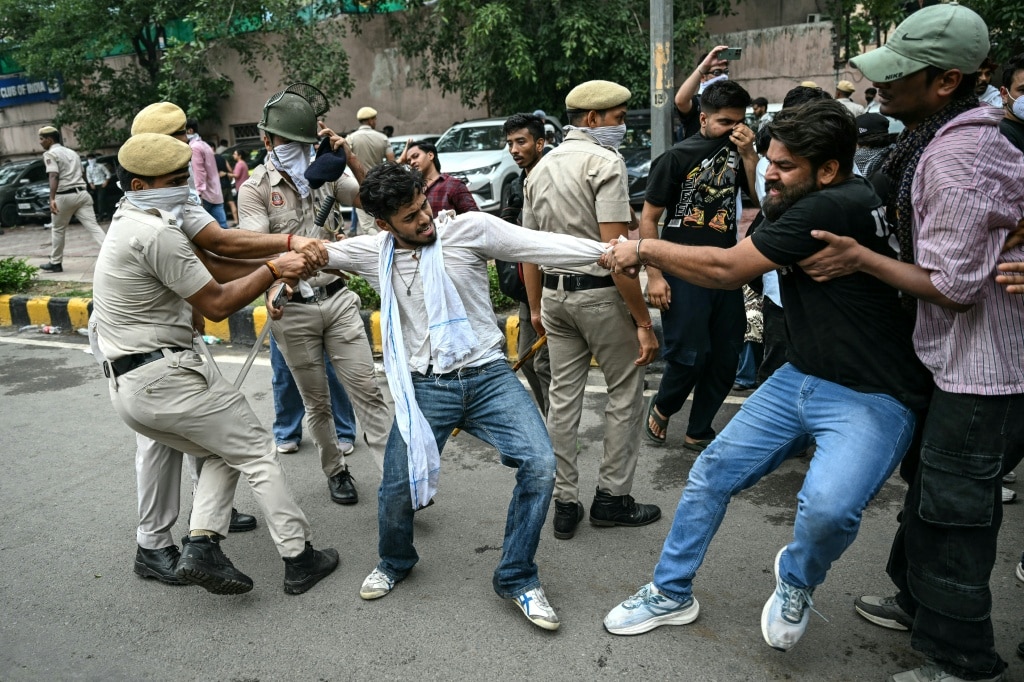
Just days after a wave of nationwide youth-led protests forced India’s federal education minister to step down over widespread public anger over recurring competitive exam failures, the organizers of the movement have issued an ultimatum to authorities: free all detained demonstrators or face a resumption of mass unrest.
The grassroots movement, known informally as the “Cockroach Movement” organized under the banner of the online Cockroach Janta Party (CJP), rose to national prominence in recent weeks after mobilizing tens of thousands of students across the country to protest persistent exam paper leaks and systemic irregularities in India’s competitive examination system. On Monday, CJP representatives confirmed that they have received widespread reports of student detentions, with the highest numbers concentrated in the northern and eastern states of Assam, West Bengal, and Bihar.
CJP leaders accuse the national government of breaking a formal agreement reached in the early stages of negotiations, where authorities pledged that no punitive legal action would be taken against peaceful participants in the protests. “If the government does not honour the agreement and release everyone detained or arrested, we will be compelled to resume the protest,” CJP spokesperson Ashutosh Ranka told reporters on Monday.
The ultimatum comes just 48 hours after Dharmendra Pradhan formally resigned from his post as education minister, a move driven by sustained public pressure over repeated high-profile mismanagements of national competitive exams that have left millions of young job-seeking Indians frustrated and disillusioned with the ruling government.
As of Monday evening, the national government has not released an official public statement responding to the CJP’s demands. However, law enforcement officials in Bihar, one of the states at the center of the protests, announced late Monday that “no adverse legal action” will be initiated against any protest participants, and that all people arrested or detained in connection to the Bihar protest actions would be immediately released.
CJP estimates that at least 100 protesters have been arrested across the country, with many slapped with stringent non-bailable criminal charges that could lead to lengthy prison sentences if convicted. In response, the movement has established a dedicated national legal fund to cover court and legal expenses for protesters who have been charged by police, CJP spokesperson Saurav Das confirmed.
The decentralized youth movement was first launched in May of this year by Abhijeet Dipke, a 30-year-old public relations graduate, and has already amassed millions of followers across major social media platforms as it tapped into widespread discontent among India’s large youth population over limited job opportunities and systemic flaws in the country’s education and examination systems. Last week, tens of thousands of protesters, the vast majority of them students, held mass rallies in New Delhi and other major urban centers, explicitly calling for Pradhan’s resignation and sweeping structural reforms to India’s examination system.
Tensions boiled over on July 20, when a large demonstration in New Delhi that attempted to march from the popular protest site Jantar Mantar to the Parliament building descended into violence. Police responded to the unauthorized march by firing tear gas canisters and charging crowds with batons to disperse protesters, triggering widespread clashes and a large wave of detentions that followed the confrontation.
In Bihar’s Siwan district, a senior police official was suspended over the weekend after he used an assault rifle to disperse a crowd of student protesters, leaving three people injured who are currently receiving medical care, Bihar Police Superintendent Puran Kumar Jha confirmed to AFP on Monday.
The actions by law enforcement have sparked widespread condemnation from political opposition leaders and judicial officials alike. A petition alleging widespread police brutality during the protests was filed with India’s Supreme Court, prompting Chief Justice of India Surya Kant to order an independent investigation into the claims. Local media outlets quoted Kant affirming that the “right to peaceful, lawful protest is absolutely guaranteed” under India’s constitution, adding that “if there is excess committed, it should be independently examined… discipline is integral to democratic process.”
The controversy dominated proceedings in India’s Parliament on Monday, with repeated disruptions to legislative business as opposition lawmakers demanded the ruling government issue a formal response to last week’s police crackdown. Mallikarjun Kharge, national president of the main opposition Indian National Congress, described the crackdown on student protesters as “one of the gravest assaults on democracy in our history” in a post on the social media platform X. “Never before have students been beaten, dragged, and treated like criminals for raising their voices,” Kharge wrote.
Despite the parliamentary disruptions, the ruling government managed to introduce new legislation in the lower house of Parliament on Monday that would impose harsher criminal penalties for anyone involved in stealing or leaking competitive examination question papers, a long-standing demand of the protesting students.