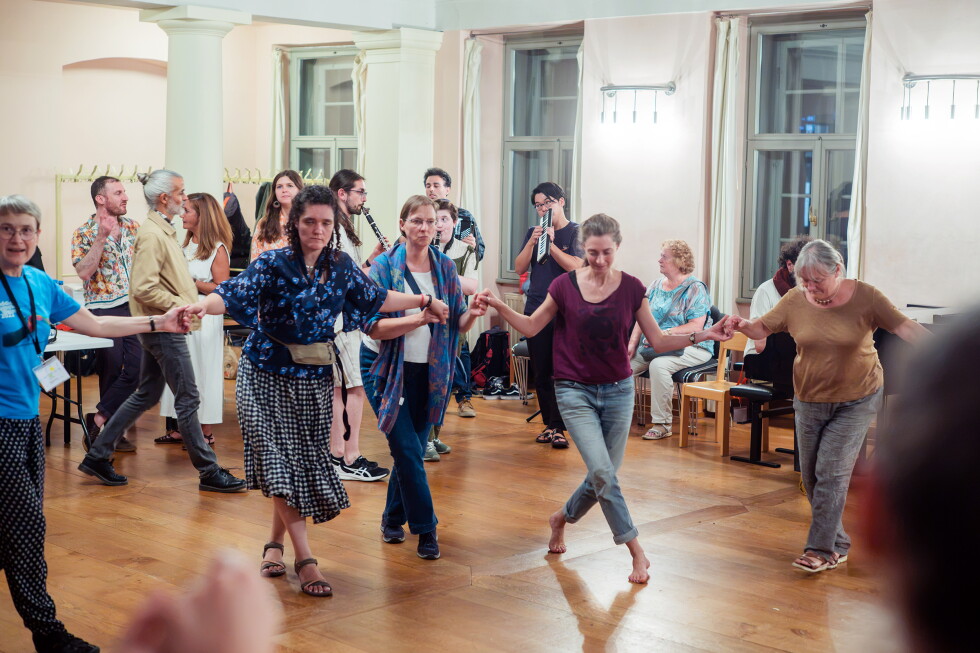
Nestled in central Germany, Weimar is a city etched into global cultural memory: it is the birthplace of the German Enlightenment, the creative home of Johann Wolfgang von Goethe and Franz Liszt, and the namesake of the fragile democratic republic that collapsed to open the door for Nazi Germany. For more than 25 years, however, a distinctly different, once-thought-lost European cultural tradition has filled its streets and performance venues: the vibrant language, music, and heritage of Yiddish.\n\nFounded in 1998 by composer and cultural scholar Alan Bern, who still serves as artistic director, the annual Yiddish Summer Weimar festival has grown from a small weekend workshop for a handful of participants to Europe’s largest gathering dedicated to Yiddish culture. Drawing hundreds of students, musicians, and scholars from across the globe, the month-long event combines immersive language workshops, skill-building musical training, and nightly public concerts that draw a combined audience of more than 10,000 people annually. All of it centers on a core mission: to frame Yiddish culture as a living, evolving tradition, not just a footnote to the Holocaust that nearly eradicated it.\n\n“From the beginning, the idea was to present Yiddish culture as something which is alive, and not something that was entirely destroyed by the Shoah,” Bern explained. Unlike the aristocratic roots of many Western European classical traditions, Bern notes Yiddish culture emerged from the masses of Jewish communities across the continent. “Jewish culture, Yiddish culture, has a different yichus than Western European classical culture. It came not from the courts of the aristocracy but the masses of the Jewish street, and he believes it’s one of Europe’s great cultural treasures nonetheless.”\n\nA millennium of Yiddish history\nYiddish first emerged around the 10th century among Ashkenazi Jewish communities in the Rhineland, in what is now western Germany. As these communities migrated eastward across Central and Eastern Europe, settling in what would become Poland, Lithuania, Ukraine, and Hungary, the language evolved: it retains close linguistic ties to German, but integrates Hebrew, Aramaic, and Slavic vocabulary and grammatical structures. By 1939, more than 11 million people around the world spoke Yiddish, making it the primary language of the vast majority of European Jews. Over centuries, it fostered a rich, distinct ecosystem of literature, folk music, political thought, and art — a world that was almost entirely destroyed during the Holocaust.\n\nToday, Yiddish is experiencing a quiet 21st-century renaissance, with growing demand across diverse communities. It remains the native language of expanding ultra-Orthodox and Hasidic Jewish communities from New York to Israel, spurring a boom in contemporary Yiddish pop culture, from rap music to graphic novels and new periodicals.\n\n“We have a huge Hasidic pop culture, a contemporary pop culture, which is growing day by day, and where you see often mixing of different elements,” said Eidel Malowicki, a Yiddish teacher at the festival who grew up in a Hasidic family in Vienna. “Now you even have Hasidic Rap, and it’s a repertoire that is growing every day. … there’s new comics coming out, new magazines.”\n\nThe revival also extends to secular Jewish communities and non-Jewish learners, for whom Yiddish fills unique personal and cultural gaps. For many young secular Jews in Israel, Yiddish offers a broader lens to explore Jewish identity outside the narrow, Hebrew-centric Zionist narrative many have grown disillusioned with.\n\nDan Kedem, a volunteer at this year’s festival who traveled from the Tel Aviv area, called Yiddish “a sort of path of redemption from the reality that I grew up in within Israel.” “The Jewish story taught to me in Israel was linear and narrow,” he explained. “So one of the things that I found most fascinating about Yiddish is that exploration of this other Jewish culture, identity and root system of paths and ideas has allowed me to explore my own identity through a much wider lens and open myself to new ideas and new thoughts.”\n\nAcross the globe, access to Yiddish language learning has exploded. The Yiddish academic journal *Ingeveb* projects that more than two dozen Yiddish-focused programs, camps, and festivals will run globally in summer 2026 alone. Popular language-learning platform Duolingo reports its Yiddish course now counts nearly 300,000 active users, most of them under 25.\n\nBridging divided cultural worlds in Weimar\nRoughly half of Yiddish Summer Weimar’s participants are not Jewish, and many are German locals seeking to reconnect with a cultural heritage erased from their national history. Michael Panzner, an intercultural consultant from Frankfurt, told the festival he grew up never meeting Jewish people in Germany, and long saw Jewish culture as a “secret” an important, overlooked part of his country’s history. At Yiddish Summer Weimar, he found a judgment-free space to explore that missing part of his national identity.\n\n“I think Yiddish is being given way too little attention in today’s cultural life and social life,” Panzner said.\n\nFor Malowicki, whose native Hasidic Yiddish dialect is rarely taught by native speakers in global programs, the festival fills a critical role as a bridge between divided cultural communities. “I see it as a chance to create a bridge between worlds that otherwise wouldn’t have a bridge or a connection,” she said. “I think that there’s a lot that we can learn from one another and our different worlds.”\n\nOrganizers frame the festival through a transcultural, transnational lens, rejecting the common misperception of Yiddish as an isolated culture only connected to remote Eastern European shtetls. To advance that mission, they regularly collaborate with artists and communities outside Ashkenazi Jewry: past projects have included youth orchestras from Poland and France, while this year’s event featured the Yam Ensemble, a collective of young musicians from Germany, Greece, and Turkey that explores shared cultural roots between Mediterranean folk and Klezmer music.\n\nWhy Weimar? It is not a historic center of Yiddish life, unlike Warsaw, Vilnius, or Krakow, but Bern and other organizers argue it is the perfect home for the festival. The city is defined by two conflicting legacies: it is the heart of German high culture, and also a cradle of 20th-century fascism: Adolf Hitler rebuilt the Nazi Party here in 1926, and today the surrounding state of Thuringia is the strongest base for the far-right, neo-Nazi-linked Alternative for Germany party.\n\n“It’s very ironic to think that here is a place that has a large Yiddish music festival, maybe one of the biggest in the world, and sold out concerts and everything, and it’s this same environment in which there’s a neo-Nazi movement that is just growing all the time,” Bern noted.\n\nEven as a cultural hub, Weimar is the ideal place for Yiddish, festival curator Andreas Schmitges argues: the city has long been celebrated as a center of German *hochkultur* (high culture), from Goethe and Schiller to Liszt and the Bauhaus movement. But Yiddish culture deserves to be counted among Europe’s great high cultural traditions too, he said.\n\n“To be honest, I think that Yiddish culture is right here in the right place where it belongs because it’s also one of Europe’s hochkulturen, so this is a perfect place,” Schmitges said.\n\nThis year’s festival ran from July 11 to August 15, with the main public concert week held from August 8 to 15, carrying forward a 25-year mission of reviving a living culture that refuses to be defined only by tragedy. “We’re not in a constant posture of mourning the past,” Bern said. “We’re also living and creating, so the fact that we’re talking about a living, creative culture, which is not in denial of the past, but also not stuck in the past, was, I think, surprisingly refreshing to people already in 1998, and it still is today.”