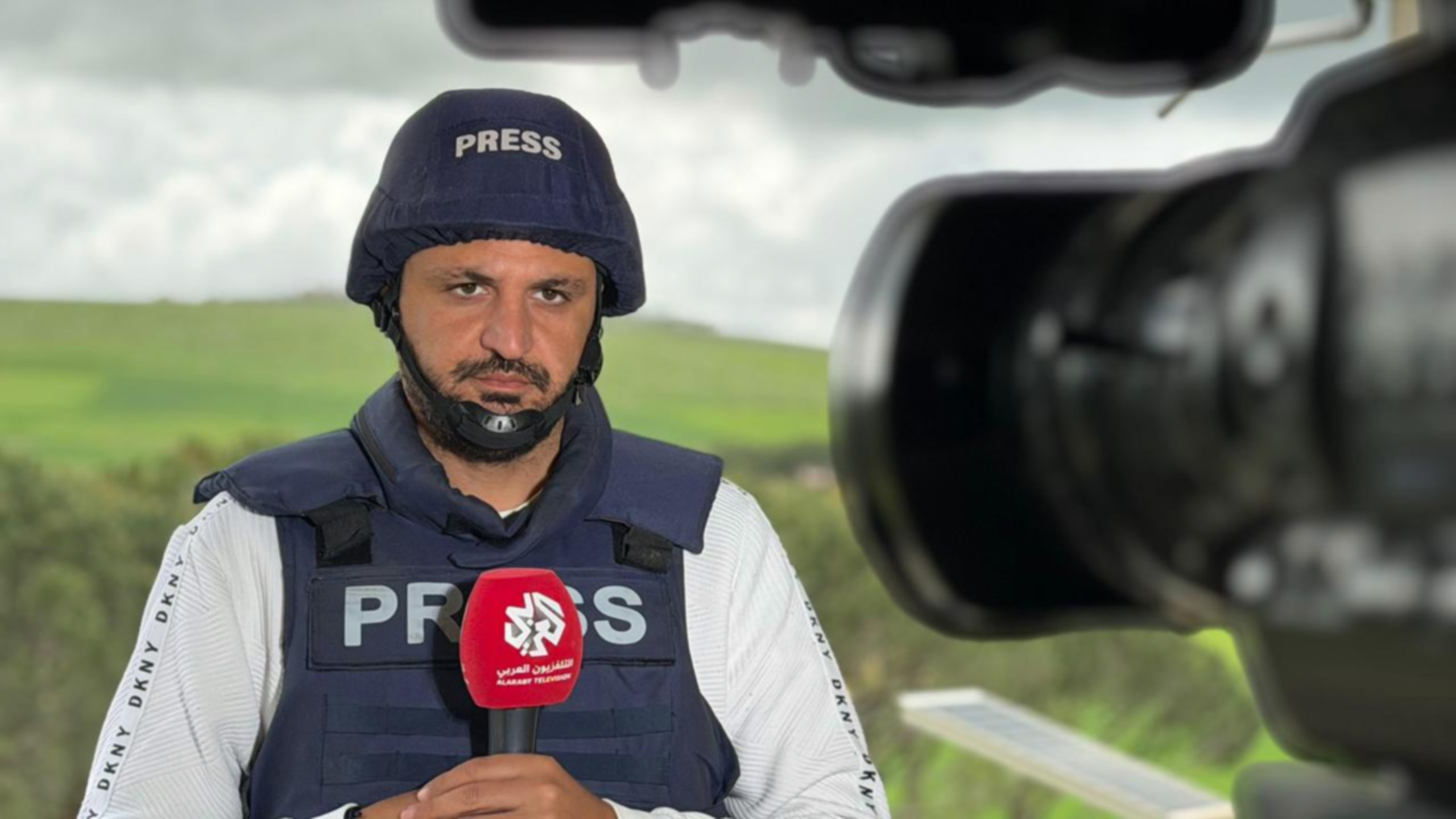
Editor’s note: This is a firsthand personal narrative from Ramez El Kadi, a Lebanese journalist who has reported from the front lines of Israel’s military campaign in southern Lebanon since the offensive first launched in October 2023.
Every trip I take down to southern Lebanon is far more than a simple commute between two urban centers. It is a profound mental shift between two very different realities of the journalistic calling: the profession we dreamed of when we first took up our notebooks, and the dangerous, altered version forced on us by years of Israel’s war.
Gone are the days when a protective vest and helmet were just optional safety gear for high-risk assignments. Today, they are as fundamental to my daily work as the camera in my hand, the notepad in my pocket, and the microphone I use to capture testimony.
Each morning, I try to frame my shift as just another routine day of on-the-ground reporting: another assignment I will finish, another trip I will return home from safely. But the old normal died the moment our colleagues became intentional targets. Now, reporting the news is no longer just a job of documenting and transmitting events. It is a constant, personal battle against the gnawing fear that rides with me and my team in the back of our car, hanging thick in the long silences broken only by anxious messages from loved ones: Why do you keep going back? Aren’t you scared? Haven’t decades of frontline work been enough?
In the early years of my career, danger had clear boundaries. I first encountered it in northern Lebanon, in Tripoli, during waves of internal unrest. Back then, threats were tied to specific locations, specific streets, and gunfire with traceable origins. You could map the risk and adjust your steps accordingly.
Today, that certainty is gone. Journalists are now explicitly listed on Israeli target banks. The repeated deliberate attacks on my colleagues have created a terrifying new reality: simply holding a camera, or reporting a story that contradicts the narrative pushed by those wielding military power, is enough to put a reporter in the crosshairs.
This truth was driven home on March 19, when RT correspondent Steve Sweeney and cameraman Ali Rida Sbaiti narrowly survived an Israeli strike near southern Lebanon’s Qasmiyeh Bridge. The pair were clearly marked as press, on assignment to cover earlier Israeli attacks on the strategically critical crossing.
For every frontline reporter in southern Lebanon, stepping out to work each day is now an existential choice, not just a professional one.
This is the most fundamental shift the war has wrought: danger no longer depends on which road you take, how close your broadcast position is to clashes in the border town of Khiam, or how many kilometers separate you from the front lines. The very equipment we carry to bring the truth to the world can, in an instant, become a death sentence.
Beyond safety protocols and security briefings, a deep psychological shift has rewired how Lebanese war correspondents prepare to do their jobs now. Standing in front of a camera today requires carrying a double awareness: you are conscious of the violence unfolding around you, and you are also acutely aware that you could become the story yourself.
Nothing highlighted this shift more sharply than the day we lost Issam Abdallah, the Reuters photojournalist killed in a deliberate Israeli strike in Alma al-Shaab. That strike, on October 13, 2023, changed everything.
Just hours before the attack, Abdallah and I stood with a group of fellow journalists scouting for a vantage point to film Israeli bombardment across the border. We split up to our positions, and everything felt routine. We were just journalists doing our jobs, unaligned with any fighting faction. Back then, the question we would have asked was simple – and in hindsight, it is devastating: why would we be targeted?
I was reporting live from a residential rooftop when an Israeli tank across the border opened fire. “It looks like the Israelis hit a house or possibly a car, judging by that thick black smoke,” I said on air, just minutes before I learned the strike had hit a group of my colleagues – all clearly, visibly marked as members of the press.
Issam was the first journalist Israel killed in Lebanon after it launched its 2023 offensive across the border. Six other reporters were wounded in that same attack. A little over a month later, journalists Farah Omar and Rabih al-Maamari were killed in an Israeli strike on another southern Lebanese town. Less than two weeks before this account was published, Fatima Ftouni and Ali Choeib were killed in a series of targeted strikes that hit their car as they traveled through Jezzine.
According to United Nations experts, at least 259 journalists and media workers have been killed by Israeli forces since 2023. That toll includes 210 Palestinian journalists in Gaza and 14 Lebanese journalists, with at least 64 of those deaths confirmed as deliberate targeted killings.
The consistent targeting of reporters has turned the constant, low hum of Israeli drones that fills southern Lebanon’s sky into a permanent, chilling warning: we are being watched. The split second of silence before a strike is no longer just anticipation of harm coming for someone else; it is the quiet dread that the next strike could be for you.
And even so, I keep going back.
I return because war cannot be reduced to a count of strikes or maps of territorial control. The real story is in the faces of ordinary people, who are erased by the dry, clinical language of military communiques. In the border villages, amid the rubble and the smoke, there is always a mother searching for her missing child, a family standing in front of what was once their home, now reduced to rubble. There are survivors who only want someone to listen to them before they are swallowed up by statistical tallies of the dead, by rhetoric that erases their humanity.
In this context, the journalist’s role is far bigger than just reporting the day’s news. We are witnesses to crimes unfolding before our eyes. We are the people tasked with pulling ordinary people’s stories out from under the fire, and carrying them to the rest of the world.
We do not go back into the field because we have no fear. We go back because we know what it would mean if this war went unwitnessed, if no one was there to hold the powerful to account.
At the end of every day, once the camera is turned off and the only sound is the quiet of the night, I find myself answering that same question from loved ones, over and over. This is why I return. Not because I seek out danger, but because war cannot be left to the people who want to bury its truth and silence its victims.