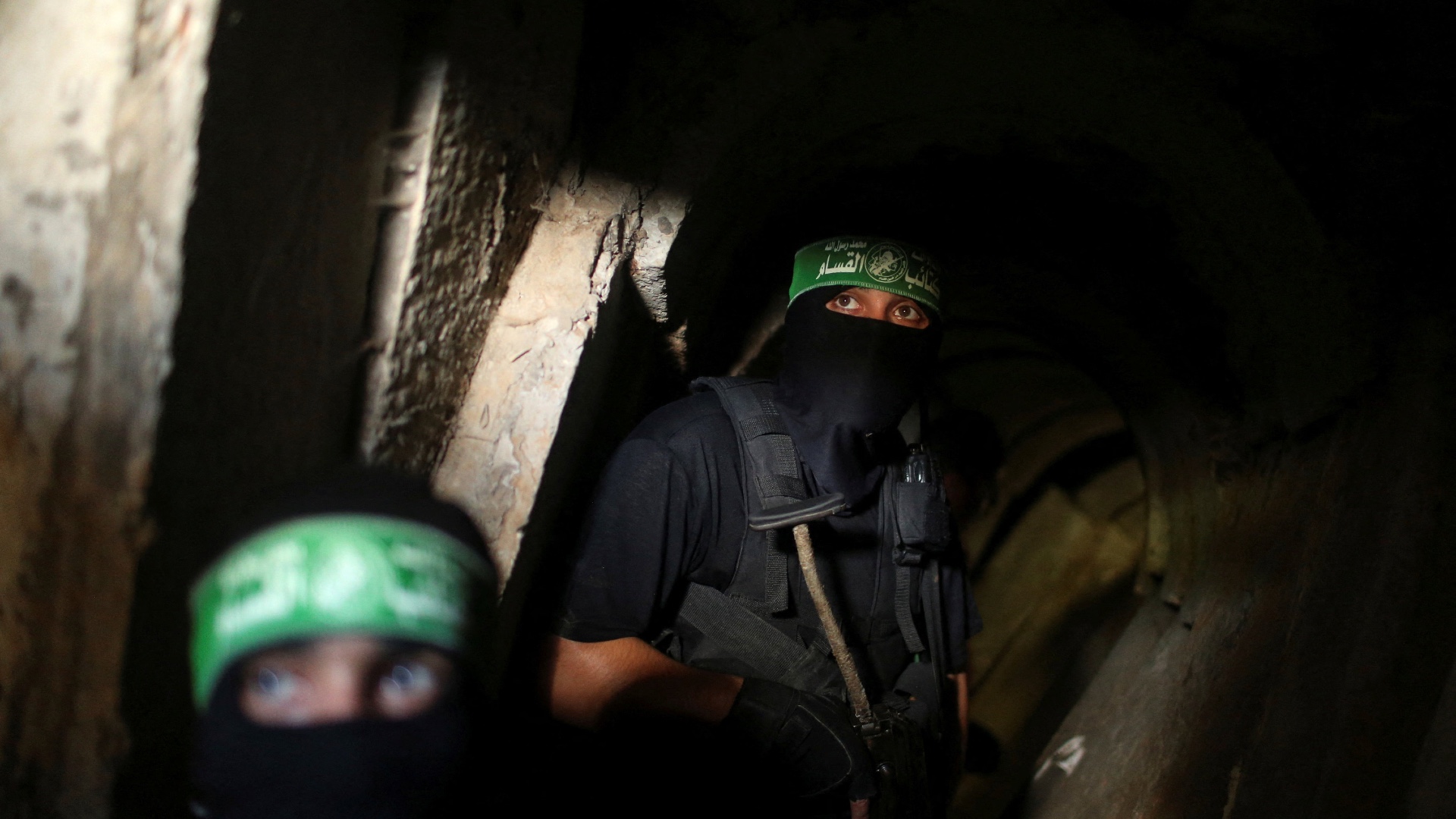
A public discrepancy between U.S. President Donald Trump and the Board of Peace, an organization Trump himself serves as lifetime chairman of, has emerged over who will take control of weapons as Hamas implements its pledged disarmament in Gaza, injecting new uncertainty into a fragile ceasefire framework announced last week. The contradiction arose during Trump’s first on-camera press availability at the Camp David presidential retreat in Maryland, where a reporter asked who would assume custody of Hamas’ weapons as part of the disarmament plan. When asked whether the weapons would transfer to a new Palestinian governing body, Trump flatly stated the Board of Peace would oversee collection of the armaments, praising the body as an extraordinary initiative led by exceptional leaders.
What made Trump’s remarks notable is that just hours before the press conference, the Board of Peace had published a public statement on social platform X outlining a very different arrangement. The board’s framework laid out a roadmap of full demilitarization, de-radicalization, and a full transfer of all civilian and security governing authority in Gaza to the National Committee for the Administration of Gaza (NCAG), a Palestinian technocratic body. It explicitly emphasized that only the NCAG would be authorized to hold, store, and control all weapons within the Gaza Strip. This wording was widely viewed as a deliberate compromise to win Hamas’ support for the plan, as the group has long insisted it will only engage with Palestinian institutions to advance Palestinian national unity.
The conflicting claims have highlighted the growing confusion surrounding the disarmament plan, which was first included in Trump’s 20-point Gaza proposal released last year. Analysts and insiders have offered conflicting assessments of whether the contradiction is a meaningful rift or simply a misstatement of process. Guy Ziv, associate director of the Meltzer Schwartzberg Center for Israel Studies at American University, framed the discrepancy as just the latest example of the chaotic and uncoordinated nature of the current proposal.
However, Bishara Bahbah, a Palestinian-American former leader of Arab Americans for Trump who served as a key backchannel between Hamas and Trump’s negotiating team ahead of the October ceasefire announcement, pushed back on the idea of a major conflict. He argued the two statements are not contradictory, explaining the Board of Peace’s reference to the NCAG means the technocratic committee will collect the weapons before transferring them to a third party, most likely Egypt, where the weapons will be permanently removed from Hamas’ access. “It’s not a contradiction. The Board of Peace would collect [the weapons], meaning the technocratic committee that would run Gaza, and they’re not going to keep them themselves. They’re probably going to hand them to some other party, most likely the Egyptians. And the Egyptians, once they have those weapons, those weapons are gone. Meaning Hamas is not going to ever see them again,” Bahbah told Middle East Eye.
Even as stakeholders work to resolve the confusion over the weapons handover, the broader plan remains far from a finalized, actionable agreement, existing more as a broad roadmap than a step-by-step implementation schedule. Hamas clarified on Friday that its commitment to full disarmament of all Palestinian factions in Gaza is conditional on both the U.S. and Israel honoring all commitments outlined in the 10 October ceasefire deal. As of Friday, Israeli drone strikes continued across Gaza, leaving at least two Palestinians dead. Ghazi Hamad, a senior Hamas representative, told Reuters that the group will retain its weapons until Israel halts all military operations, allows expanded entry of humanitarian aid and commercial goods into Gaza, and withdraws all Israeli military forces from the enclave.
When asked what assurances he had received from Israel that it would comply with its obligations under the plan, Trump told reporters he has a standing understanding with Israel, and that “Israel is very happy about it. Israel helped us, and they’ve been very good.” But Israeli officials have openly rejected the plan, creating a major hurdle to implementation. Michael Koplow, chief policy officer for the Washington-based Israeli Policy Forum think tank, wrote on X that he believes Israel’s current strategy is to publicly approve the framework to shift blame to Palestinians if talks collapse. “Israeli strategy with Trump has been [to] say yes, count on the other side saying no, and assign the blame when nothing moves forward onto the Palestinian side,” Koplow noted.
Israeli National Security Minister Itamar Ben-Gvir went further, publicly stating that the Israeli government has not agreed to any terms of the plan. “The draft agreement published by the ‘Peace Council’ is not acceptable to Israel,” he wrote in Hebrew. “The targeted killings in Gaza must continue, encouraging emigration must happen, Israel must win.” With Israeli national elections scheduled in less than two months, incumbent Prime Minister Benjamin Netanyahu has faced strong political pressure to avoid any perceived concessions on issues related to Palestinians, making compromise on the disarmament plan unlikely in the near term.
Bahbah argued that the plan can only move forward if Trump personally intervenes to pressure Israel to comply, noting that current Secretary of State Marco Rubio is widely seen as unilaterally pro-Israel and hostile to Palestinian interests, actively working to block progress on issues such as allowing Palestinians to travel to the U.S. “Unless the president himself is convinced… into making this a priority, Israel is going to find one excuse after the other,” Bahbah said.
Beyond the immediate dispute over weapons collection, analysts have questioned the Trump administration’s long-term vision for Palestinian statehood, a core demand of nearly all Board of Peace stakeholders, particularly Arab, Muslim, and European partners. “What is the vision that the administration has? They’re not really using the two-state discourse that has been used for 25 years since Bill Clinton,” Ziv noted. “How are they going to square the circle here? Netanyahu is not going to agree… to a Palestinian state. That’s not happening.” Previous reporting from Middle East Eye has indicated the Trump administration may be willing to delay progress until after the Israeli election, waiting to see if Netanyahu is voted out of office.
While it remains uncertain how fully Hamas will implement disarmament as long as Israeli military threats persist, the current draft plan calls for Hamas to first transfer its heavy weapons, including mortars and rocket launchers, followed by small arms such as Kalashnikov rifles. Bahbah noted that Hamas’ commitment to end weapons development, smuggling, and public military displays in Gaza was a difficult concession for the group, given that Israel has continued to violate ceasefire terms on a daily basis and target Hamas leaders in Gaza.
As of Thursday, Gaza’s Ministry of Health has confirmed that at least 73,341 Palestinians have been killed in Gaza since the 7 October 2023 attacks on southern Israel led by Hamas. More than 1,200 of those deaths have occurred after the 10 October ceasefire announcement, killed by Israeli sniper fire or airstrikes. Overall, more than 174,000 Palestinians have been wounded in the conflict.
Despite the domestic political hurdles in Israel and ongoing tensions, international reaction to the disarmament announcement has been largely positive, though tempered with calls for full compliance from all parties. Saudi Arabia, which has been seeking a normalization agreement with Israel that was derailed by the 7 October attacks, described the Board of Peace announcement as historic. “The Kingdom commends President Trump’s leadership and steadfast commitment, which have been instrumental in achieving this significant milestone,” the Saudi foreign ministry said in a statement. “The Kingdom also emphasizes the importance of the full withdrawal of Israeli forces from the Gaza Strip, the deployment of the International Stabilization Force, and the continued, unhindered delivery of humanitarian assistance and reconstruction support to the Palestinian people.”
Kaja Kallas, European Union High Representative for Foreign Affairs and Security Policy, called the developments constructive, while noting that significant challenges remain. “A lot needs to fall in place for this to work. Success depends on the full commitment of all parties. Verifying Hamas’ compliance will be a significant challenge. Israel would need to eventually withdraw from Gaza,” Kallas wrote on X. She added that the EU remains Gaza’s largest humanitarian donor, having pledged €900 million in aid for Gaza recovery in July.
Pakistani Prime Minister Shehbaz Sharif, who is currently involved in mediation talks between the U.S. and Iran, welcomed the disarmament plan and called for full Israeli withdrawal. “The mediating countries including the United States of America, Egypt, Qatar, and Turkiye, deserve special appreciation for their efforts in achieving this progress. Under President Trump’s courageous leadership, this represents a significant achievement for the Board of Peace,” Sharif wrote. “Pakistan also hopes that these efforts will lead to the realization of the right to self-determination of the people of Palestine.”
Canada, which was disinvited from the Board of Peace by Trump after it criticized the body’s membership structure, also called the announcement an important step forward. “As one of the largest donors to the humanitarian crisis in Gaza and the West Bank, Canada stands ready to contribute to this effort,” Canadian Prime Minister Mark Carney wrote on X. “We remain committed to a just and lasting resolution to the Israel-Palestine conflict, based on a negotiated two-state solution in which Israeli and Palestinian people can live in peace, security and dignity.”