Five days after swimming across to the Spanish North African territory of Ceuta with her teenage sister and cousin, 20-year-old Moroccan migrant Dikra has no certainty of where her next meal will come from — all her meals so far have been donated by generous local residents. One thing she is completely sure of, however, is that she will not return to her home country. “I want to stay. I want to reach mainland Spain,” Dikra told reporters, requesting her last name be withheld to protect her family back in Morocco for safety reasons.
By Sunday afternoon, Dikra counted herself among the small group of remaining holdout migrants in Ceuta, after more than 59,000 of the 60,000 people who breached the Morocco-Ceuta border on Thursday and Friday of the previous week voluntarily crossed back into Morocco. The unprecedented mass crossing left at least 72 people dead during the dangerous journey, and the sudden humanitarian crisis sparked by the surge has reignited long-simmering debates over immigration policy across Europe and the rest of the globe.
For Dikra, the decision to leave Morocco grew out of urgent personal need. While she worked as a cleaner in the coastal city of Tangier, she fled her home to escape an abusive alcoholic father. She holds a professional diploma in hairdressing, and hopes to put that qualification to work building a new life in mainland Spain — a goal that remains out of reach for now, separated by the Strait of Gibraltar and the European Union’s layered, often slow-moving asylum system.
Migrants who have chosen to stay in Ceuta are left in limbo, with no clear information on what authorities will do with them next. Thirty-five-year-old Abdel Karim, another migrant from Morocco, waited outside Ceuta’s official migration reception center all day Sunday, desperate for any updates on his case. Karim was unemployed in Morocco, and had previously lived in mainland Spain years before the crossing. He was later expelled from France, where he had been living homeless on the streets after leaving Spain.
“In Morocco, I’m labeled a deportee,” Karim explained. “Anyone who has been deported knows what that label brings — constant stress, chronic depression, crippling anguish.” Karim said he saw viral social media posts about the mass border crossing, and chose to seize the chaotic window of opportunity. He crossed into Ceuta with just 10 euros in his pocket, and showed reporters his feet, blistered and sore from the long journey. He says he is willing to take any work he can find in Spain, and remains unshaken by the bureaucratic hurdles standing between him and the mainland.
Ceuta, along with its sister Spanish enclave Melilla on the Moroccan coast, is not part of the European Union’s Schengen Area of free movement. Any migrant seeking to travel from either enclave to mainland Spain must pass through mandatory official border checks and asylum processing before being allowed entry.
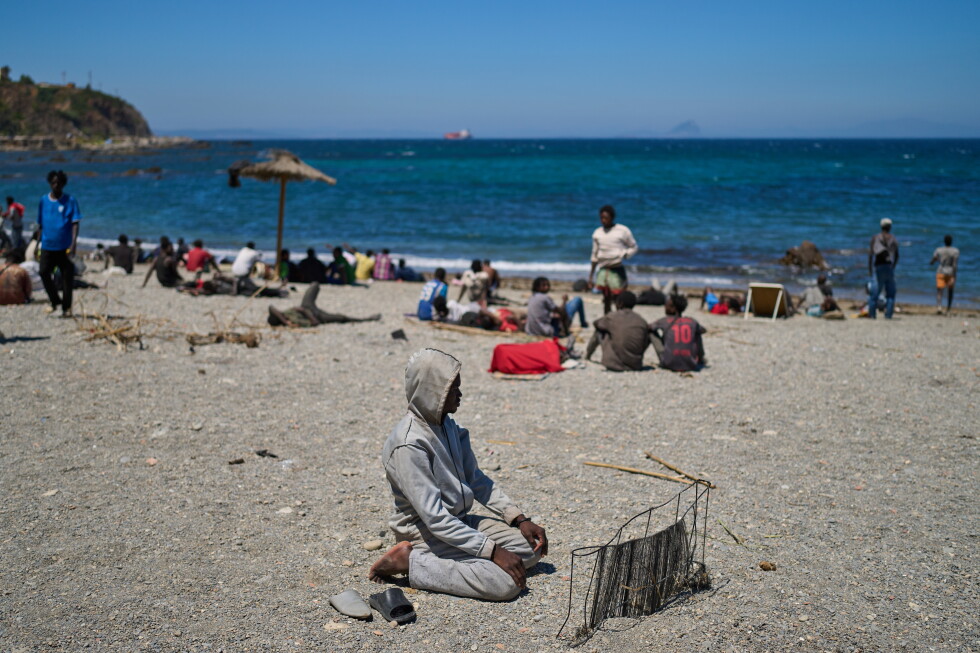
By Sunday evening, hundreds of recent arrivals gathered on one of Ceuta’s public beaches. Some clustered around military trucks as Spanish armed forces personnel distributed bottled water to the crowd. A short distance away, outside a local migrant shelter, 25-year-old Senegalese migrant Cesse Aliou rested with a group of other sub-Saharan African migrants who had made the crossing together. Aliou said he had worked at a call center in Morocco, earning roughly 279 euros ($322) per month, but the position was irregular and offered no long-term stability.
He traveled by train from Casablanca to Tangier, then on to the border town of Fnideq, before swimming the short distance across to Ceuta. Just a short distance from where Aliou rested, on a wooded patch of public land across the street from the shelter, a violent scuffle broke out between a group of migrants over access to drinking water that had been dropped off by local volunteers. “We are all exhausted here,” Aliou said, gesturing toward the ongoing fight. “Finding food, finding a place to sleep — it’s all incredibly hard right now. You can see for yourself what the situation is like.”