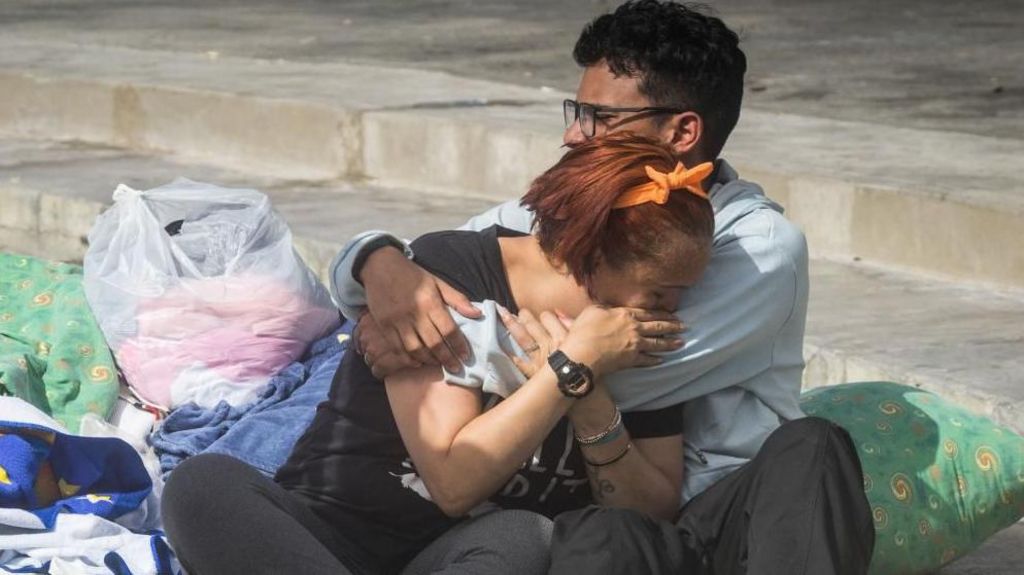
Venezuela is grappling with the devastating aftermath of back-to-back earthquakes that have left thousands homeless, scores missing, and communities across the capital Caracas and coastal regions reeling from widespread destruction. Days after the tremors hit, survivors wake each morning to a grimmer reality, as hopes of finding trapped missing loved ones alive continue to dwindle. Many have spent nights sleeping rough in public spaces, traumatized by nightmares of collapsing structures and haunted by their sudden loss.
For 50-year-old former police officer Jan Carlos Roa Garcia and his family, life has been upended overnight. While their Caracas apartment building did not fully collapse, severe structural damage has rendered it unsafe to reoccupy. Speaking through tears, Garcia said he feels lost about how to rebuild his family’s life after the disaster. “If I were 30 instead of 50, maybe I could start over. But I have no idea where to begin, and up until now, no government official has reached out to us,” he explained. Though exhausted and frustrated, the longtime public servant refrained from harsh public criticism of the official disaster response.
Local musician Zaira Castro, who lives just a block from two leveled buildings in the heavily damaged Chacao district of Caracas, had no such hesitation. “Everyone is deeply frustrated because the government has not delivered the urgent, serious support we need right now,” Castro said from a neighborhood plaza. “Right now, it is ordinary Venezuelans helping each other. We have learned to rely on one another because the government does not exist for us in moments like this.”
When interim president Delcy Rodriguez visited the Chacao area alongside the local mayor to assess the damage, she was met with open anger from displaced residents. One resident yelled at the delegation that officials were “campaigning in the middle of a tragedy” while the government did nothing to support affected families.
The reporter has a personal connection to the damaged area, having lived in Los Palos Grandes, one of the hardest-hit neighborhoods in Chacao, during their time as BBC Venezuela Correspondent. Their former apartment building sits just meters from the collapsed Petunia building, where rescue crews have worked around the clock to reach people trapped under the rubble. A friend recently shared on social media that her mother is among those still missing at the Petunia site. It was a small relief to find the reporter’s former apartment building, Alheli, still standing, with its friendly long-time caretaker Pedro still greeting residents on the front porch. Even among unharmed buildings, residents are shaken: one elderly resident twisted her ankle fleeing during the tremors, and all said they had never experienced a disaster of this scale in Venezuela in their lifetimes.
The desperation is far more acute in the worst-hit regions, particularly the coastal town of La Guaira, where more than 100 buildings have been completely flattened, leaving an apocalyptic landscape. As rescue efforts stretch past the critical 72-hour window, fading hopes have fueled growing public anger. “There are still people trapped under that concrete, we need heavy machinery to reach them,” pleaded Eileen Lada, a La Guaira resident who lost her home. “Please, send help.”
Amid the widespread despair, moments of hope have emerged: rescue teams, both local and international, have pulled several survivors out of the rubble, including a newborn baby rescued in a widely shared operation. Videos circulating on social media show rescue workers celebrating small victories with the characteristic determination and warmth of Venezuelan people, moments that have moved viewers across the country.
Local hospitals along the northern coast are already stretched to breaking point. Venezuela’s healthcare system has suffered from decades of systemic underfunding, and it is now being forced to respond to a disaster that would overwhelm even better-resourced nations. Doctors and nurses are working tirelessly in impossible conditions to treat the injured, but survivors’ accounts of their experiences paint a grim picture. “It was horrific – so many people dead, so many family members missing,” Maria Vargas, a survivor recovering from her injuries in a hospital bed, told AFP. “I lost my entire home, but we are alive, thank God.”
The first 48 hours after an earthquake, widely considered the most critical window for rescuing trapped survivors, has long passed. For a country that has already endured years of political and economic crisis, this disaster now stands as one of the darkest moments in Venezuela’s modern history.