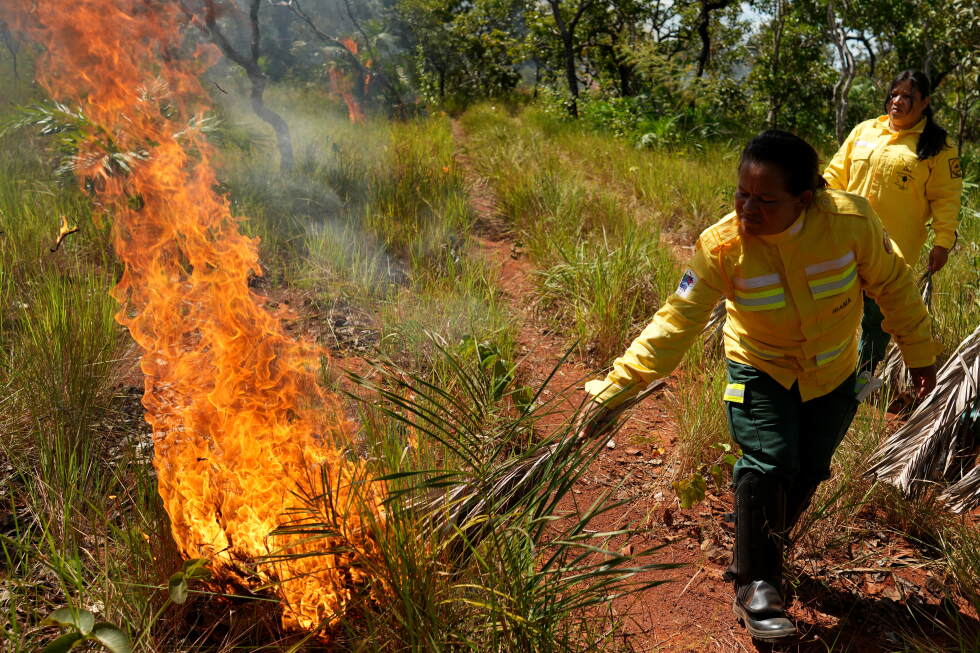
On a recent May morning in the remote Xerente Indigenous Territory of Brazil’s northern Tocantins state, a low crackle like distant rainfall drifted across the Cerrado, the sprawling savanna ecosystem that stretches across central and northern Brazil. Unlike the unplanned, destructive blazes that terrorize the region every dry season, these flames were intentional, part of a proactive wildfire prevention strategy forged through a historic collaboration between the Xerente people and Brazil’s federal environmental authorities.
This year, the work carries extra urgency: with an El Niño event approaching, forecasters warn of prolonged drought and soaring regional temperatures that will create perfect tinder for out-of-control wildfires, amplifying the annual risk the Xerente have faced for generations.
For decades, the Xerente and other Indigenous communities across Brazil faced systemic prejudice that dismissed their millennia of land management wisdom. Brazilian environmental policy for generations clung to a strict “zero-fire” doctrine, which labeled any controlled burn an illegal threat requiring immediate suppression. But over time, ecological research and shifting policy perspectives have revealed the critical role that low-intensity, controlled fire plays in the natural evolution of savanna ecosystems like the Cerrado. Today, that outdated approach has been replaced by a groundbreaking model: Indigenous ancestral fire management paired with modern scientific monitoring.
The 2026 controlled burn operation, carried out on May 19, brought together trained Indigenous firefighters and agents from IBAMA, Brazil’s federal environmental protection agency, to map and burn targeted areas of dry vegetation ahead of the August-September peak dry season. On the ground, Xerente firefighters carried on tradition, igniting small, controlled patches with dry palm leaves and drip torches, while a small airborne team dropped precision incendiary spheres from a government helicopter to reach mapped, hard-to-access areas. Crews stood by at all times to immediately extinguish any flames that threatened to spread beyond planned boundaries, leaving behind a patchwork of safely burned plots that will act as natural fire breaks when high-risk season arrives.
“The Xerente know this region, its climate, its vegetation, and the optimal windows to carry out burns better than anyone,” explained Marco Borges, the IBAMA agent coordinating fire prevention efforts across Tocantins. “We came to learn from their traditional knowledge, adapt it to our conservation goals, and align our work with their relationship to fire. They are our best teachers.”
Ecologists confirm this approach aligns with the Cerrado’s natural history. “Fire is a natural part of the Cerrado’s ecosystem, and many native species actually rely on periodic low-intensity burns to thrive,” said Leandro Maracahipes, a biologist and researcher at Yale University. Historically, natural blazes sparked by lightning occurred at the start of the rainy season, when fuel loads were low and fires stayed contained. But in recent decades, human activity—particularly clearing for surrounding soy and cattle farms—has shifted fire patterns, leading to far more intense, destructive blazes during the peak drought months of August and September.
By carrying out controlled burns early in the dry season, when vegetation is not yet fully parched, teams reduce the buildup of excess flammable grass that would otherwise feed catastrophic wildfires. The burned patches form protective barriers around villages, critical headwaters, and ecologically sensitive sites. As Maracahipes explains, the old zero-fire policy backfired dramatically: “Totally excluding fire leads to a massive buildup of fuel that feeds high-intensity burns. These intense fires can kill even the most fire-resilient trees and spread so rapidly across the landscape that firefighting becomes nearly impossible.”
The day of the operation opened with a traditional ceremony that highlighted the new collaborative dynamic between Indigenous leaders and government officials. When IBAMA convoys arrived at the Xerente territory, 30 Indigenous community members gathered at the people’s association’s wood-and-thatch headquarters, forming two facing parallel lines to create a ceremonial corridor. One line was made up of Xerente firefighters in official bright yellow brigade uniforms, while the other held community members, many shirtless with traditional body paint marking their connection to ancestral land. Together, they chanted traditional songs and stomped in rhythm, welcoming the official team to their territory.
Waiting at the end of the corridor was 68-year-old Lazaro Xerente, the community’s eldest traditional chief. Clad in a feathered headdress and bearing traditional body paint, he thanked officials for the collaboration but pushed back against the harmful misinformation that often plagues Indigenous communities after major fire events. “People say, ‘Oh, it’s the Indigenous people who are causing fires,’” he said through a translator. “But in reality, since I was born, and long before me, my ancestors have always protected this forest.” After major wildfires, out-of-context images of Indigenous controlled burns frequently circulate on Brazilian social media, falsely blaming communities for destruction that is in fact caused by unregulated clearing activity outside Indigenous territories. All burns in the current program are carefully mapped and monitored by joint fire management teams.
Planning for each day’s burns combines modern satellite mapping data with generations of Xerente knowledge of the territory’s terrain and ecology, a model that has been formalized through government partnerships dating back to 2014. Some Xerente firefighters are hired on two-year government contracts, receiving formal training and a monthly salary, while others volunteer their time. The program receives partial funding from a partnership between the Bunge Foundation and IBAMA, which supports training and equipment for up to 40 Indigenous fire brigades across five Cerrado and Amazon states.
This year’s operation is taking place as Brazilian authorities are on high alert for the impacts of the approaching El Niño. The climate phenomenon typically brings hotter, drier conditions to the Cerrado and Amazon, creating ideal conditions for wildfire spread. During the 2023-2024 El Niño event, data from MapBiomas, a nonprofit tracking deforestation and fire activity, shows Brazil suffered historic burning that destroyed more than 30.8 million hectares—an area larger than the entire country of Italy. The Amazon bore the brunt of the damage, accounting for nearly 60% of the total burned area, with the Cerrado ranking second at almost 10 million hectares affected.
Brazil’s Environment Ministry has been tracking El Niño impacts since the start of 2026 and has deployed more than 4,000 brigade members across the country. Under President Luiz Inácio Lula da Silva, the government established a national fire management policy in 2024 that formalizes cross-sector coordination between authorities, civil society, and Indigenous communities, explicitly including the use of controlled burns led by Indigenous land managers. While the zero-fire policy remains in place for the more moisture-reliant Amazon ecosystem, where extreme drought has made even low-intensity fires a major risk, the Cerrado has embraced controlled burn as a core conservation tool.
“When applied with technical expertise and traditional knowledge, fire can make a major contribution to environmental conservation,” said André Lima, secretary for deforestation control and land-use planning at Brazil’s Ministry of the Environment. “For example, when used in prescribed burns for sustainable land management, it can help prevent the major catastrophic disasters that destroy vast swathes of ecosystem every year.”
For the Xerente, the model is a long-overdue validation of the wisdom their ancestors have nurtured for millennia. Bolivar Rodrigues Xerente, a Xerente member working with Brazil’s Indigenous affairs agency FUNAI, summed up the collaborative ethos that underpins the program: “My Indigenous elders taught me that traditional knowledge and modern science are like the two wings of a bird. A bird with two wings can navigate the wind, but with only one wing, it cannot fly. Technology without the traditional knowledge held by Indigenous communities simply does not work.”