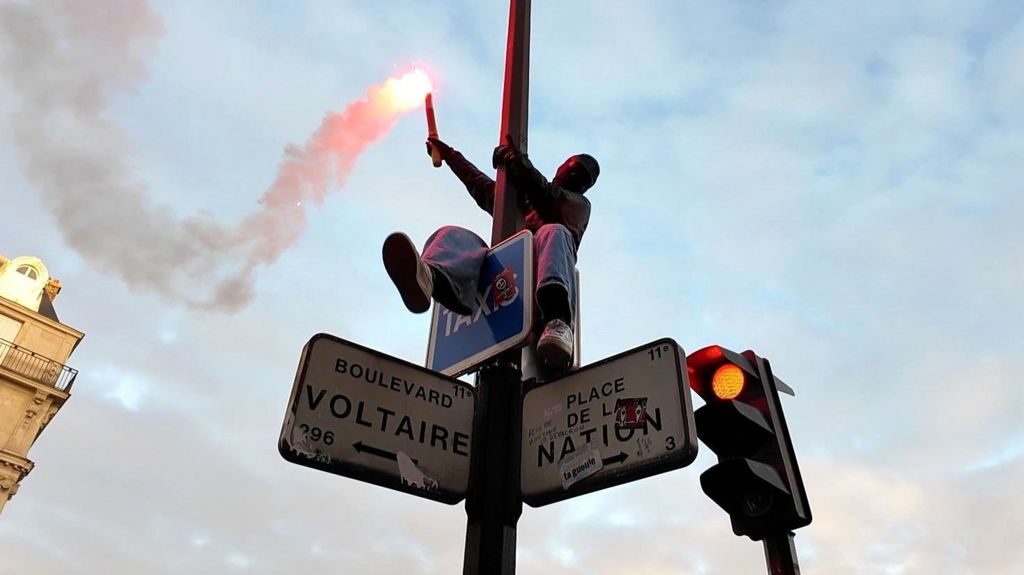
Against a backdrop of sky-high public debt, a politically weakened President Emmanuel Macron entering his final six months in office, and six consecutive weekends of mass demonstrations roiling the nation, France finds itself mired in unprecedented social and political turmoil. The wave of unrest, initially sparked by student-led mobilizations over soaring living costs, collapsing public services, and widespread allegations of excessive police force, has devolved into scattered bouts of looting and targeted violence, even as protest-related aggression has dipped compared to levels recorded the previous month.
President Macron has publicly pinned the outbreak of rioting on what he labels “delinquents” and coordinated ultra-left factions, asserting their explicit core goal is to dismantle the French Fifth Republic. This sweeping allegation has rapidly become a highly charged political football in the lead-up to critical 2027 presidential and parliamentary elections, as competing factions jockey for public support. The mainstream left has placed full blame for the cost-of-living crisis on centrist and right-wing policy failures, while centrist and conservative figures accuse hard-left actors of orchestrating violent unrest — a charge the hard left categorically rejects. Meanwhile, the nationalist far-right has centered its campaign platform on promises to restore full law and order across French urban areas if voted into power.
To verify the veracity of Macron’s claims, BBC correspondents embedded directly within protest crowds to engage with members of the notoriously media-averse radical left ecosystem, most notably the Black Bloc: a loose collective of demonstrators identifiable by their all-black clothing and face-concealing ski masks or balaclavas, who typically emerge from side alleys at dusk as daytime peaceful protests wind down and riot police deploy in full force.
French intelligence agencies have openly acknowledged they drastically miscalculated the scale of anger, destruction, and injury that unfolded during the peak of unrest last month. Official tallies indicate over 1,000 police officers sustained injuries during clashes, while dozens of young protesters suffered severe wounds including broken bones, with two reported to have lost hands after altercations with officers using stun grenades. Le Monde maintains a continuously updated public database tracking the growing volume of protester injury reports, and the French Insurers Federation calculated that property damage to shops and private businesses on the single most violent day of unrest, October 17, reached a staggering €207 million.
In response, authorities have imposed heavy, sweeping policing restrictions on all subsequent demonstrations, a measure protesters decry as heavy-handed state repression. Correspondents witnessed small groups of potential rioters, armed with glass bottles and homemade paint bombs, vastly outmatched by police equipped with batons, stun grenades, and tear gas as officers kettled large sections of crowds to restrict movement.
During one of these containment operations, reporters connected with 18-year-old Nas, a teen from a deprived outer-city banlieue housing estate, who spoke anonymously to avoid police detection. Nas and his peers insisted they were not formally organized or recruited by established radical left groups, but were driven to anger by crumbling local public schools, underpaid and overworked teachers, systemic barriers to stable well-paying work, and the chasm between France’s stated ideals of equality and their lived experience of marginalization. “Without violence, you don’t achieve anything,” Nas told reporters. “It’s the only way to get our voices heard. We won’t give up our fight.”
Masked hard-left student activists, who also spoke on condition of anonymity, pushed back against public outcry over rioting, framing state violence as a far greater moral transgression. “What’s a smashed shop window compared to police using stun guns on protesting school kids?” one activist argued. “People are regularly going cold and hungry. They’re losing faith in this society.”
French internal intelligence estimates the total nationwide population of self-identified ultra-left activists stands at roughly 5,000. One 17-year-old Black Bloc member operating under the codename Anticapitalist Starflix, who showed reporters homemade eggshell paint bombs designed to obscure riot police visors and force officers to remove their face protection and be exposed to their own tear gas, explained that Black Bloc is not a formal hierarchical organization, but a shared tactical framework. He noted that the collective includes both ideologically motivated activists pushing for systemic reform or full revolution, and opportunistic looters who exploit the group’s uniform anonymity to steal from local businesses. Young radicals coordinate protest locations and share operational security guidance via encrypted apps Signal and Telegram, while affiliated left-wing online platforms and Instagram accounts circulate protest tips first popularized by 2019 Hong Kong demonstrators, including guidance to leave phones at home to avoid tracking and “be like water” to blend in and move unseen through crowds. All young interviewees insisted no formal central leadership directs their actions, framing their mobilization as a spontaneous outpouring of anger.
A veteran long-term Black Bloc activist scoffed at Macron’s assertion that ultra-left groups are plotting to overthrow the Republic, calling it a deliberate state manipulation of public fear. “The intelligence services know full well we are not a coordinated, organized force,” he said. “People turn up to a protest, get dressed in black and do their own thing. The uniting factor is rage, and it’s not unique to France — you see the same anger spilling out in Italy, Germany, Spain. It’s exploding by itself.” The activist also rejected any formal link to firebrand left presidential candidate Jean-Luc Mélenchon and his France Unbowed (LFI) party, dismissing Mélenchon as a complicit part of the existing capitalist system who actively works to de-escalate unrest rather than amplify it. He added that the movement’s core goal is not to destroy France, but to dismantle an unjust capitalist system that leaves millions of people unable to afford basic costs like groceries or fuel.
Correspondents also traveled to rural ultra-left anarchist and eco-activist communities outside Limoges, where a 19th-century town hall heavily damaged in a suspected arson attack during protests has emerged as a symbolic marker of France’s current fractured state. A 39-year-old long-time local ultra-left activist, a father of one, told reporters he was willing to take a bullet to defend young protesters from state violence, citing disgust at the gap between France’s founding values of liberty, equality, and fraternity and the pervasive systemic injustice facing working-class communities.
Despite the fiery rhetoric, multiple independent analysts including recently retired former police commissioner Michel Klein confirmed that the scattered, under-resourced radical left movement lacks the manpower, weaponry, and unified structure to pose any credible existential threat to the French state, and that widespread fears of impending civil war are unfounded. Klein did, however, warn of a rapidly growing risk of violent clashes between far-left and far-right factions in the lead-up to next year’s election, as far-right vigilante groups have begun deploying to protest sites across the country claiming to defend public order. Current election polling projects a final presidential run-off between far-right leader Marine Le Pen and hard-left candidate Jean-Luc Mélenchon, leaving the nation more politically polarized than it has been in decades, with no clear path to de-escalation in sight as the country barrels toward what many observers are describing as a perfect storm of political, social, and economic instability.