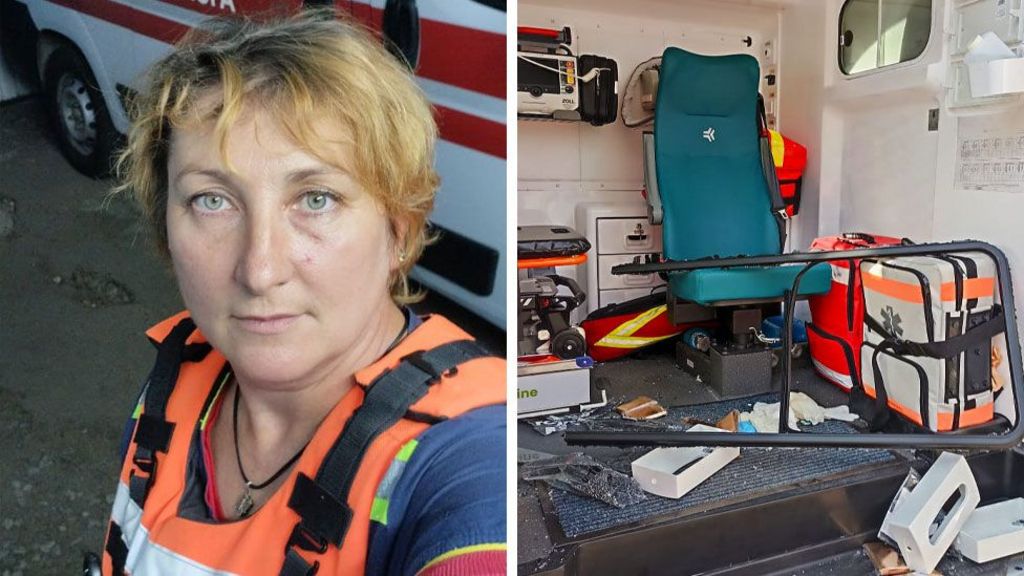
In the embattled southern Ukrainian city of Kherson, paramedic Inna Lytvynenko has become the face of a disturbing new reality of Russia’s full-scale invasion: deliberate hunting of medical first responders by unmanned drones. The veteran emergency worker never responds to a call without donning her high-visibility orange body armor, a precaution that proved life-saving last June when she was dispatched to treat a woman wounded in an earlier Russian drone strike.
Moments after Lytvynenko arrived on scene, an FPV (first-person view) drone crashed directly into her marked ambulance. As she scrambled to escape, she caught the distinct buzzing of a second incoming drone, locked on a direct course for her. “I panicked. I grabbed my trauma bag and started running,” Lytvynenko recalled of the 10-minute pursuit that left her running for her life. “I shouted and screamed. I knew that if I stopped, I would die.” The drone eventually broke off its chase, and Lytvynenko was extracted by local police – but the coordinated attacks on the rescue mission did not end there. Two more vehicles arriving to evacuate the wounded woman were hit by drones, and it took hours before a third police vehicle could successfully pull the injured civilian to safety.
Lytvynenko’s harrowing experience, which she describes as “safari hunting” of medical workers, is not an isolated incident. Data from global health and humanitarian organizations confirms a steady, alarming escalation of deliberate attacks on Ukrainian healthcare infrastructure and personnel that violates core international humanitarian law laid out in the Geneva Conventions, which require all warring parties to protect hospitals, ambulances, and medical teams.
The World Health Organization (WHO) has documented 3,118 attacks on healthcare facilities and workers across Ukraine since Russia launched its full-scale invasion in February 2022 – an average of two attacks per day. The trend of targeting has accelerated sharply in recent years: attacks rose by 30% in 2024, followed by a further 20% increase in 2025, and WHO officials project this upward trajectory will continue through 2026. “This is a new normality, which should not be the normality,” said Dr Jarno Habicht, WHO’s representative in Ukraine.
A new report from Doctors Without Borders (Médecins Sans Frontières, MSF) concludes that these attacks are not accidental side effects of large-scale combat operations, but a systematic, deliberate strategy. The frequency of strikes confirms that targeting healthcare is “a sustained feature of the war rather than an episodic consequence of large scale offensives,” the report found.
Just last month, three Russian missiles struck a Kherson hospital within minutes of each other, killing one doctor and leaving the facility severely damaged. Hospital director Olena Tymoshenko said the coordinated strike leaves no doubt it was intentional: “It cannot be an accident.”
Moscow’s forces frequently employ a tactic called “double-tap”, where they strike the same location twice in quick succession, with the second strike deliberately targeting first responders who arrive to rescue survivors of the initial attack. In a recent large-scale air assault on Kyiv, seven people – including a police officer and a rescue volunteer – were killed in a second strike on an already targeted site. Most recently, Russian air strikes have also expanded to target humanitarian aid warehouses: last month alone, facilities belonging to three United Nations agencies, including the WHO, were damaged in strikes. Habicht noted that the WHO shares the exact coordinates of all its facilities with both Moscow and Kyiv specifically to prevent accidental strikes, making the damage even more alarming.
While large missile strikes can sometimes be indiscriminate, FPV drone strikes are almost always intentional. These small, maneuverable drones transmit a live video feed directly to their operators on the ground, meaning the pilot can clearly see what target they are attacking. “When it hits an ambulance, it has to be on purpose,” explained Robin Meldrum, MSF’s country coordinator in Ukraine.
Lytvynenko echoed that assessment, noting she was wearing a clearly marked medical uniform, and her ambulance bore standard medical identification that would have been visible to the drone operator. WHO data shows that 20% of all attacks on Ukraine’s healthcare system target ambulances, a statistic that confirms this is part of a pre-planned strategy to erode access to care for frontline civilians.
The human cost of this sustained campaign is already devastating. Civilians living in areas near the front line – most of whom are elderly residents with chronic health conditions who could not evacuate – have been increasingly cut off from even basic health services. Even if they survive routine shelling and air strikes, lack of access to medication and routine care leaves many vulnerable to preventable death. Ambulance teams now face impossible choices: risk being targeted to reach a patient, or leave the injured and ill without care.
For medics like Lytvynenko, every mission is now a matter of life and death. She and her colleagues constantly monitor social media for incoming threat reports, and pray for safety on every call. “These drones can appear from anywhere, they can even get through anti-drone nets,” she said. In many high-risk areas, police are now sent instead of ambulances to avoid losing medical personnel.
As both Russian and Ukrainian forces develop longer-range FPV drones, the high-risk danger zone for medical operations has expanded steadily, forcing humanitarian health groups to move their mobile clinics further and further back from the front line. “Two years ago, we could go up to 5-8km from the frontline,” Meldrum said. “Now we won’t go anywhere within 30km and this distance keeps growing.”
Over the past 18 months, MSF has suspended regular medical services in roughly 80 frontline villages that previously relied on its support, and recently paused ambulance operations in Sloviansk, a major eastern Ukrainian city. Following the most recent “safari” drone attack targeting medics, Ukrainian President Volodymyr Zelensky has called for greater international pressure on Russia to end the deliberate targeting of civilian first responders. For medical workers and humanitarian teams on the ground, the reality is clear: the fundamental rules of war designed to protect civilians and medical personnel are being ignored with devastating consequences. “It doesn’t feel like we’re protected in this environment, and in the way that Russia is conducting the war,” Meldrum said. “We don’t feel that the rules of war are being respected.”