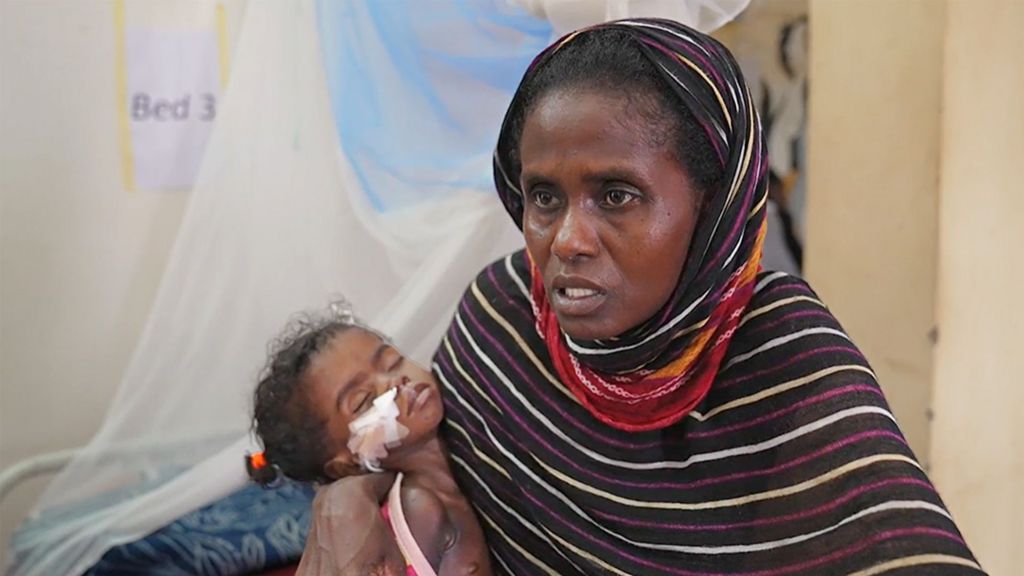
The ongoing civil war in Sudan has left a trail of devastation, with countless lives shattered and families torn apart. Among the victims is Touma, a 25-year-old mother whose life has been irrevocably altered by the conflict. Sitting in the malnutrition ward of Bashaer Hospital in Khartoum, Touma cradles her three-year-old daughter, Masajed, who is severely malnourished and too weak to cry. ‘I wish she would cry,’ Touma whispers, her voice filled with despair. The hospital, one of the few still operational in the capital, is overwhelmed with children suffering from acute malnutrition, their mothers helplessly watching over them. Touma and her family were forced to flee their home after the Rapid Support Forces (RSF) looted everything they owned, leaving them with nothing but their lives. ‘We had livestock, milk, and dates. Now, we have nothing,’ she recalls, her voice trembling. The war has plunged Sudan into one of the world’s worst humanitarian crises, with three million children under five acutely malnourished, according to the UN. Despite the hospital’s free basic care, lifesaving medicines must be paid for by families, leaving many, like Touma, to make impossible choices. She could only afford antibiotics for one of her twin daughters, choosing Manahil over Masajed. ‘I wish they could both recover,’ she sobs, cradling her dying child. The war has left families with nothing, no means to save their children, and little hope for survival. The conflict, which began in April 2023 between the Sudanese army and the RSF, has turned Khartoum, once a vibrant cultural and commercial hub, into a battlefield. The city is now littered with the remnants of war—burnt-out cars, tanks, and shattered homes. Amid the destruction, 12-year-old Zaher wheels himself through the wreckage, singing softly, ‘I’m coming home.’ Zaher, who lost both legs in a drone strike, dreams of prosthetic limbs so he can play football again. His mother, Habibah, recounts the horrors of living under RSF control, where they were constantly under threat. ‘We couldn’t switch on our lights at night,’ she says. The war has robbed children of their childhoods, leaving them to navigate a world of violence and loss. Ahmed, a 16-year-old who works clearing debris, has found human remains in a playground where he once played with his brothers. ‘I have been certain that I was destined to die,’ he says, his voice devoid of hope. Yet, amidst the despair, moments of resilience shine through. Zaher, despite his injuries, drags himself across a scarred football pitch, determined to play the game he loves. ‘Football and my friendships have saved me,’ he says, smiling for the first time. The war has left an indelible mark on Sudan’s children, but their spirit and determination offer a glimmer of hope in a land ravaged by conflict.
‘I can’t afford to save both twins’: Sudan’s war left one mother with an impossible choice