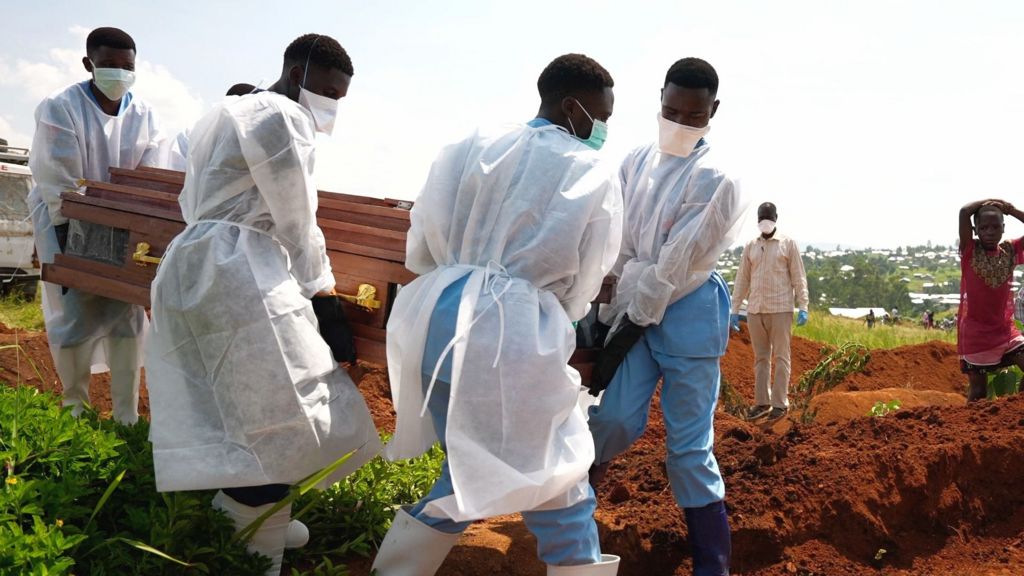
In the bustling, unusually quiet Nyamurongo cemetery of Bunia, the capital of Ituri province in northeastern Democratic Republic of the Congo, fresh mounds of dirt dot the grassy ground at a rate no resident has seen before. This city sits at the epicenter of an ongoing Ebola outbreak that has claimed nearly 200 lives in recent months, and every new grave tells a story of devastating loss and a desperate fight to stop the virus’s spread.
For Joel Lonza Makumbu, the devastation of the outbreak is not an abstract public health statistic—it is a personal catastrophe that has gutted his entire family. Standing knee-deep in the soil of his mother’s fresh grave, just one day after burying his father, Makumbu describes this as his sixth trip to the cemetery in a short stretch of weeks. Ebola has already taken his parents, three sisters, and a brother-in-law, and three more of his relatives remain in treatment centers fighting the disease. “I want to say for all people [to hear] that Ebola is true,” he stresses, a urgent warning to those who still doubt the danger of the virus amid widespread local misinformation.
The current outbreak is driven by the rare Bundibugyo strain of Ebola, which kills roughly one in four people it infects. Transmitted exclusively through direct contact with infected bodily fluids—including blood, semen, breast milk, vomit, and urine—the virus demands strict public health protocols to halt transmission, and modified, safe burial practices are widely recognized as one of the most critical interventions to stop new infections.
Traditional Ituri funeral customs are deeply rooted in community and cultural belief: for generations, families have washed and dressed the deceased in fine clothing—women often in wedding gowns, complete with makeup—before holding multi-day ceremonies full of singing and celebration, as community members believe death is a journey to the world of ancestors, not an end. Many of these long-held practices, however, put grieving family members at extreme risk of infection, so public health teams have had to negotiate sensitive changes to these rituals.
Today, no large crowds of mourners gather at Nyamurongo, and the traditional pre-burial body washing carried out by family members is strongly discouraged. Burials that once took days of preparation now are completed in 10 minutes, with the Ebola deceased immediately sealed in leak-proof body bags before interment. But rather than forcing communities to abandon their traditions entirely, international aid groups have worked to adapt safety protocols to honor cultural needs, wherever possible without putting lives at risk.
“We need to be very close to the communities and engage with them very closely and make sure that they understand what’s going on, they’re informed and they consent,” explains Maria Munoz-Bertrand, public health emergency coordinator for the International Federation of the Red Cross and Red Crescent (IFRC). To accommodate families, the IFRC now places sealed body bags inside solid coffins fitted with small transparent panels that allow mourners to glimpse their loved one’s body; some body bags even have clear film at the top to reveal the deceased’s face. “If the family asks for something special to be included in the procedure, as long as it respects the infection prevention and control measures, and it doesn’t put anyone at risk, we will try to accommodate the wishes of the family as much as possible, because we understand that it’s a very difficult time for families,” Munoz-Bertrand adds.
On a recent trip with an IFRC burial team to collect a body from Bunia’s Ebola treatment centre, the delicate balance of grief, culture and safety is on full display. Outside a makeshift transit morgue tent, family members wait along the roadside to accompany their loved one to the cemetery, including one grieving mother who had just lost her child to the virus. Health workers in full personal protective equipment seal the body bag inside the coffin, disinfect their path, and retreat, before six IFRC volunteers, also fully protected, retrieve the coffin for transport.
For 34-year-old mother of four, whose body the team retrieved that day, her father Simone Nyal watches the modified process from a distance, still reeling from how quickly the virus took his daughter. “She was ill for just one week before she succumbed. She has left us her four children – I don’t know how we will cope,” he says. At the cemetery, the woman’s mother and sister wait by the open grave, and the burial is completed in less than 10 minutes. Volunteers decontaminate their gear and depart, leaving gravediggers to fill the plot.
Negotiating these changes requires a unique blend of cultural literacy and patience, says Julienne Anoko, an anthropologist working with the World Health Organization (WHO) who has responded to multiple Ebola outbreaks across Central and West Africa. Anoko and her team spend days listening to grieving families, acknowledging their pain, and drawing on local cultural knowledge to help communities accept the necessary changes to burial practices.
The most challenging negotiations, Anoko says, surround the burial of pregnant women who die of Ebola. Local tradition holds that a pregnant woman must “travel light” to the afterlife, requiring the fetus to be removed before burial—a practice that would expose family members to massive amounts of infectious bodily fluids. To address this, Anoko frames the restriction through a cultural lens, explaining to communities that their own ancestors would have approved of the modified practice to protect the living. “We negotiate to make the family accept the unacceptable. Sometimes it may take three days, but we negotiate, and I use the knowledge of their culture,” she says.
Over years of working through outbreaks, Anoko has built deep trust with local communities, bridging the gap between public health science and traditional cultural values to make safety protocols acceptable. Even with this progress, the work of containing the outbreak remains far from over. Misinformation still circulates, and for families like Makumbu’s, the pain of loss is far from over—with more loved ones still fighting for survival in treatment centres. As he finishes covering his mother’s grave, Makumbu leaves with a stark warning for the world: Ebola is real, and it continues to tear through communities in Ituri, leaving few families untouched.