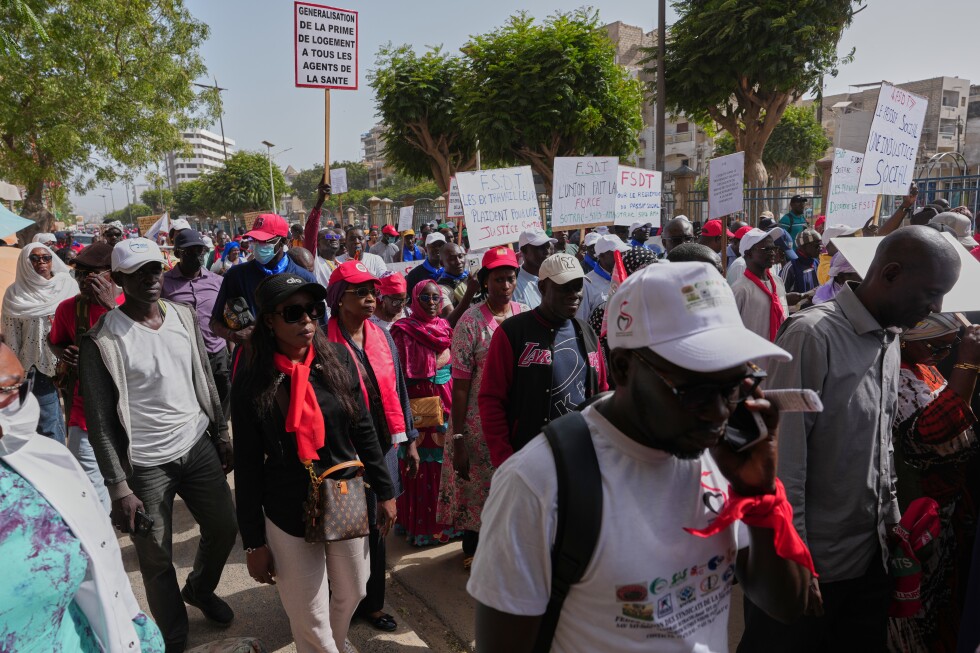
On a mid-week day in Dakar, Senegal’s coastal capital, thousands of demonstrators filled the streets to voice growing frustration with the country’s new ruling administration, as a crippling national debt crisis pushes daily living costs to unsustainable levels for ordinary citizens. The demonstration was a coordinated effort between Senegal’s most influential labor unions and the Front for the Defense of Democracy and the Republic (FDR), a major opposition political coalition, bringing together workers, union activists, and government critics from across the political spectrum.
Mody Guiro, leader of the National Confederation of Senegalese Workers — the nation’s largest union body — told reporters the current government has broken a landmark agreement struck one year prior. Under that deal, unions agreed to pause all planned strike action in exchange for commitments to raise public sector wages and improve national working conditions. For its part, the Senegalese government argues that a historic debt crisis inherited from the previous ruling administration has stripped the state of discretionary funding needed to fulfill these pledges.
Many protesters wore identifying red scarves and branded union headwear, carrying hand-painted signs that called for the reinstatement of thousands of laid off public employees and sharp cuts to personal income tax rates. Some groups chanted overt calls for the removal of Prime Minister Ousmane Sonko, the country’s second-highest ranking official.
Sonko and President Bassirou Diomaye Faye’s administration took office in April 2024 on a wave of popular support, fueled by campaign promises of sweeping transformative reform. Their platform centered on rooting out systemic corruption, expanding employment opportunities for Senegal’s large youth population, and ensuring the nation captures maximum economic benefit from its abundant natural resource reserves. To date, however, the ruling PASTEF party’s reform agenda has hit significant roadblocks.
A 2025 official government audit confirmed that the previous administration left the country with a total public debt of $13 billion — a figure far larger than had been previously disclosed to the public. That debt burden has pushed Senegal’s debt-to-GDP ratio to approximately 132%, one of the highest debt levels recorded on the African continent. Ongoing negotiations with the International Monetary Fund to secure a new economic bailout program have stalled in recent months as the country’s fiscal outlook continues to deteriorate.
Worsening economic conditions have amplified daily hardship for millions of Senegalese people, with the nation’s youth population bearing the brunt of the crisis. Roughly 75% of Senegal’s total population is under the age of 35, making youth unemployment one of the country’s most pressing social issues. Tensions have already boiled over once this year: in February, student protests over unpaid government financial aid at Senegal’s leading public university were met with a violent crackdown by security forces, which left one student dead.
Speaking at Wednesday’s demonstration, youth activist Mohamed Fall emphasized that widespread frustration has ground daily life across the country to a halt. “The country is at a standstill. It is essential that the government finds solutions to revive Senegal’s economy instead of picking fights everywhere,” Fall said.
For many demonstrators, the anger stems directly from unmet campaign promises. Pape Laobe Samb, a former 12-year veteran employee of the Port of Dakar, is one of more than 700 port workers laid off since the start of 2025 as part of the Faye administration’s push to overhaul bloated state institutions. “This is not what they promised people. They said they were going to create jobs and develop the country but they did the complete opposite,” Samb told the Associated Press in an interview at the protest.
The newly appointed director of the Port of Dakar, who took the post shortly after Faye’s inauguration, has framed the layoffs as a necessary clean-up of irregular, patronage-based contracts left behind by the previous government. Unions push back against this narrative, arguing that nearly all the terminated workers were affiliated with the previous ruling party, and that the mass firings were an unlawful, politically motivated purge rather than a genuine institutional reform.