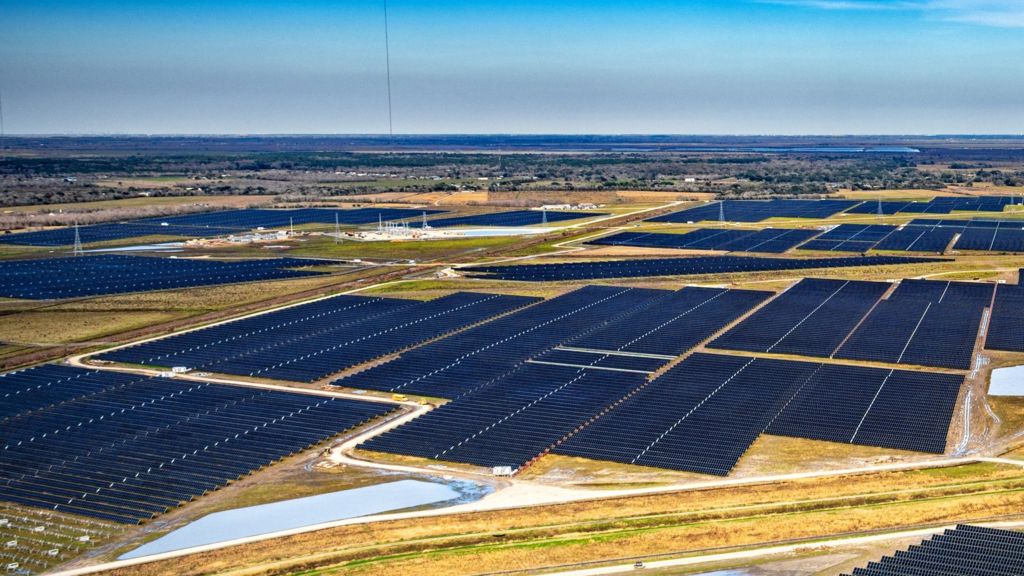
For nearly 70 years, the Cargil family has worked the flat, arid plains outside Uvalde, a small community in southwest Texas. At 67, Steve Cargil, the third generation to tend the land, long expected one of his three children would carry on the legacy he inherited from his father. That certainty crumbled in 2018, when a devastating hailstorm wiped out an entire season of carefully tended cabbage and onion crops that Cargil and his son Ryan had nurtured for months.
Shortly after the storm, Ryan told his father, “You do everything right, and we work so hard, and you come out one morning and it’s all gone.” With none of his children willing to take on full-time farming, Cargil faced the imminent end of his family’s agricultural legacy, and an uncertain retirement—one without a traditional pension, a common reality for American farmers.
Then, an unexpected opportunity emerged. Cargil signed a 25-year lease with energy developer OCI Energy, granting the company access to 600 acres of his land—roughly a quarter of his total property—to build a utility-scale solar farm. Today, that agreement delivers Cargil $200,000 in guaranteed annual income, a windfall he never could have imagined. “Never in my wildest dreams did I think that a solar project would be on my farm,” Cargil says. “Looking back now, I call it a blessing.”
The steady lease income has already reshaped Cargil’s life and the future of his farm. Amid a years-long crippling drought across the American Southwest, he has been able to redirect all his allocated irrigation water to the 1,800 acres he continues to cultivate, eliminating the constant financial stress of volatile diesel and fertilizer prices that have pushed many small American farms to bankruptcy. “It’s changed my life,” he says.
Cargil’s story is at the center of a historic energy shift unfolding across Texas. Long known as the heart of American oil production, Texas surpassed California earlier this year to become the nation’s top producer of solar-generated electricity. According to U.S. Energy Information Administration data, last March marked the first time Texas produced more electricity from solar power than from coal. On hot summer afternoons, when demand for electricity peaks to power millions of air conditioning systems, solar regularly meets roughly one-third of the state’s total power needs, according to Mark Stover, executive director of the Texas Solar and Storage Association.
Stover explains the state’s unprecedented solar boom is driven by two core factors. First, Texas operates its own independent power grid, making it far faster and cheaper to connect new solar farms to the system than in other parts of the country. Second, Texas is one of the fastest-growing states in the U.S., with its population surging 15.8% between 2015 and 2025, creating explosive demand for new, affordable electricity generation. “We need a whole lot of power in Texas, and we need it quickly,” Stover says.
Decades of incremental manufacturing improvements have also driven down the cost of solar technology to the point that it is now the cheapest form of power generation in the state, according to James Scott, vice president of project development at OCI Energy. “No one would have believed that 20 years ago,” Scott says. Once a solar farm is constructed, the cost of its output can be locked in for decades, because its fuel—sunlight—is free. OCI sells power at $40 per megawatt-hour for 25-year contracts to large corporate buyers including Apple and Amazon, which prioritize long-term price stability. By comparison, the U.S. Energy Information Administration reports new coal plants produce power at nearly $90 per megawatt-hour.
For this boom to continue, developers rely on rural landowners like Cargil, because utility-scale solar requires large, flat plots of open land. In exchange, leases—typically 25 to 30 years with annual incremental increases—provide stable, multigenerational income for farm families, allowing many to retire comfortably, set up long-term family trusts, or keep struggling operations solvent. Stover adds that the land footprint of solar development across Texas is far smaller than critics claim, noting that “the industry is utilizing less than 0.15% of Texas land.”
Despite the economic and energy benefits, solar expansion has sparked significant pushback in some rural communities. In northeast Texas’s Franklin County, a small group of long-time local residents has fought new utility-scale solar projects for years. BF Hicks, a local lawyer whose family has owned land in the county since the 1800s, says he became an opponent after watching neighbors sign long-term leases that allowed developers to clear centuries-old oak forests for new installations, and burn the cleared vegetation, leaving smoke hanging over the town for weeks. The issue became personal for Hicks when a solar farm was built adjacent to his family’s 200-year-old cemetery.
David Truesdale, a retired federal law enforcement officer who moved to Franklin County to escape urban density, joined the opposition after a proposed solar project was sited near his home. He notes that under current Texas law, large solar projects do not require mandatory environmental review, and raises safety concerns about the lithium-ion battery storage units paired with most large solar farms, warning that a single battery fire can trigger a cascading chain reaction that destroys large swathes of surrounding land. “We’re destroying the world as we’re trying to save it,” Truesdale says of the widespread land clearing he has witnessed.
While both Hicks and Truesdale emphasize their opposition is not rooted in partisan politics, their concerns reflect broader rural anxieties about solar development, including negative impacts on scenic views, altered water runoff patterns after land clearing, and the risk of battery fires. Former President Donald Trump has attacked wind and solar power as “farmer destroying” and moved to roll back federal tax credits for renewable energy projects. Yet polling from Fabrizio Lee and Associates—Trump’s own polling firm—found in February that 68% of Republican voters believe the U.S. needs “all forms of electricity generation, including utility solar” to keep energy costs low. Stover adds that solar development has broad support in Texas’s Republican-controlled state legislature, where policymakers accept that “these technologies bring reliability benefits to the grid.”
Back in Uvalde, Cargil says the steady income from his solar lease has given him renewed optimism that his family’s farm will survive to see a fifth generation of Cargil stewards, even as he has no immediate plans to retire. Echoing advice his father passed down to him decades ago, Cargil says, “You’re better off being lucky than being smart. And this was one of those cases where I was just lucky.”