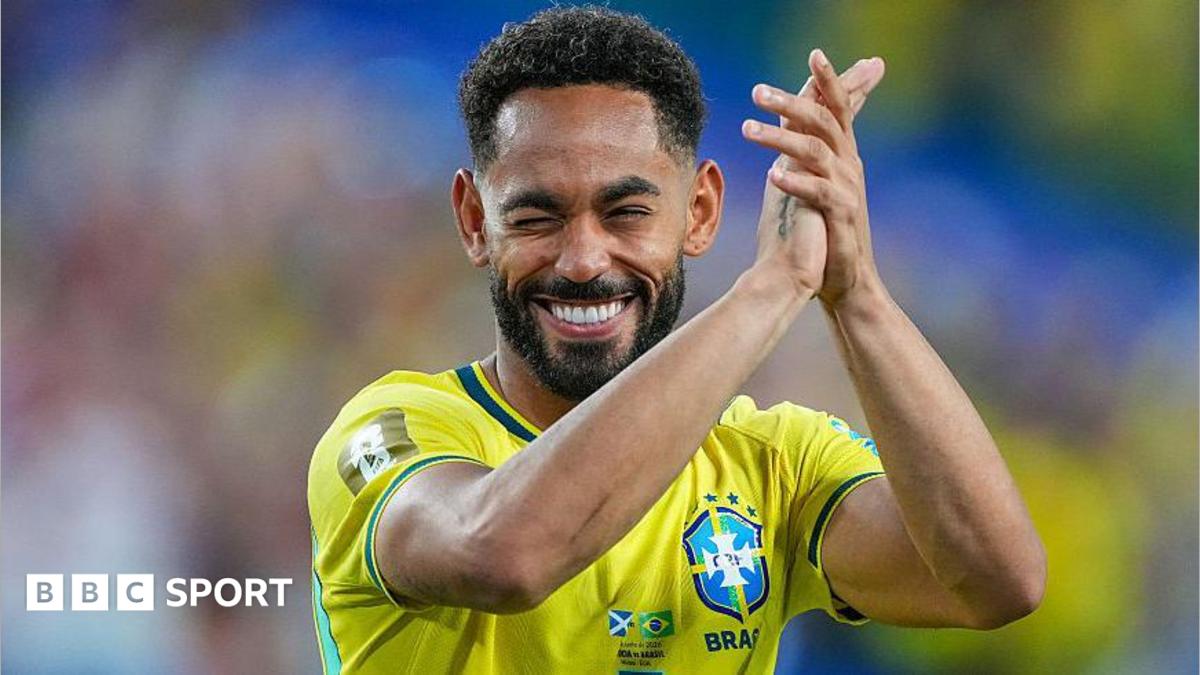
As the 2026 FIFA World Cup knockout stage approaches, Brazil’s national side is finally hitting its stride at the perfect moment, with head coach Carlo Ancelotti settling on a core starting XI that has grown sharper, more confident, and more cohesive with every group stage outing. Their next test, a Round of 32 clash with Japan, looms as a stiff challenge — but right now, everything feels like it is falling into place, and much of that success can be traced back to the unexpected standout of Brazil’s attack: Matheus Cunha.
For decades, Brazilian football fans have demanded a traditional, out-and-out number nine leading their front line, a imposing goalscorer in the mold of legendary strikers like Ronaldo, Romario, and Adriano. Cunha does not fit that classic mold. Instead, he operates as a dynamic “nine-and-a-half” — a hybrid forward capable of holding the central striking role while also dropping deep to link play, create chances for teammates, and contribute to build-up play. With three tournament goals already to his name, he is far from a pure playmaker, but he brings a unique versatility to Brazil’s attack that no other center-forward in the team’s recent history has ever offered.
In his movement off the ball, Cunha draws direct comparisons to former Liverpool and Brazil forward Roberto Firmino, constantly dropping into deeper areas to pull opposition center-backs out of their defensive shape. If a defender follows Cunha deep, it opens up acres of space in behind for Brazil’s flying wingers Vinicius Junior and Rayan to exploit. If the defender stays anchored to the goal line, Cunha is free to receive the ball between the lines, create attacking sequences, or test the goalkeeper from open play. He has also fully embraced the less glamorous side of his role, leading the team’s high press and even dropping into a position in front of midfield to disrupt opposition build-up, creating a critical balance that has unlocked Brazil’s attacking potential.
Cunha’s rise to become Brazil’s starting center-forward came about almost by accident. Heading into the tournament, Ancelotti had no clear first-choice striker, having tested a host of options including Cunha, Igor Thiago, Endrick, Joao Pedro, and Richarlison during preparation. A late injury ultimately opened the door for the current combination that has clicked: when versatile attacker Raphinha picked up a hamstring injury in Brazil’s opening match against Morocco, he was replaced by Rayan, a winger who stays fixed to the right flank rather than drifting across the front line. With Vinicius Junior holding down the left and Rayan on the right, Cunha is left with all the space he needs to roam into his preferred deep-lying positions, a setup that plays directly to his strengths. Ancelotti still retains options for different match scenarios — Igor Thiago offers a more traditional target-man presence for when Brazil is chasing a game or facing a physically imposing defense — but fans back in Brazil have quickly embraced Cunha as the solution to the side’s long-standing striker question.
Much of the credit for this successful evolution of Brazil’s side goes to Ancelotti himself, whose adaptability has reshaped what people expect from a Brazilian national team. The Italian manager is widely lauded for his elite man-management skills, but his tactical intelligence often flies under the radar. Unlike many modern sides that prioritize holding 70% or more of possession to control games, Ancelotti’s Brazil is comfortable ceding the ball to opponents, drawing them forward into vulnerable areas, then hitting them with organized, high-intensity counter-pressing. This trap worked to perfection against Scotland, where Brazil conceded possession but controlled the space, scoring two goals (one disallowed harshly) in a result that left Scotland’s knockout hopes all but dashed. The tactic was not a fluke, either: Brazil used the same approach to score similar goals in pre-tournament warm-up matches against Panama and Egypt. For Ancelotti, there is no need to force a fixed “team identity”; instead, the side adapts its style to fit the opponent and the flow of the match.
This iteration of Brazil is a marked break from the nation’s classic footballing templates in more ways than one. For decades, Brazil built their success around attack-minded, overlapping full-backs from the legendary generation of Roberto Carlos, Cafu, and Dani Alves. This time around, Ancelotti has opted for more conservative full-backs who stay back to shore up the defense, a change that allows Vinicius Junior to stay higher up the pitch and stay fresher for attacking transitions. The backline has gelled into a solid unit, and Ancelotti has also tweaked his formation to fix early midfield issues: after 34-year-old Casemiro was left badly exposed playing as a lone defensive midfielder in the opening match against Morocco, the side shifted from a 4-2-3-1 to a 4-3-3, with Lucas Paqueta partnering Casemiro to cover when Bruno Guimaraes makes attacking runs forward. This adjustment has given Brazil much more solid control of the midfield, a critical improvement ahead of their game against Japan, a fluid, dangerous attacking side that will test Brazil’s center of the park.
After three group stage matches, Brazil’s form speaks for itself: the side has conceded only one goal while netting seven, and a growing sense of optimism has replaced the pre-tournament anxiety that dominated back home. Right now, the Brazilian public is behind this new-look side, and the team is peaking at exactly the right time to make a deep run in the tournament.