Long before the first hint of sunrise stains the sky over Surat, India’s sprawling synthetic textile manufacturing hub, 35-year-old migrant worker Sibaram Pradhan is already awake. Seated cross-legged on the concrete floor of a cramped plywood cubicle he shares with nine other migrant men, Pradhan breaks into a sweat before his day even begins. This summer, climate-amplified extreme heat has left no corner of India untouched, wrapping both days and nights in a suffocating blanket of humidity and high temperatures that lingers even at 6 a.m.
Like hundreds of thousands of fellow migrants from Odisha, the eastern Indian state he calls home, Pradhan commutes 2,000 kilometers to work in one of Surat’s thousands of power loom factories. He is one of millions of South Asian workers trapped in a cycle of grueling labor: substandard overcrowded housing and brutally hot, poorly ventilated, deafening factory floors, conditions that grow more dangerous by the year as climate change intensifies regional heatwaves.
“I’m a poor person. I have come all this way from Odisha to Gujarat just to put food on the table,” Pradhan explains. “We have no choice but to work to survive.”
The first task of his long day is a quick video call to his wife and two children, who remain in Odisha. Once that is done, he offers a quick prayer to a small portrait of his deity taped to the plywood wall of his cubicle, then joins a queue stretching down a dark, narrow hallway for access to the shared bathroom facilities. Up to 100 workers share just two toilets and a handful of water taps, relying on buckets to bathe.
More than 200 migrant workers are housed across two converted warehouse floors split into thin plywood cubicles. With only a handful of ceiling fans to circulate stagnant, warm air, the entire complex offers almost no ventilation. This summer, temperatures have already climbed past 38 degrees Celsius (100 degrees Fahrenheit), turning both factories and worker housing into oppressive, stifling spaces that offer little relief from the heat. Pradhan rushes through his morning routine: any late arrival to the factory means a dock in his daily pay.
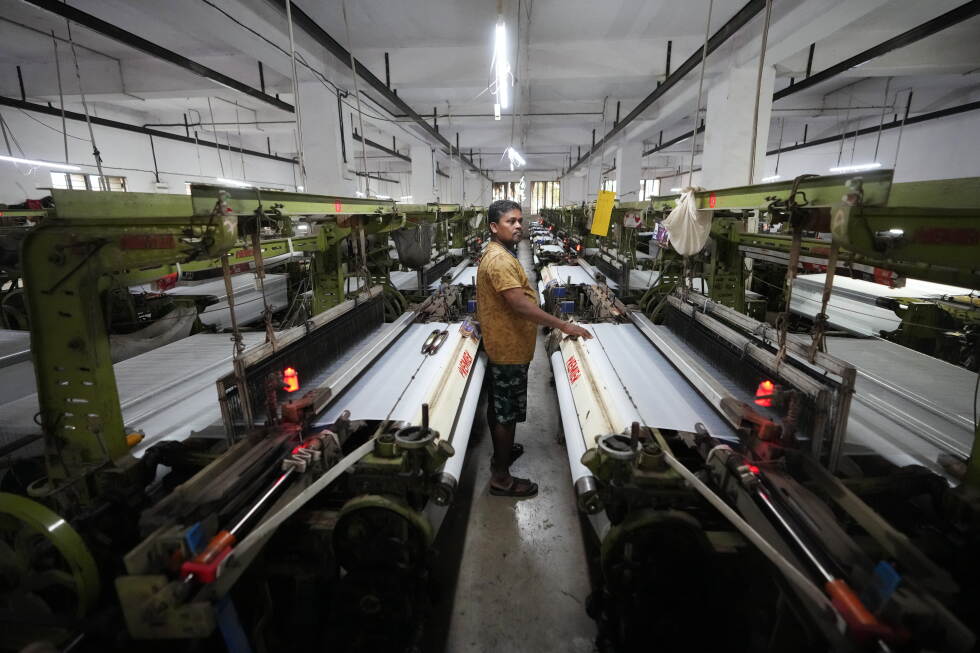
Inside the factory walls, Pradhan’s shift stretches up to 12 hours. He is responsible for loading polyester yarn onto power looms, monitoring for broken threads, checking bobbin placement, and maintaining uniform fabric quality across up to 15 machines at once. He moves constantly between the units, enveloped in a constant roar of noise that can reach 130 decibels — a volume equivalent to a gunshot fired at close range, or a high-speed train passing just meters away.
The unrelenting heat forces Pradhan to work in only a sleeveless undershirt and shorts. He drinks water almost nonstop and regularly wrings sweat out of his clothing to keep it from becoming soaked and heavy. The job requires constant vigilance around the unguarded, fast-moving heavy machinery: “Even if we’re exhausted, we have to stay focused, because people lose fingers to these machines all the time,” Pradhan says. “If you get hurt, you have to pay all your own medical bills, and you don’t get paid for the days you can’t work.”
Nearly all factories rely on nothing more than ceiling fans to cool machinery and workers, with no systemic ventilation to flush out accumulated heat. After hours of exposure to the sweltering conditions, many workers report frequent dizziness, splitting headaches, and persistent chronic fatigue. Heat exhaustion and dehydration-related illnesses and even deaths are alarmingly common among the workforce, says Siba Malik, a leader of Surat’s power loom worker union. Experts warn that national heat-related death tolls are almost certainly drastically undercounted, due to inconsistent reporting protocols on death certificates, leaving reliable official statistics out of reach.
Virtually all of Surat’s textile workforce is made up of internal migrants, the vast majority of whom hail from Odisha’s Ganjam district, one of India’s regions most vulnerable to climate-driven natural disasters. Workers report that repeated cyclones, flooding, and erratic rainfall have destroyed small-scale farming, the traditional livelihood in the district. Combined with chronic water shortages and a lack of local infrastructure and alternative work opportunities, these climate shocks have pushed hundreds of thousands of people to seek factory work in Surat. A 2023 nonprofit report estimates that as many as 800,000 Ganjam district natives currently work in Surat’s textile sector.
“There is simply no work to be found in our home villages,” says Seemanchal Sahu, another power loom worker who has lived and worked in Surat for more than 15 years. “If we could make a living there, we would never have left.”
Malik, a former power loom worker himself, notes that the vast majority of these workers lack health insurance, paid leave, or any other basic labor protections, leaving them extremely vulnerable to illness or injury. Any interruption to work means an immediate stop to their income. He has spent years organizing workers to collectively demand better working conditions and basic benefits, but progress has been slow. Workers have little leverage to push for change: they are dependent on the meager wages factories offer, which range from 600 to 750 Indian rupees (approximately $6 to $8) per day, or pay based on how many meters of fabric they produce.
After finishing his 12-hour shift around 7 p.m., Pradhan walks back to his housing complex, where the heat offers no reprieve. Nighttime temperatures in Surat regularly hover around 30 degrees Celsius (86 degrees Fahrenheit), so the cubicles remain just as hot and stuffy after dark as they are during the day. If the bathroom queue is not too long, he will take a quick second bucket bath, then head to the on-site canteen for dinner, which usually consists of lentils, rice, and cheap seasonal vegetables like eggplant or potato. Fish is only served once a week.
After eating, Pradhan usually spends an hour or so socializing with other workers at a nearby street tea stall, since sitting inside the overheated cubicle is unbearable. When he finally returns to his room to sleep, the conditions still work against him. “It’s just as hot inside the room at night,” Pradhan says. “We can’t sleep properly. I wake up three or four times every single night.”
Even with his grueling seven-day-a-week schedule, Pradhan spends roughly one-fifth of his income on rent and food at the complex, but still manages to send roughly 6,000 rupees ($63) home to his family in Odisha every month. His routine rarely changes, broken only by rare holidays like Diwali or the Odia New Year, when he travels back to his home state to visit his family.
Through all the hardship, Pradhan holds onto one hope: that his children will be able to build a better life than he has. He is saving to send them to school, so they can get stable, professional jobs that do not require the backbreaking, dangerous labor he endures every day. “I know exactly how hard this work is,” he says. “I will never let my children end up here.”