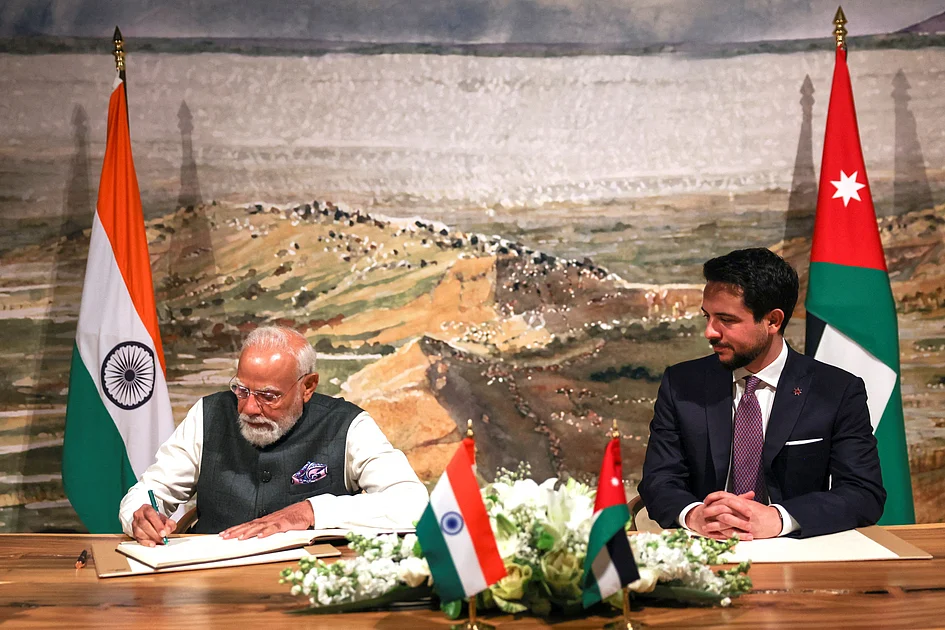
Indian Prime Minister Narendra Modi’s recent three-nation tour through Jordan, Oman, and Ethiopia has signaled a significant evolution in India’s international positioning, demonstrating a nation confidently asserting its role as a global bridge-builder rather than aligning with rigid geopolitical blocs.
The diplomatic journey, characterized by substantive engagements rather than ceremonial formalities, began with an unprecedented display of personal diplomacy in Jordan. Crown Prince Hussein Abdullah II, a 42nd-generation descendant of Prophet Muhammad, personally chauffeur-driven PM Modi to cultural sites and the airport—a gesture transcending conventional diplomatic protocols and symbolizing deepening bilateral trust.
Jordan’s King Abdullah II provided robust endorsement of India’s economic ascent during the India-Jordan Business Forum, proposing an ambitious economic corridor leveraging Jordan’s strategic location and free trade agreements alongside India’s industrial capabilities. With current bilateral trade at $2.8 billion, Modi’s target of doubling this figure to $5 billion within five years reflects determined economic ambition. The nations expanded cooperation across renewable energy, water management—critical for water-scarce Jordan—digital infrastructure, and cultural exchange.
In Oman, the visit yielded structural transformation through the landmark Comprehensive Economic Partnership Agreement (CEPA)—only Oman’s second such agreement in two decades, following one with the United States. The agreement grants zero-duty access on over 98% of Oman’s tariff lines, benefiting Indian textiles, gems, jewelry, engineering goods, pharmaceuticals, and automobiles while protecting sensitive sectors. The partnership enhances services trade, facilitates skilled professional mobility, and permits 100% foreign direct investment in major sectors, creating opportunities for Indian MSMEs, artisans, and women-led enterprises. Modi received the Order of Oman (First Class), joining recipients like Queen Elizabeth II and Nelson Mandela, marking the fifth GCC nation to confer its highest honor upon him.
Ethiopia provided the philosophical dimension of the tour, where Modi addressed parliamentarians envisioning a world with equitable development, accessible technology, and respected sovereignty. Agreements covered education cooperation, counterterrorism collaboration, and establishment of a data center at Ethiopia’s Ministry of Foreign Affairs. Modi became the first foreign head of state to receive Ethiopia’s highest civilian honor, the Great Honor Nishan Ethiopia.
The tri-nation mission demonstrates India’s strategic autonomy—a foreign policy approach that values-driven without being ideological, inclusive without being transactional, and confident without being confrontational. As Global South nations assert renewed influence, India positions itself as both an economic anchor and diplomatic bridge between Eastern and Western hemispheres, offering partnership, stability, and scale while maintaining independent strategic calculus.