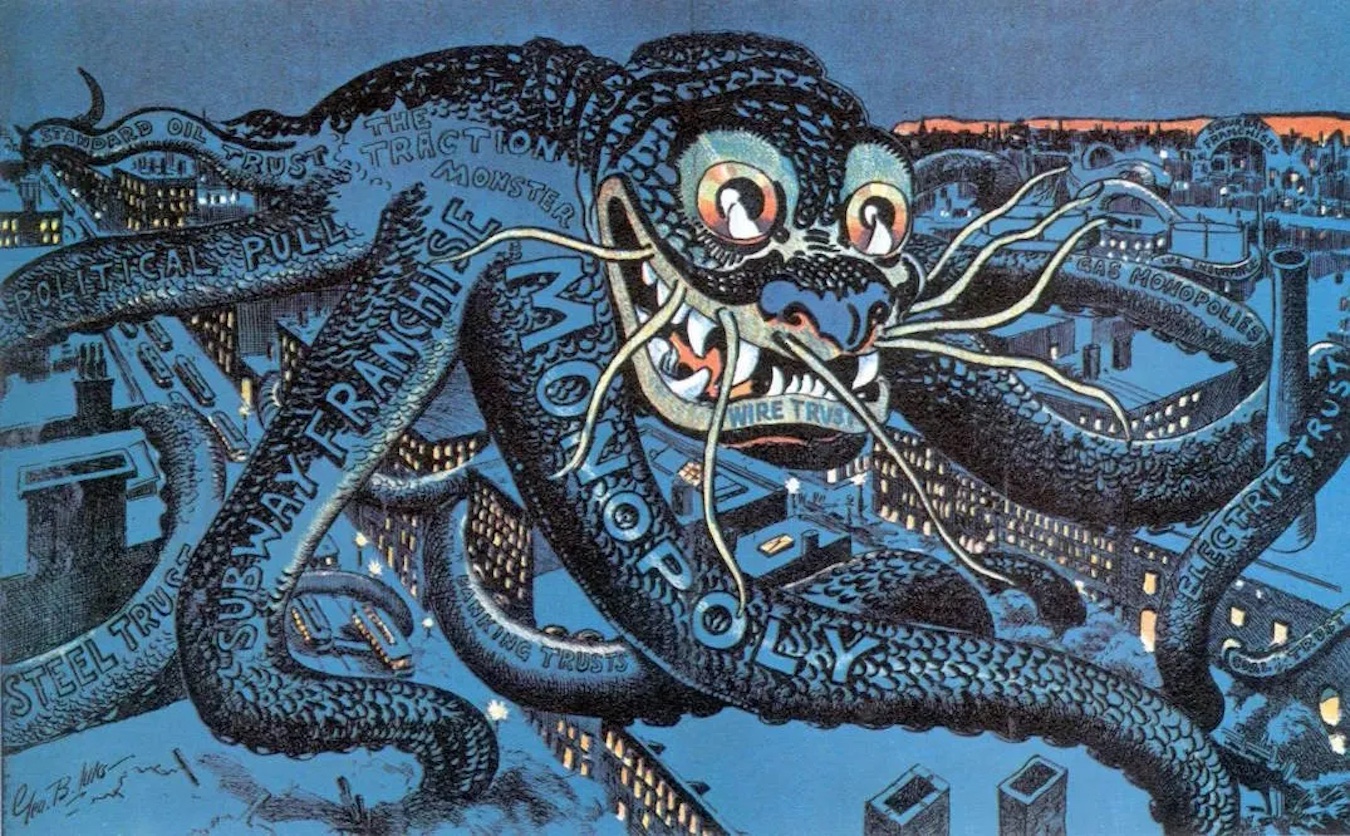
For more than a decade, economist and commentator Noah Smith stood firmly among the growing cohort of analysts convinced that rising corporate market power was inflicting widespread damage on the U.S. economy. Throughout the 2010s, a mounting body of circumstantial economic research supported this narrative, linking industrial concentration to a host of the country’s most persistent negative economic trends. In a 2017 analysis, Smith broke down the accumulating evidence like a detective building a case: rising national market concentration, expanding corporate price markups, growing industry profits, falling business investment, suppressed wages in concentrated labor markets, higher prices following mergers, weakened antitrust enforcement, and weakened overall output. While some points remained unconfirmed, the weight of evidence was compelling enough that Smith, writing at Bloomberg, repeatedly backed the argument that concentrated market power made the U.S. economy less efficient and more unequal, and that stronger antitrust enforcement was a worthy policy solution. He did, however, caution that antitrust was not a guaranteed fix, and argued that Big Tech was not an appropriate target for aggressive antitrust action. When Joe Biden won the presidency in 2020, Smith was optimistic that these academic ideas would finally translate to real policy change, particularly with appointments like Lina Khan signaling that the Democratic Party was ready to prioritize antitrust reform. For years, leading economists had built the intellectual case for aggressive antimonopoly action through books, research reports, and public warnings, culminating in the Biden administration’s historic shift toward stricter antitrust enforcement. While Smith criticized some of the Biden’s administration high-profile Big Tech antitrust actions — noting the government lost most of its cases and that the campaign against Meta was misaligned with actual market harms — he celebrated the incremental wins that antitrust regulators secured in mundane, concentrated sectors ranging from meat processing to pharmaceutical manufacturing. These wins were not enough to reverse decades of growing consolidation, but Smith held out hope they would create a chilling effect that slowed the march toward industry dominance by megacorporations. In recent years, however, Smith has developed increasingly serious doubts about the modern antimonopoly movement, even as his concern over unaccountable corporate power has grown amid the rise of AI and the corruption of the Trump era. What has turned him away from the movement is its growing tendency toward ideological monomania and the harmful policy outcomes that this obsession produces, he argues. Quoting a famous quip from economist Robert Solow, Smith notes that just as everything reminds Solow of sex, everything reminds today’s antimonopoly activists of corporate concentration. A 2024 deep dive by journalist Jonathan Chait into the movement’s origins, focused on founder Barry C. Lynn, laid bare this all-consuming ideological bent. Lynn frames monopoly power not as one of many pressing economic problems, but as the singular root cause of nearly every ill facing modern America, from rising wealth inequality to the growth of the radical right, to racism and homophobia, to the collapse of local news media. Antitrust, in Lynn’s framework, is not merely a regulatory tool but an all-encompassing ideology for reshaping all of American society. This totalizing theory is deeply flawed, Smith argues, with most of the links between concentration and social ills resting on flimsy, unproven assumptions. For example, to blame corporate concentration for a recent rise in racism requires accepting three unproven claims: that racism has actually increased in recent decades, that any increase is driven primarily by economic factors, and that those economic factors stem directly from corporate consolidation. Even on core economic questions, the evidence contradicts the antimonopoly narrative: multiple credible research teams have found that employer concentration in local U.S. labor markets has actually declined over recent decades, undermining the claim that monopsony power is the root cause of slow wage growth. During the post-pandemic inflation of 2021-2022, leading antimonopoly activists like Elizabeth Warren blamed “greedflation” — corporate price-gouging enabled by market power — for rising prices, but multiple rigorous studies have found that markups remained stable during the inflation surge, and that more concentrated industries actually passed less of their cost increases onto consumers. Even moderate antitrust experts acknowledge that the movement has strayed into overreach, with one former antitrust industry leader noting that neo-Brandeisian antimonopolists have turned antitrust from a law enforcement tool into a catch-all solution for every economic, political, and social problem facing the country. Yet this moderate perspective has been sidelined by the movement’s ideological leadership, whose obsession with concentration has led to misdirected policy actions that harm workers and consumers rather than helping them. For example, activists have targeted low-margin industries like grocery stores, health insurance, and airlines, even though these sectors consistently post profit margins below the national corporate average. During the post-pandemic inflation, Warren blamed high food prices on grocery chain market power, even though grocery margins actually fell as inflation accelerated, and the Biden administration’s blockage of the Kroger-Albertsons merger rested on the same flawed logic. Most notably, the Biden antitrust blockage of the Spirit-JetBlue merger led directly to Spirit going out of business entirely, putting 17,000 workers out of a job and ultimately increasing industry concentration anyway. On housing, the movement has pushed the popular narrative that corporate landlord buying of single-family homes is the primary cause of high rents, even though corporate ownership of rental housing remains a tiny share of the overall market, and multiple studies find corporate landlords actually charge lower rents on average than small independent landlords. The real driver of high rents is supply constraints, and the antimonopoly focus on corporate ownership distracts from policy solutions that would actually bring prices down. Beyond flawed policy targeting, the modern antimonopoly movement rejects core empirical principles of economic research, Smith argues. Movement leaders including Lynn and Lina Khan have openly denied the existence of market forces, claiming all prices are determined entirely by political power. This claim is empirically indefensible: basic observations from declining demand when prices rise to increasing fish prices after bad weather confirm that market forces shape outcomes across the economy. Even on the core claim that U.S. market power has increased steadily over recent decades, the empirical evidence remains far from settled. While researchers like De Loecker and Eeckhout found large increases in aggregate price markups, many other economists dispute this finding, pointing to widespread measurement challenges: ambiguous market boundaries, shifting product definitions, inconsistent geographic market definitions, difficulty allocating fixed costs across multi-product companies, and problems measuring risk-adjusted profits that produce wildly different results depending on the underlying assumptions researchers choose. The problem is that antimonopoly crusaders refuse to accept this uncertainty, and instead dismiss anyone who questions their claims as a paid corporate shill, closing off open debate and cementing ideological orthodoxy. This factional intolerance was on full display when the movement attacked Ezra Klein and Derek Thompson’s book *Abundance*, which argues for removing regulatory barriers to increase the supply of housing, energy, and other key goods. Instead of embracing the shared goal of expanding affordable abundance, movement leaders immediately attacked Klein and Thompson as corrupt corporate allies, simply because they were not part of the antimonopoly faction. This behavior, Smith argues, reveals that the movement prioritizes building factional power within the Democratic Party over advancing good policy. Any thinker or analyst who is not part of the clique is treated as an enemy, regardless of the content of their ideas. History is full of similar pseudo-cult intellectual movements that have captured political parties: on the Republican side, 1980s supply-side economics and modern national conservatism fit this pattern, while on the Democratic side, Modern Monetary Theory (MMT) rose and fell as a similar totalizing ideology. Unlike MMT, however, the antimonopoly movement has succeeded in capturing substantial power and prestige within the modern progressive movement, with backing from leading elected officials and major progressive media platforms. While Smith reaffirms that corporate power remains a real and pressing problem in the U.S. — particularly with the rise of large AI companies that threaten to amass unprecedented market and political influence — he argues the movement’s current monomania, epistemic closure, rejection of empiricism, and factionalism make it unfit to address this challenge. Meaningful reform to curb corporate power will require a more pragmatic, evidence-based approach that rejects the idea that breaking up monopolies is the solution to every problem, Smith concludes.