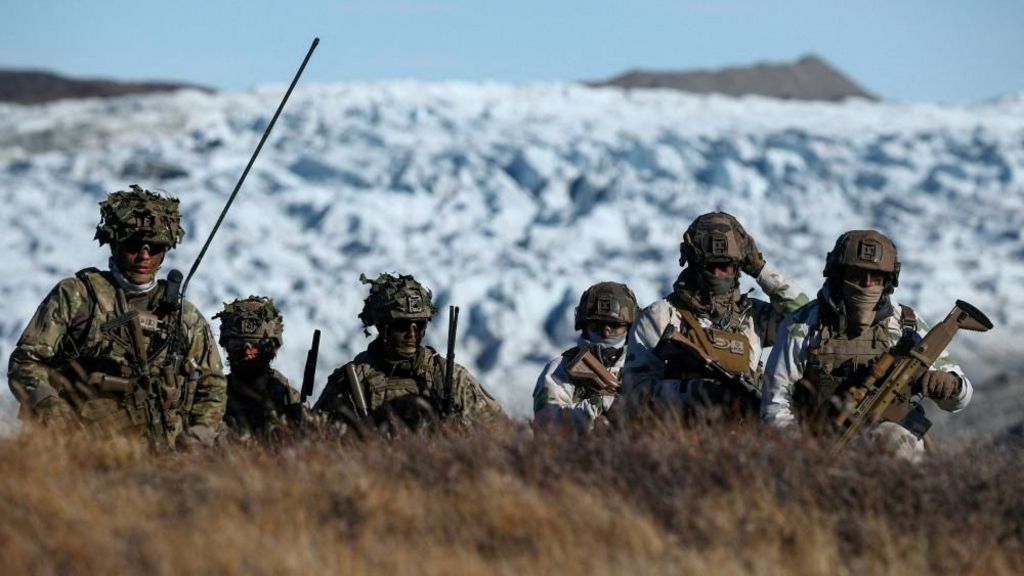
The White House has confirmed that all strategic options remain under consideration regarding Greenland, including potential military action, as articulated by former President Donald Trump. This revelation has triggered profound concerns within the NATO alliance, given the prospect of one member state initiating aggression against another—Denmark, which maintains sovereignty over the vast Arctic territory.
Trump has consistently framed Greenland as critically important to U.S. national security, alleging without substantiation that its waters are ‘covered with Russian and Chinese ships.’ Defense specialists analyzing the scenario acknowledge that a rapid military takeover would be operationally feasible due to Greenland’s minimal population of approximately 58,000 and virtually nonexistent military defenses. The territory relies on Denmark for protection, which maintains limited air and naval resources across the massive island, with certain remote areas patrolled only by the specialized Sirius Patrol unit using dog sleds.
Analysts like Hans Tito Hansen of Risk Intelligence and Justin Crump of Sibylline Ltd. suggest that the U.S. 11th Airborne Division, supported by air and naval assets, could execute an invasion with overwhelming force, potentially encountering little resistance. However, such an operation would blatantly violate international law and risk catastrophic diplomatic fallout, potentially fracturing NATO.
Despite the theoretical ease of invasion, numerous former U.S. officials and security experts deem military action highly improbable. Mick Mulroy, former Deputy Assistant Secretary of Defense, emphasized that any move toward military engagement would likely confront staunch Congressional opposition, invoking the War Powers Act to prevent unauthorized conflict.
Acquisition via purchase, reportedly the administration’s preferred method, presents another complex avenue. However, both the Greenlandic and Danish governments have firmly stated the territory is not for sale. Any potential treaty would require a two-thirds Senate majority and European Union approval—hurdles experts consider insurmountable. Furthermore, such expenditure could alienate Trump’s political base, which prioritizes domestic spending.
Alternatively, the U.S. might pursue a soft-power strategy, encouraging Greenland’s independence movement—polls indicate strong local desire for autonomy from Denmark, though not for assimilation into the U.S.—and subsequently establishing a defense partnership akin to agreements with Pacific nations like Palau. However, this approach would not grant the U.S. ownership of Greenland’s extensive mineral resources, likely a key motivator for the administration.
Ultimately, analysts concur that without support from the Greenlandic people, any non-military strategy to incorporate the territory will fail. As one expert noted, the current U.S. administration has a limited timeframe, while Greenlanders are considering their future over the next millennium.