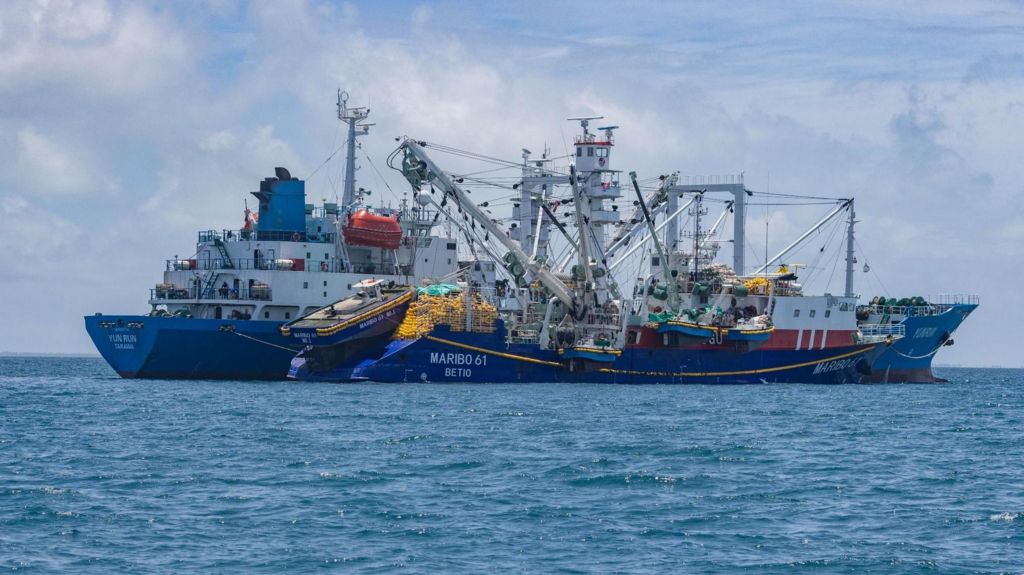
Stretching across more than 3.4 million square kilometers of the central Pacific Ocean, the small island nation of Kiribati holds an outsize role in the global tuna industry. Despite having a total land area roughly equal to that of New York City, this scattered archipelago of 33 islands sits at the heart of the world’s most productive tuna fishing grounds, which collectively supply more than half of the global tuna catch. For Kiribati, this abundant marine resource is not just a cultural cornerstone — it is the entire backbone of the country’s economy. Unlike larger Pacific neighbors such as Papua New Guinea, Kiribati has almost no other natural resources to draw on: its highest natural elevation above sea level is just two meters, with limited fresh water reserves and virtually no terrestrial mineral or agricultural assets. As a result, revenue from selling tuna fishing licenses to international fleets makes up more than 70% of the country’s total government income, the highest proportional dependence of any nation on Earth, according to official data. Between 2018 and 2022, this revenue equaled roughly 40% of Kiribati’s entire GDP, figures from the International Monetary Fund show. In 2024 alone, license sales generated $137 million for the government, a sum officials describe as a “critical financial lifeline” for the nation of 130,000 people. Today, large fishing vessels from major tuna-consuming nations including Japan, China, the United States, and European Union member states travel to Kiribati’s Exclusive Economic Zone (EEZ) to harvest the region’s abundant stocks of skipjack, yellowfin, and bigeye tuna. As veteran fisheries specialist Simon Diffey, who has worked on Kiribati for more than 30 years, notes, more than half of all canned tuna sold globally comes from the Western Central Pacific, including Kiribati’s waters. The global tuna industry is currently valued at over $44 billion per year, making Kiribati’s control over its vast EEZ an invaluable economic asset. Yet the same ocean that sustains Kiribati now threatens its very survival, driven by the impacts of human-caused climate change. Warming ocean temperatures are already reshaping tuna migratory patterns, and scientists warn that the tiny nation is at extreme risk of losing its most valuable natural resource. Tuna are extremely sensitive to even small shifts in water temperature, able to detect changes as small as one-tenth of a degree Celsius. As Pacific surface waters warm, research consistently shows that tuna populations are migrating eastward in search of cooler habitats — a shift that would pull stocks permanently out of Kiribati’s EEZ. For Kiribati, this potential migration carries cascading economic and food security risks. If tuna leave the country’s territorial waters, international fleets will no longer purchase fishing licenses, sending government revenue plummeting and creating extreme fiscal volatility. The Pacific Community, a regional development organization, has identified Kiribati as one of the nations worst impacted by projected tuna migration. Preliminary modeling from Kiribati’s Ministry of Fisheries estimates that if global greenhouse gas emissions remain at high levels, the country could lose more than $10 million in annual fishing access fees by 2050. Even in a best-case low-emissions scenario, where overall tuna biomass in Kiribati’s EEZ remains stable, local small-scale fisheries are still projected to see substantial catch declines. The Line Islands, one of Kiribati’s three island groups, could see local catches drop by two-thirds even under low emissions. These declines come as Kiribati’s population grows and rapid urbanization in the capital Tarawa puts additional strain on already limited land and food resources. Fish have long been the primary source of protein for Kiribati’s communities, with the average resident consuming 100 kilograms of fish per year — more than 10 times the average per capita consumption in the United States. As local stocks decline, households are increasingly turning to imported processed foods, which drives up household costs and reduces nutritional quality, especially for remote outer island communities. The United Nations Food and Agriculture Organization warns that this shift is creating a growing food security crisis for the nation. Facing these overlapping threats, Kiribati and international partners are rolling out new adaptation strategies to build resilience and diversify the country’s economy. Last year, the United Nations Green Climate Fund launched a $156.8 million regional adaptation project covering 14 Pacific nations and territories, focused on supporting tuna-dependent economies like Kiribati. The initiative aims to strengthen early warning and stock monitoring systems to help Kiribati better predict tuna migrations, protect food security, and stabilize government revenue. According to Kiribati’s Ministry of Fisheries, the project is expected to provide roughly four million nutritious fish meals annually for local communities. The Kiribati government is also pursuing domestic economic shifts to reduce its dependence on foreign license sales. It is expanding domestic tuna processing and canning facilities to capture more value from its tuna resources, rather than exporting the raw catch via foreign fleets. Officials are also developing ocean aquaculture for species including milkfish, snapper, and sea cucumbers, to both boost domestic food security and create new export opportunities. Beyond the fishing sector, the government is working to diversify national revenue through expanding tourism, developing renewable energy infrastructure, and growing the country’s offshore sovereign wealth fund. “Kiribati retains grounds for optimism and strategic opportunity,” says Riibeta Abeta, permanent secretary for Kiribati’s Ministry of Fisheries. Still, the nation faces an existential threat from the broader impacts of climate change, with even the most ambitious adaptation measures dependent on global action to cut greenhouse gas emissions and slow ocean warming.