Three years into Sudan’s brutal civil conflict, orthopedic surgeon Dr. Jamal Eltaeb has faced one impossible, gut-wrenching choice after another. Which wounded patient will get the last vial of painkiller? Is it ethical to operate without proper anesthesia to save a dying child? Where will the next liter of generator fuel come from to keep the hospital’s lights on? Through all of it, only one decision has ever felt inevitable: he would stay and keep working.
Eltaeb now leads Al Nao Hospital in Omdurman, the urban neighbor of Sudan’s capital Khartoum, a territory that has changed hands repeatedly between Sudan’s national army and the Rapid Support Forces (RSF), the country’s powerful paramilitary group. As front lines shifted closer to the facility and patient overflow stretched its capacity to breaking point, many of his colleagues fled for safety. But the soft-spoken 54-year-old surgeon refused to leave, even after repeated bombing strikes on the hospital and the near-total depletion of critical medical supplies.
“I weighed the options of staying here, and taking care of your patients and helping other people that need you as a skilled surgeon, rather than choose your own safety,” Eltaeb explained in an interview with The Associated Press.
He is one of thousands of Sudanese medical workers and civilians who have stepped forward to fill the gap left by a largely disengaged international community, which has turned most of its attention and humanitarian resources to ongoing conflicts in Ukraine and the Middle East. Eltaeb has borne firsthand witness to the human cost of the war, which the United Nations estimates has killed tens of thousands of people and pushed Sudan’s entire public health system to the brink of collapse. Today, nearly 40% of the country’s hospitals are no longer functional; many have been stripped of critical equipment or repurposed as military bases by armed factions. Even after the Sudanese army retook full control of Khartoum in recent months, Al Nao remains one of the only fully operational health centers in the entire capital region.
Walking through the hospital grounds with AP journalists, Eltaeb pointed to the lingering scars of the conflict’s worst months. A shattered window across the courtyard marks the spot where a patient’s family member was killed in a strike. A tattered canvas tent is the last remaining structure of the temporary encampment erected to hold hundreds of mass casualties when the fighting reached its peak.
“We were working everywhere, in tents, outside, on the floor, doing everything to save patients’ lives,” he said.
Eltaeb’s extraordinary sacrifice has earned global recognition: he is this year’s recipient of the $1 million Aurora Prize for Awakening Humanity, an award that honors individuals who risk their own lives to save others. He has already donated a large portion of the prize funds to medical and humanitarian organizations working across Sudan and neighboring crisis zones.
Before the war broke out in April 2023, Al Nao was a quiet community hospital that rarely filled its 100 available beds. When RSF fighters captured large swathes of Khartoum in the first weeks of conflict, wounded residents flooded the facility seeking care. Eltaeb’s original hospital closed just days after the war began, so he relocated to Al Nao to help. By July 2023, nearly all the facility’s senior staff had fled the capital, leaving Eltaeb to take charge of the hospital with only a small team of remaining employees and local volunteers.
For weeks at a time, the hospital had no access to grid electricity, relying on irregular fuel deliveries from the army to keep generators running. Antibiotics, painkillers, and anesthetics quickly ran out as demand for care surged. Just a month after Eltaeb took leadership, the facility was hit by its first bombing strike.
“From that moment, we knew that we are a target … And from that time, they didn’t stop targeting us,” Eltaeb said. The RSF carried out three additional strikes on the hospital in the months that followed.
On one particularly devastating day in late 2024, an airstrike hit a nearby market, leaving more than 100 wounded people desperate for care. Eltaeb and his small team were forced to triage patients under extreme pressure, making impossible calls on who would receive what little care was available. Eight people died that day.
“You choose … as if you can choose who is going to live and who is going to die,” he said.
The day brought an even more harrowing choice: Eltaeb had to perform emergency amputations on two young children without general anesthetic, as the children were bleeding heavily and there was no time to move them to the damaged operating wing. Using only local anesthetic, he removed an arm and a leg from a 9-year-old boy, and a leg from his 11-year-old sister. Today, Eltaeb keeps photos of the surgeries on his phone, to show the world the unreported horror of Sudan’s conflict that few outsiders have witnessed.
To keep the facility supplied, Eltaeb’s team turned to a network of local volunteers. When the team posts requests for critical medications on social media, local pharmacists who have closed their shops amid the conflict often donate their stock, sending volunteers to collect the supplies. Volunteer Nazar Mohamed spent months navigating Omdurman’s bomb-damaged streets, often traveling by bicycle, to deliver medications while fighting echoed across the city. International donations came from aid groups and the global Sudanese diaspora, with Sudanese doctors living overseas providing remote clinical guidance for treating mass casualties when standard medications run out. When medical supplies ran low, the team improvised: they built makeshift beds and crutches from scrap wood and repurposed ordinary clothing as bandages and splints.
Today, fighting has shifted away from the Khartoum area to other regions of Sudan, and many international aid groups that supported Al Nao have redirected their limited resources to harder-hit zones. Eltaeb says the hospital currently has enough funding to cover staff salaries and generator fuel only through June, and it needs roughly $40,000 per month to stay operational. While several countries have pledged reconstruction aid to Sudan, local medical leaders worry that the ongoing conflict in the Middle East will divert attention and funding, particularly from Gulf states that had originally promised major support for Sudan’s recovery.
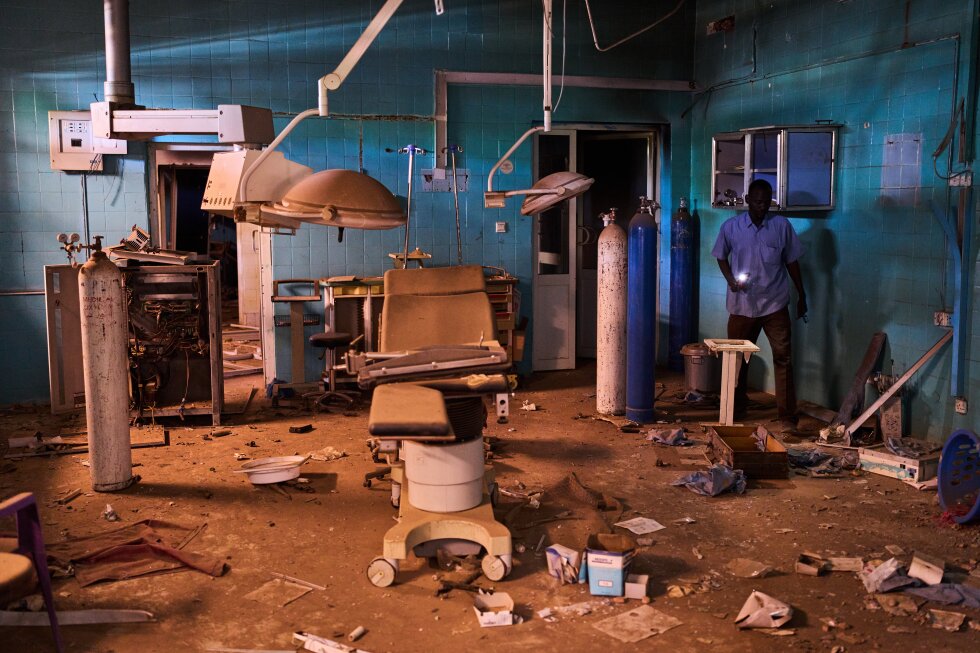
Across Omdurman at Al Shaabi Hospital, which was occupied by the RSF for most of the war, director Dr. Osman Ismail Osman says the few hundred thousand dollars in government funding provided for repairs is nowhere near enough to rebuild the completely destroyed facility. Millions of dollars of medical equipment lie broken and piled in dusty corridors, scattered with chunks of concrete from damaged walls and twisted metal bed frames. The goal of reopening the hospital for emergency care in the coming weeks is a distant ambition.
But for medical workers like Eltaeb, who have learned to keep working through even the most impossible circumstances, hope persists. “I believe I did my best as a doctor as a Sudanese,” the surgeon said.