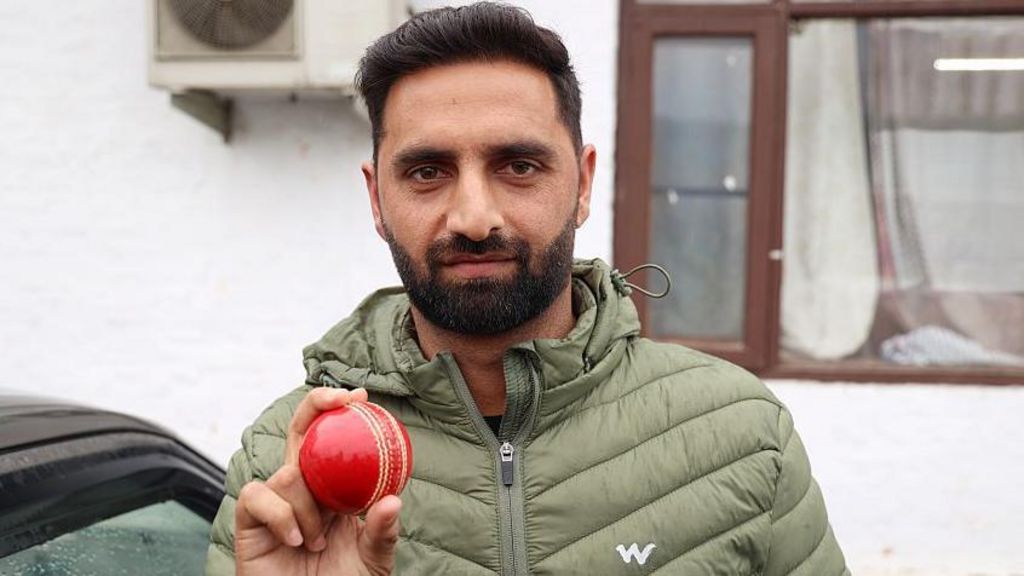
Decades of systemic challenges, harsh climatic conditions, and limited sporting infrastructure have long stood between Jammu and Kashmir’s aspiring cricketers and the highest levels of the sport. But for 29-year-old all-rounder Auqib Nabi, a childhood promise of greatness has turned into history, as he becomes the first cricketer from the region to earn a call-up to India’s men’s Test cricket squad.
Auqib’s inclusion replaces star fast bowler Jasprit Bumrah for India’s upcoming two-match Test series against Sri Lanka, which is scheduled to kick off on 15 August. The milestone is more than a personal win: it marks a watershed moment for cricket development across a region that has spent decades battling systemic and environmental barriers to professional sport.
Growing up in a remote village in Jammu and Kashmir’s Baramulla district, Auqib cut his teeth playing cricket on uneven local grounds with almost no formal infrastructure. His father, Ghulam Nabi Dar, a local schoolteacher, initially pushed his son to prioritize academic study and pursue a career in medicine, echoing the widespread local belief that professional cricket offered no viable future for young people from the region. “There was no scope in cricket. We used to think playing sport was a waste of time, so I insisted that Auqib focused on his studies,” Ghulam explained in reflections on his son’s early journey.
But Auqib’s relentless passion for the game eventually changed his father’s mind. After years of watching his son dedicate every spare moment to training, Ghulam reversed his position and became one of Auqib’s strongest supporters. “After seeing his passion for cricket, I accepted it. I realised that, as a parent and a teacher, I shouldn’t force him to do something he didn’t want to do. I started supporting him,” he said.
Even childhood friends recalled how out of reach a professional cricket career seemed for young players in the region. Junaid Dar, Auqib’s childhood companion, remembers questioning Auqib’s unwavering commitment at a time when professional sport was barely a concept in local communities. “Auqib was obsessed with cricket from childhood. I used to ask him, ‘Why are you doing all this? There’s no future in it.’ We came from a place where there was no concept of playing sport professionally and hardly any infrastructure,” Junaid said.
To access the training facilities he needed to develop his skills, Auqib made a grueling 70-kilometer round trip to Srinagar nearly every day just to practice on regulation cricket pitches. When he attended his first formal cricket trials, he did not even own a proper pair of spiked cricket shoes. For a full decade, he stuck to a brutal daily routine: rising before dawn for gym work, then spending the rest of the day honing his craft on the pitch. “Auqib is very hardworking and consistent. He knows how to fight obstacles and make a way for himself. He would wake up early to go to the gym and then practise for the rest of the day. He did that almost every day for 10 years,” said Auqib’s cousin Bilal Ahmad Dar.
That decade of grind began to pay off in 2020, when Auqib made his debut in the Ranji Trophy, India’s elite domestic first-class cricket competition, representing Jammu and Kashmir. He announced his arrival with a stunning five-wicket haul against Jharkhand in his first outing, signaling the arrival of a promising new fast-bowling talent.
Parvez Rasool, Jammu and Kashmir’s first-ever international cricketer and Auqib’s long-time captain, has watched the all-rounder’s progress from the early days of his career. He says Auqib’s extraordinary work ethic and discipline have always set him apart from his peers. Success, however, did not come overnight. Even after finishing as the leading fast bowler in the 2024–25 Ranji Trophy season with 44 wickets, Auqib remained largely overlooked by national selectors, a snub that stung for the player and his support system. “When you do well but don’t get recognition, it hurts. But we should never lose hope. Hope is what keeps the world intact. I always believed his time would come,” Ghulam said.
That patience paid off in the following season, when Auqib delivered one of the most dominant bowling campaigns in modern Ranji Trophy history. He claimed 60 wickets across 10 matches, finishing as the tournament’s top wicket-taker and leading Jammu and Kashmir to their first-ever Ranji Trophy title, a historic win that ended a 67-year wait for the region.
That standout performance earned Auqib a blockbuster INR 84 crore (approximately £730,000 or $982,000) contract with the Delhi Capitals in the Indian Premier League. While he received limited playing time in the high-profile T20 league, his red-ball form had already caught the attention of India’s national selection panel, paving the way for his historic Test call-up.
For Rasool, Auqib’s achievement carries significance that extends far beyond the player himself. “Playing Test cricket is the ultimate dream for any cricketer. It was my dream too. Seeing Auqib earn that call-up fills me with immense pride. In a way, it feels like a dream many of us in Jammu and Kashmir carried has finally been realised through him. It is a historic moment not just for Auqib and his family, but for cricket across the region,” Rasool said.
He emphasized that breaking into the Indian national team requires an extra level of resilience for players from Jammu and Kashmir, where decades of underdevelopment, conflict, and limited access to facilities create barriers that players from other parts of India rarely face. “Making it to the Indian team is incredibly difficult for any player, but the challenge is even greater when you come from Jammu and Kashmir. For years, we have had limited infrastructure, fewer opportunities and many obstacles that players from other parts of the country don’t necessarily face. To reach this level, you need exceptional consistency, mental strength and the determination to keep believing in yourself. Auqib has shown all of those qualities, which is why this achievement is so special,” Rasool explained.
Jammu and Kashmir first gained affiliation with the Board of Control for Cricket in India (BCCI) in 1957, but to this day the region only hosts two major cricket stadiums, both with limited facilities. Long, snow-heavy winters and decades of regional instability have further slowed the growth of organized cricket in the area. “This is a landmark moment for cricket in Jammu and Kashmir. For a long time, people questioned whether someone from our region could make it to India’s Test team. Auqib has answered that question. His selection shows players from Jammu and Kashmir can compete with the best if they are given the opportunity,” Rasool said.
Rasool believes Auqib’s journey will inspire a new generation of young cricketers across the region, filling a gap that has long existed for local sporting role models. “When I started playing, there weren’t many role models from Jammu and Kashmir. Today, things are changing. Auqib becoming the first player from the region to earn an India Test call-up will give countless youngsters the belief that they can dream big too. His journey proves that no matter where you come from or what challenges you face, hard work and perseverance can take you to the highest level,” he said.
Back in Auqib’s home district of Baramulla, Ghulam Nabi Dar has become a local celebrity overnight, recognized everywhere he goes by community members celebrating his son’s achievement. “People come up to me, hug me and say, ‘This is Auqib’s father.’ It makes me immensely proud,” he said. The milestone caps a remarkable journey that began with a young boy’s bold promise to his cousin: that one day, cricket’s biggest stars would be asking *him* for a selfie. That day has now arrived.