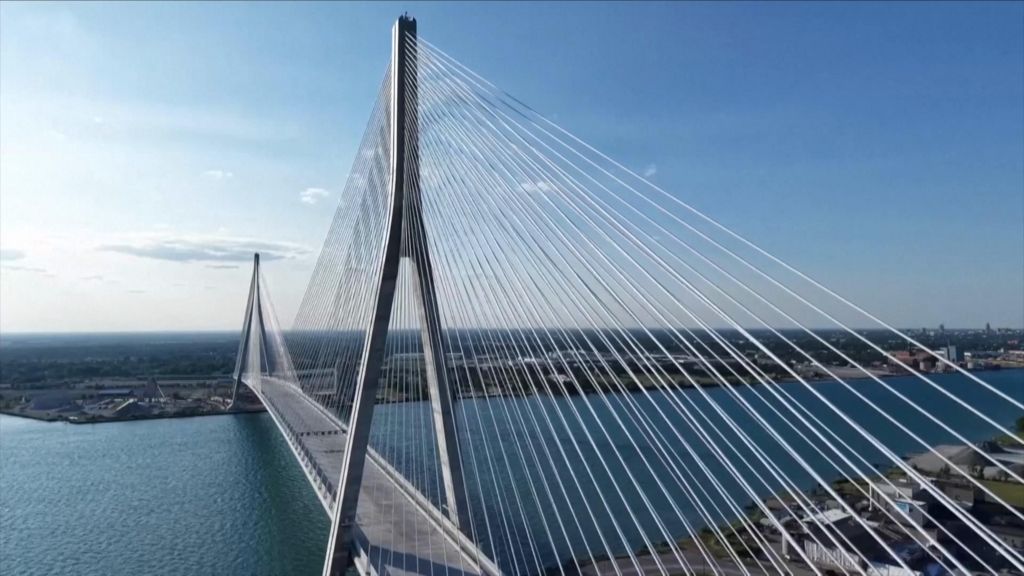
After years of planning and construction, the Gordie Howe International Bridge, a infrastructure project designed to connect the United States and Canada across the Detroit River, has finally opened its lanes to commercial and passenger vehicle traffic. But what was meant to be a landmark celebration of cross-border collaboration has instead emerged as a stark symbol of the growing frictions between the two North American neighbors, opening against a backdrop of simmering trade tensions that have strained their longstanding economic partnership.
For decades, the crossing has been hailed as a transformative project that would cut congestion at existing border checkpoints, slash transit times for commercial freight, and boost economic activity on both sides of the river. Spanning nearly 1.5 miles, the bridge connects Detroit, Michigan, in the US with Windsor, Ontario in Canada – two cities at the heart of the $700 billion annual cross-border trade relationship between the two countries. When the first motorists rolled across the new span this week, officials from both nations acknowledged the infrastructure milestone, but the festive mood was undercut by ongoing disagreements over trade policy that have raised tensions in recent months.
The trade row that has overshadowed the opening centers on a range of lingering disputes, from US tariffs on Canadian steel and aluminum implemented in previous years to disagreements over dairy market access and clean energy subsidy rules that have created frictions in the post-USMCA trade era. Analysts note that while the bridge itself is designed to facilitate smoother trade flows, its launch amid ongoing disagreements highlights how political tensions can overshadow even the most ambitious cross-border infrastructure projects. What was intended to stand as a monument to cooperation has instead become a talking point for critics on both sides, who point to the unresolved disputes as evidence of growing rifts in the bilateral relationship.
Despite the tensions, many business leaders on both sides of the border still emphasize the long-term benefits of the bridge. They argue that once trade disputes are resolved, the new crossing will deliver significant economic gains, reducing supply chain delays that have cost businesses millions of dollars annually. For now, however, the Gordie Howe International Bridge carries a symbolic weight that extends far beyond its role as a transportation link: it serves as a reminder of how closely the economic fates of the US and Canada are tied, even as political disagreements continue to test their partnership.