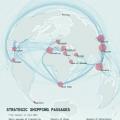
For more than 500 years, narrow maritime straits across the globe have stood as the unshakable backbone of international commerce, and equally as persistent flashpoints for great power rivalry that shape global geopolitics to this day. Today, growing friction around two key Middle Eastern waterways underscores just how much these small stretches of water continue to hold the global economy hostage to political conflict.
As Iran increasingly asserts unilateral control over the Strait of Hormuz, the primary maritime gateway to the Persian Gulf, its Yemeni allied faction the Houthi movement has launched repeated disruptions to commercial shipping transiting the Red Sea en route to and from Saudi Arabian ports. Experts warn this unrest could easily spill over to the Bab el-Mandeb Strait, the mandatory passage for all vessels traveling between the Red Sea and the Suez Canal, one of the world’s most vital man-made trade routes.
Hormuz, Bab el-Mandeb, and roughly 10 other straits globally are classified as critical strategic chokepoints for international trade. Every year, thousands of vessels—from oil and liquefied natural gas tankers to bulk cargo ships and container carriers carrying consumer goods and raw materials—pass through these narrow natural maritime corridors, their operations critical to keeping global supply chains moving and energy prices stable.
Sylvain Domergue, a geography lecturer at Sciences Po Bordeaux and author of *Geopolitics of Maritime Spaces*, explained the international legal framework governing these waterways in an interview with AFP. The 1982 United Nations Convention on the Law of the Sea (UNCLOS), signed in Montego Bay and widely described as the global constitution for the world’s oceans, formally enshrines two core rules for natural straits: they cannot be subject to commercial tolls, and the principle of free and unrestricted navigation for all vessels is guaranteed under international law. This stands in contrast to man-made waterways such as the Suez Canal and Panama Canal, where the nations that control the infrastructure have the legal right to charge transit tolls for passage.
Domergue noted that while Iran has never formally ratified the UNCLOS convention, it has abided by its free navigation principle for decades as a matter of customary international law—something that is changing as Tehran escalates its geopolitical posturing.
The struggle for control over strategic straits dates back centuries. As early as 1507, Portugal, whose explorers pioneered European sea access to South Asia and the East Indies, attempted to seize full control of Hormuz to lock in a monopoly over trade in spices and other valuable commodities from the Orient. That early attempt at control sparked a centuries-long debate over maritime sovereignty, which eventually settled on the *Mare Liberum* doctrine put forward by Dutch jurist and philosopher Hugo Grotius in the early 17th century. Grotius’ core thesis—that the sea is the shared property of all nations, belonging to no single state—became the foundation for modern international rules on navigation, with straits recognized as critical to enabling long-distance global trade.
“To guarantee freedom of navigation across the world’s oceans, one had to start by guaranteeing freedom of passage through straits,” Domergue explained. The Netherlands championed this doctrine, and was later joined by Britain, and eventually the United States. While the U.S. has also never ratified UNCLOS, it adheres to almost all of the convention’s provisions to this day.
However, the principle of free navigation did not stop European powers from shaping their colonial expansion around control of strategic straits. Britain built its global naval empire around key military outposts along critical waterways: its largest Asian colonial naval base was built in Singapore, which gives it direct oversight and control over the Strait of Malacca, the chokepoint that today carries the largest share of global maritime trade bound to and from China. Britain also established a key outpost on Socotra Island, located just off the Bab el-Mandeb Strait at the southern entrance to the Red Sea.
In Europe, the Danish straits (the Oresund and Kattegat), which connect the Baltic Sea to the North Atlantic, were a major 19th century flashpoint. For centuries, Denmark charged transit tolls for passage through the waterways, and they remain strategically critical today, as they control all Atlantic access for Baltic nations, most notably Russia.
The only major global straits where tolls are still legally collected today are the Turkish Straits—the Bosphorus and the Dardanelles. They are governed by the 1936 Montreux Convention, an earlier international agreement that predates UNCLOS and preserves Turkey’s right to charge for transit.
Looking ahead, Domergue warned that new tensions over strategic straits are already emerging in other parts of the world. The Taiwan Strait has become an increasing flashpoint amid China’s rising territorial claims in the Indo-Pacific, while the Strait of Malacca—shared by Singapore, Malaysia, and Indonesia—carries its own set of unresolved sovereignty and economic disputes.
Domergue pointed to growing low-level friction in the Taiwan Strait, where he noted there is already an ongoing “sand war”: Chinese vessels regularly travel into waters claimed by Taiwan to dredge marine sand for China’s construction sector, a move widely viewed as deliberate provocative encroachment.
More recently, when Iran announced plans to introduce a new transit toll for the Strait of Hormuz, the Malaysian prime minister initially publicly praised the idea and suggested Malaysia could follow suit for the Strait of Malacca, before quickly walking back the comment. If tolls were introduced for Malacca, Domergue argued, Singapore would suffer a major blow to its status as the premier logistics and trade hub for East Asia.
Today, as geopolitical tensions rise across the Middle East and Indo-Pacific, these centuries-old disputes over control of the world’s most critical maritime chokepoints remain as relevant to global trade and security as they were 500 years ago.