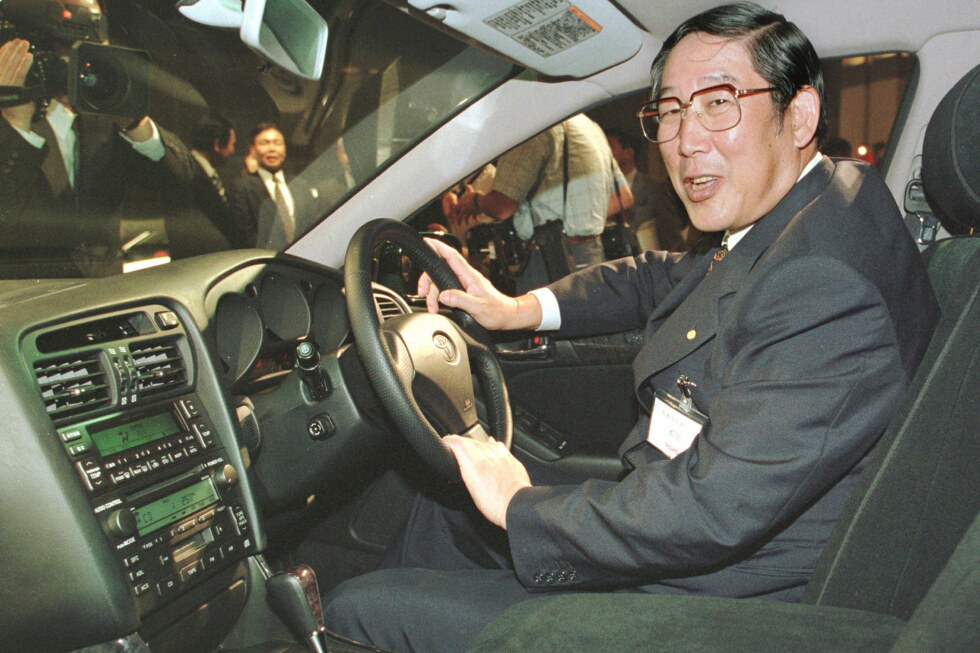
TOKYO – Toyota Motor Corporation announced Wednesday the passing of Hiroshi Okuda, the former chief executive who guided the Japanese automaker through an era of unprecedented global growth. Okuda was 93 years old, and details on the date and specific cause of his death have not been released to the public as of the announcement.
Okuda’s 45-year tenure at Toyota spanned transformative roles, including 11 years as the company’s president and chairman from 1995 to 2006. He leaves a lasting legacy centered on two landmark contributions to the global auto industry: the development of the world’s first mass-produced gas-electric hybrid vehicle, the Prius, launched in 1997, and the aggressive, strategic expansion of Toyota’s manufacturing and sales footprint across North America and Europe.
At the time of its launch, the Prius represented a groundbreaking leap in fuel-efficient automotive technology, emerging at a moment of already rising global gasoline prices. The model quickly became an international symbol of the auto industry’s shift toward more sustainable, green mobility, and cemented Toyota’s decades-long reputation as a leader in fuel efficiency — a standing the brand extended across its lineup, including top-selling models like the Camry.
Born in central Japan, the same region that hosts Toyota’s global headquarters, Okuda graduated from Tokyo’s prestigious Hitotsubashi University in 1955 with a degree in business. What made his rise to the top of Toyota unusual was that he was not a member of the founding Toyoda family, a break from the traditional leadership structure that had long defined the automaker. Known for his frank speaking style and approachable sense of humor, Okuda held a black belt in judo and was ahead of his time in Japanese corporate culture when it came to advocating for leadership turnover and empowering younger executives.
Long before the current wave of generational corporate shift, Okuda pushed for handing leadership reins to executives in their 50s rather than keeping power concentrated among leaders in their 60s, a rare priority for Japan’s traditional business sector in his era. He summarized his philosophy of adaptive change in a 2005 press conference, stating: “A company must change when things are going well. There’s no point in trying to change after things start going bad.” This commitment to organizational agility aligned perfectly with Toyota’s founding “kaizen” principle of continuous improvement, which paired with the company’s just-in-time production system that minimizes excess inventory to drive operational efficiency.
As Toyota grew to challenge the dominance of Detroit’s “Big Three” U.S. automakers — General Motors, Ford, and Chrysler — Okuda openly warned of potential political and public backlash against the Japanese brand’s rising market share. He consistently emphasized that the auto industry was an interconnected global sector, often using the term “harmony” to frame his vision of cross-border collaboration. By the 1990s and early 2000s, Toyota and other major Japanese automakers were posting record profits while U.S. automakers struggled with deep losses, stoking “Japan-bashing” sentiments that had first emerged in the 1980s. Critics at the time also argued that a weak yen gave Japanese automakers an unfair trade advantage, as it increases the yen value of overseas earnings when converted back to the domestic currency. Okuda remained a key strategic adviser to Toyota’s board after stepping down as chairman, and was part of the organization when it added its first American board member, Jim Press, in 2007.
Outside of his work at Toyota, Okuda was one of the most respected figures in Japan’s broader business community. He served as the head of multiple influential Japanese business groups, including the Japan Business Federation (Keidanren), the Japan Automobile Manufacturers Association, the Japan Federation of Employers’ Associations, and sat on Japan’s Prime Minister’s Economic Strategy Council.
Toyota has not released details about Okuda’s surviving family. According to the company, funeral arrangements are being handled privately by Okuda’s family, and a public memorial ceremony may be announced at a later date.