On the rugged, untamed West Coast of New Zealand’s South Island, a dramatic story of community kindness and canine resilience has come to a heartwarming close, nearly a week after a hiking accident left an injured hiker separated from her beloved pet.
The incident unfolded on March 24, when 34-year-old hiker Jessica Johnston slipped and fell 180 feet (55 meters) from a rocky waterfall along the Arahura River, while trekking through remote native bush with her 4-year-old border collie, Molly. Emergency rescuers were quickly dispatched to the hard-to-reach location, where they found Johnston alive but suffering extensive bruising and deep lacerations across her body. With the hiker’s condition requiring urgent medical care, crews airlifted her to a nearby hospital, but a frantic initial search for Molly turned up no trace of the dog, forcing rescuers to leave the missing canine behind in the unforgiving wilderness.
For Matt Newton, owner and lead pilot of Hokitika-based Precision Helicopters Ltd — whose operating base sits just a short distance from the Arahura River — the story didn’t end there. After reaching out to Johnston while she recovered in hospital to offer his support, Newton committed to launching his own sustained search for Molly. He made multiple initial flights over the search area, but dense vegetation and tricky terrain blocked all efforts to locate the dog.
Refusing to abandon the mission, Newton and his family launched a public fundraiser to cover the cost of additional flight time and specialized thermal imaging equipment required for a more thorough search. The appeal resonated deeply with the public, and within days, hundreds of strangers from across New Zealand and beyond contributed more than NZ$11,000 (US$6,300), far exceeding the fundraising goal.
With funding secured, Newton launched a renewed search on March 31, bringing on board a veterinary nurse, trained volunteer searchers, and a tracking dog named Bingo to assist in the operation. Just an hour after the helicopter took to the skies, the team hit a breakthrough: thermal imaging picked up a heat signature matching a dog near the base of the waterfall, just meters from the spot where Johnston had fallen a week prior.
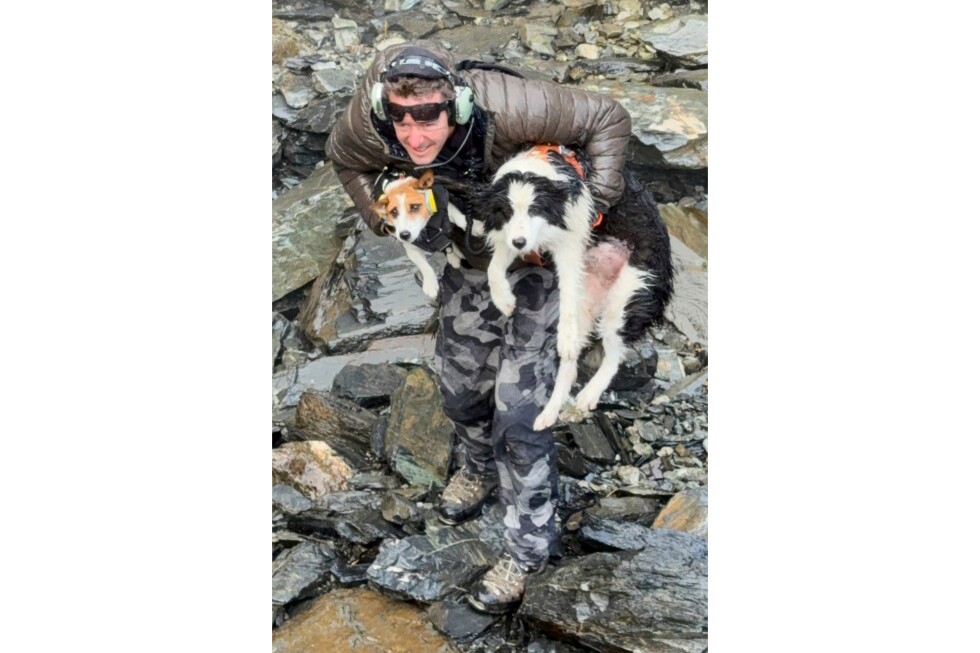
The helicopter descended to a narrow ledge near the riverbank, allowing a volunteer and tracking dog Bingo to disembark and coax the scared, hungry Molly out of hiding. Rescuers described the border collie as thin, bedraggled, and hungry, but surprisingly steady; she did not run from the team, and allowed them to approach and secure her safely. Newton later shared that he believes Molly survived her seven days alone in the wild by preying on small feral animals that inhabit the river valley.
After the successful extraction, Molly was brought back to the Precision Helicopters base, where waiting volunteers had planned to rotate into search crews. Instead, they scrapped the scheduled flight rotations, gathered for an impromptu celebratory barbecue, and took turns greeting and cuddling the rescued dog. Just hours later, Johnston — still recovering from her injuries — was able to travel to the base for an emotional, tearful reunion with her long-lost companion.
Newton noted that the joy of being reunited with Molly is already giving Johnston a major emotional boost as she recovers. “Having your dog back, that’s for sure… that’ll speed up her healing process a whole lot,” he said. Images released by Precision Helicopters captured the tender reunion, as well as the moments of Molly’s extraction from the remote river edge.
The story has captured hearts across New Zealand, a testament to the power of collective community goodwill to bring about a happy ending that no one expected after the original hiking accident.