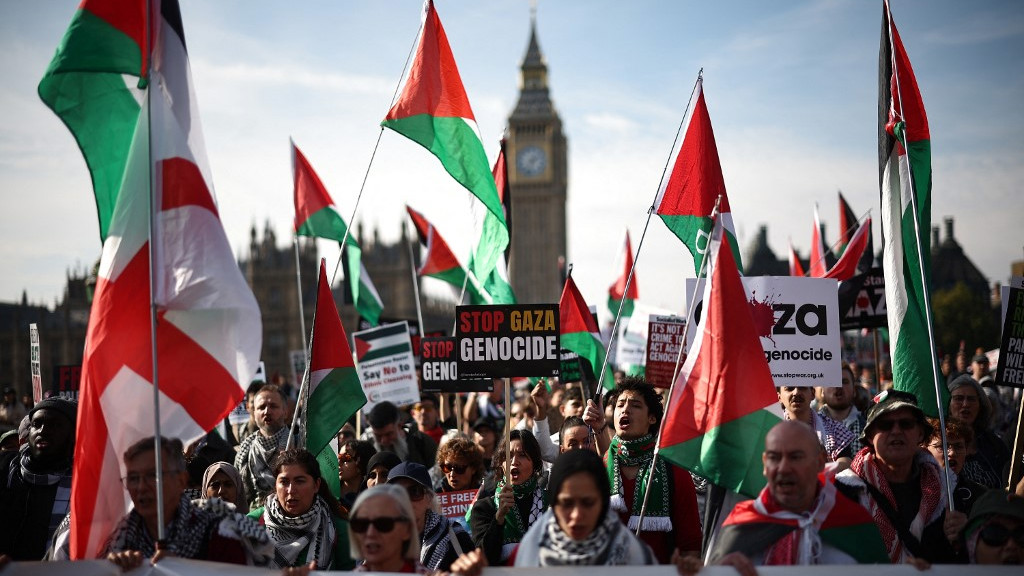
Exclusive new data obtained by Middle East Eye (MEE) has uncovered a striking electoral trend from England’s 7 May local elections: candidates who publicly backed Palestinian rights outperformed nominees from most major established parties, only trailing the right-wing Reform Party in win rates for contested seats.
The data confirms that public opposition to ongoing British policy cooperation with Israel remains a deeply resonant political issue across England, and that running on a clear pro-Palestine platform has emerged as a measurable predictor of electoral success in dozens of local races.
All candidates who signed the Palestine Solidarity Campaign (PSC)’s widely supported “Pledge for Palestine” secured victory in 27% of the seats they contested. By comparison, Reform candidates posted a 30% win rate, while the Labour Party — the current national governing party — won just 22% of its contested seats, and the Liberal Democrats followed closely behind at 21%.
More than 1,600 candidates across the political spectrum signed the pledge, which commits elected officials to use their local office to advance Palestinian human rights. Signatories vow to take all appropriate steps to uphold the inalienable rights of the Palestinian people, and to support efforts to secure accountability for what the pledge frames as Israel’s crimes of genocide, military occupation, ethnic cleansing and apartheid.
The pledge also requires candidates to prevent their local councils from complicity in or normalization of Israel’s alleged violations of international law. Key commitments include divesting council pension funds and other publicly administered assets from companies that enable these violations, and aligning local procurement policies with these goals.
Signatures came from a broad cross-section of political groups: more than 1,000 Green Party candidates, over 200 Labour candidates, more than 200 independent and small local party nominees, as well as a number of Liberal Democrat and Conservative candidates. Pro-Palestine candidates were particularly likely to run and win in seats with large youth, student, ethnic minority and Muslim populations.
One of the most high-profile successes came in Hackney, east London, where 31 Green candidates signed the pledge, including mayoral candidate Zoe Garbett, who won her race. The Greens secured a dominant majority on Hackney Council, taking 42 of the body’s 57 total seats. In neighboring Haringey, north London, the Greens surged to 28 council seats, overtaking Labour and coming just short of a full majority, with 26 of the party’s successful candidates having signed the pledge. Across the Midlands, in Bradford and Birmingham, dozens of independent and Green signatories won their local council contests.
Jeanine Hourani, a representative of Palestinian Youth Movement Britain — a partner in the Vote Palestine grassroots coalition that backed the pledge campaign — emphasized that the results confirm Palestine is a critical local issue for voters across England. “In the months leading up to election day, 16 local campaigns were launched, spending thousands of hours canvassing and organising dozens of local action days,” Hourani said. She added that the outcome highlights how essential grassroots community organizing is to the pro-Palestine movement, while sending a clear warning to mainstream elected officials: “Pledge signatories collectively outperformed almost every political party, and their successes will only grow as we look towards the 2029 general election.”
Asma Alam, a newly elected Green councillor for Manchester’s Burnage ward, who won her seat after signing the pledge, framed Palestinian rights as an inherent local government responsibility. “If councils have power over pensions, procurement and public money, then Palestine is absolutely a local government issue,” she said. Alam pointed to Greater Manchester’s pension fund, the largest local government pension pool in England, valued at more than £31 billion. Campaigners have identified nearly £905 million in fund investments tied to companies that they say are complicit in Israel’s oppression of Palestinians. “We cannot pass motions, say the right things, and then carry on as normal,” Alam said. “For me, this is simple: I will not take a council pension while that pension is tied to Palestinian suffering. Divestment is not symbolic. It is about refusing to let public money bankroll injustice.”
The electoral success of pro-Palestine candidates comes against a backdrop of growing tension between the national Labour government and pro-Palestine activists within and outside the party. In January, Communities Secretary Steve Reed issued a warning to all Labour-run local councils that they could face legal action if they move to boycott Israeli businesses, directing councils to a 2016 national government ban on procurement boycotts targeting Israeli firms and companies that trade with Israel.
Over the past two years, dozens of local authorities have passed votes to boycott companies linked to Israeli war crimes, arms supplies to Israel, or economic activity in the occupied Palestinian territories. Multiple local council pension funds — including those in Islington, Lewisham, Wandsworth and Caerphilly — have already removed companies listed by the United Nations as operating in occupied Palestinian territories from their investment portfolios.
Prominent veteran pollster Sir John Curtis noted after the elections that the Green Party, which drew the largest share of pro-Palestine candidates, inflicted far more damage to Labour’s vote share across England than the Reform Party, a shift that experts attribute in part to the Green Party’s clear embrace of pro-Palestine policy.
MEE, which publishes independent, in-depth coverage of the Middle East, North Africa and global affairs, obtained the exclusive data for this report.