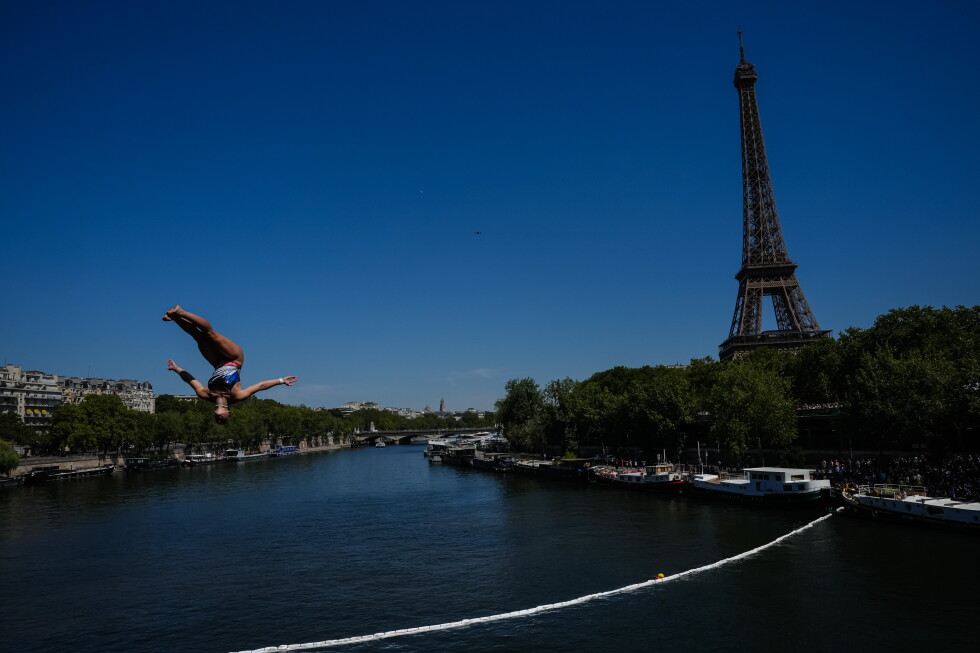
PARIS — On the banks of the Seine, with the iconic Eiffel Tower looming in the background, Paris has made history this week hosting its first ever high-diving competition on the iconic river. Athletes launched themselves from a 20-meter platform anchored to the Bir-Hakeim Bridge, turning the waterway into a world-class sporting venue and marking a key milestone in the city’s years-long campaign to reclaim the Seine for public recreation after a century of swimming bans.
The event, part of the 2026 European Aquatics Championships, highlighted both the progress and remaining challenges of Paris’ water cleanup initiative. Last Thursday, a sudden disruption halted training operations when testing detected unexpected traces of hydrocarbons in an upstream section of the river. The incident, which exposed the lingering uncertainty of holding major sporting events in an outdoor natural environment, was quickly resolved by Friday: the French Swimming Federation confirmed the contaminated area had been fully treated, clearing the way for athletes to return to the water and the competition to proceed on its original schedule. The high-diving tournament is set to conclude Saturday with medal-deciding final rounds, while the broader European Aquatics Championships, which mark the centenary of the inaugural event first held in Budapest in 1926, will run through August 16. This is the first time Paris has hosted the championships since 1931, bringing more than 1,000 elite athletes to compete across five aquatics disciplines, with the Seine playing host to both open-water swimming and high diving.
For Paris officials, the event is more than a sporting competition: it is a public demonstration of the massive investments put in place ahead of the 2024 Paris Olympic and Paralympic Games to reverse decades of river pollution. Upgrades to sewage infrastructure to prevent untreated waste from flowing directly into the Seine, alongside overhauls to stormwater management systems, formed the core of a 1.4 billion euro project that lifted the 100-year public swimming ban in 2025.
“There are things that are within our control, and there are uncertainties that are inevitably linked to any outdoor activity,” explained Maxime Sauvage, Paris’ deputy mayor in charge of sports, facilities and equitable access to recreation. “There is always a small risk, but that is also part of what makes outdoor events special. When they work, it is magical.”
Hundreds of spectators flocked to the Seine’s banks on Friday to watch the competition, many of whom stumbled on the event spontaneously while sightseeing along the river. Among the accidental audience was Rebecca Kapogiannis, a 45-year-old tourist from London, Ontario, who was in Paris celebrating her daughter’s college graduation. Kapogiannis said her daughter had even packed a bathing suit ahead of the trip, holding out hope for a chance to swim in the iconic river.
“We just headed down to the Eiffel Tower today and thought we would walk along the Seine and stumbled upon this and thought it was a really cool activity to watch,” Kapogiannis told the Associated Press. “I was not expecting a competition to take place in the Seine, but I think it’s such a cool use of this water that runs right through the city.”
Cynthia Matz, another tourist visiting with her husband, echoed that sentiment, noting the iconic riverside setting made the event far more accessible and appealing than it would have been in an indoor aquatics center. “Anybody can go. I don’t have to know anything about diving. I can just say, ‘This is really cool to see,’” Matz said. “Having it out in public, people will just stop and go, ‘Huh, what’s going on?’ and stop and spend some time and enjoy it.”
That spontaneous access to elite sport in the heart of the city is exactly the transformation Paris officials have worked for decades to achieve. For more than a century after the 1923 swimming ban, the Seine was primarily associated with commercial shipping, tourist cruises and industrial logistics, long written off as too polluted for public recreation. For generations of Parisians, the 1988 pledge by then-Paris mayor Jacques Chirac to restore the Seine to swimmable condition seemed like an impossible, distant dream.
But two years after the 2024 Olympics, that vision is steadily becoming reality. Images of elite athletes competing on the river have already been joined by everyday Parisians swimming in designated public zones, with official data from Paris City Hall showing roughly 70,000 people used the city’s official Seine swimming areas in July alone, putting 2026 on track to surpass last summer’s total of 100,000 users. Growing public participation underscores rising enthusiasm for the project to reimagine the river as a space for recreation, not just commerce and tourism.
“For decades, the Seine was limited to economic purposes, tourism with sightseeing boats, and logistics with ships loading and unloading goods in Paris,” Sauvage said. “It was a river with high levels of pollution that also had a significant impact on its biodiversity.” Today, the city’s goal is to add a new recreational identity to the Seine without eliminating its existing economic and cultural roles, he explained. “Paris is not just a postcard image, it is also a magnificent sporting venue,” Sauvage said. “It is a city that people come to visit, but it is also a city to be experienced by bike, through running, through sport, through play and through swimming.”